E-Paper



New underpass at Delhi’s Pragati Maidan may open December-end
The last missing puzzle of the Pragati Maidan Integrated Corridor project is set to be opened in phases, with the first segment set to be operational in late December or early January. The second segment is still under repair due to damage caused by flooding.

 Prefer HTon Google


The last missing puzzle of the Pragati Maidan Integrated Corridor project — an underpass at the junction of Bhairon Marg and Ring Road in central Delhi — is set to be opened in phases, Public Works Department (PWD) officials aware of the matter said, with the first segment — two-lane tunnel section for traffic moving from Bhairon Marg towards Noida — set to be operational in the last week of December or the first week of January.
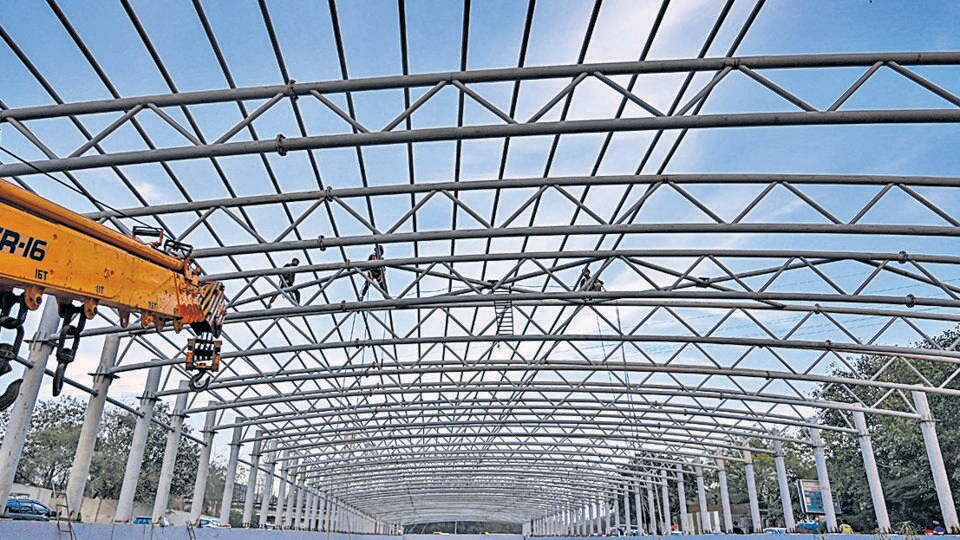
The officials said that work still remains on the second segment — a three-lane section parallel to the two-lane underpass — due to damage caused by flooding during the July floods.
The Pragati Maidan complex and its integrated transit corridor were developed with Bharat Mandapam ahead of the G20 Summit in September, and the main 1.3 km long tunnel and five underpasses in its vicinity were launched by Prime Minister Narendra Modi in June.
Segments of the remaining underpass have, however, seen multiple delays and engineering challenges due to damage during the floods.
A PWD official associated with the project said that due to the very slow progress in repair work, a decision has been made to first open the two-lane tunnel section. “The two-lane tunnel will be opened for traffic movement by December last week or latest by January. It was expected to carry traffic from ITO towards Bhairon Marg but we are considering that it will initially carry traffic moving from Bhairon Marg towards Noida as the traffic load is much more in that direction,” he said.
According to the official, the three-lane tunnel is facing multiple technical issues, and work has stalled due to uneven settlement. “We are planning to rope in experts from IIT-Delhi to help us in the matter,” he added.
HT had on September 12 reported that the unprecedented floods in July led to a pile-up of silt and shifted heavy structures at the two underpass sections. The underpass is vulnerable to frequent inundation as it is hardly 100m from the banks of the Yamuna, and groundwater levels at the site are also very high.
Dr S Velmurugan, chief scientist at Central Road Research Institute (CRRI), said: “Around 35% of at-grade traffic will reduce once the underpass is fully operational... This one structure alone will decongest a 7-8km stretch,” he said.