From open defecation and waste burning to industrial dumping and cattle bathing, Delhi’s Munak Canal – a critical lifeline supplying raw water to the Capital – is choked with pollution. A new report by the South Asia Network on Dams, Rivers and People (SANDRP) warned that widespread contamination along the canal could threaten the safety of Delhi’s drinking water and undermine operations at water treatment plants.
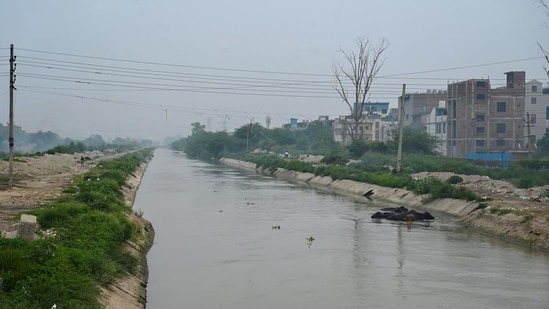
The report, based on an inspection conducted on October 25, details violations along the canal’s route through Haryana and northwest Delhi. It was submitted on Sunday to the Delhi government, pollution control authorities, and ministers of water, environment, and health, along with photo evidence and geotagged locations of violations.
Built between 2003 and 2012 as part of the Western Yamuna Canal system, the Munak Canal carries over 1,000 cusecs of Yamuna water every day to Delhi through two main channels – the Carrier Line Channel (CLC) and the Delhi Sub Branch (DSB). Despite being a key piece of infrastructure for the city’s water supply, its maintenance and protection have remained woefully inadequate.
“There are multiple sources of pollution right now which are leading to contamination of the CLC, eventually impacting the drinking water of Delhi. This water is treated, but neither are our treatment plants highly advanced to remove heavy metals, nor is the final water being tested for such impurities and contamination. Even after treatment, a number of pollutants can still be in the drinking water,” said Bhim Singh Rawat, associate coordinator of SANDRP.
The inspection revealed “very serious water polluting activities” near Bawana, where the canal is crossed by three roads with multiple bridges. These sites have turned into dumping grounds for discarded worship materials and solid waste. The report notes that large quantities of garbage are being dumped and segregated near JJ clusters, with waste spilling directly into the water.
{{/usCountry}}The inspection revealed “very serious water polluting activities” near Bawana, where the canal is crossed by three roads with multiple bridges. These sites have turned into dumping grounds for discarded worship materials and solid waste. The report notes that large quantities of garbage are being dumped and segregated near JJ clusters, with waste spilling directly into the water.
{{/usCountry}}The team also found electric wires being burnt on the canal’s slopes – a common practice to extract copper – leaving behind ash and residues that wash into the canal. At several points, SANDRP said, industrial waste dumping and burning were clearly visible.
“The banks of both canals are strewn with fresh human excreta at a number of places, and in some areas, even inside the canal,” the report said. In 2019, the Delhi Jal Board (DJB) had sanctioned a project to construct RCC walls along the canal in Bawana and Rohini to curb open defecation, but SANDRP said violations continue unabated.
Other observations include cattle being bathed in the canal, the spread of water hyacinth, and damaged plaster lining, which could increase the risk of breaches.
In the past two years, the Munak Canal has suffered three major breaches – in June 2023, October 2023, and July 2024 – disrupting Delhi’s water supply for days each time.
The report recommends both short- and long-term steps to safeguard the canal. Immediate measures include patrolling by home guards or civil defence personnel, installation of CCTV cameras, improved lighting, iron barricades on bridges, and creation of waste collection facilities at a safe distance from the canal.
“The government must ensure proper waste disposal and discourage people from throwing materials into the canal. Without visible enforcement, the situation will only worsen,” it said. SANDRP has also called for regular inspections and coordination between the DJB, DPCC, and local bodies to prevent further pollution.
On being asked, a government official said they have not seen the report but the government has already commissioned a feasibility study for developing elevated corridor along the canal. The Munak canal section in Delhi will undergo significant upgrade, the official added.
DJB officials did not respond to HT’s request for a comment on the report.
Meanwhile, in a separate petition ongoing in the National Green Tribunal (NGT) over dumping of waste along the banks of Yamuna near Pushta Road, Wazirabad and Jagatpur, a recent report by the Delhi government – uploaded on Sunday said corrective action had been initiated.
It referred to a recent meeting by the Delhi chief secretary in September, following which directions have been issued. This included directions to the Municipal Corporation of Delhi (MCD) to lift all waste along the river banks within a fortnight and for the deputy magistrate (central) to supervise all cleaning.
“The chief secretary has also asked to arrange a permanent arrangement for waste collection by installing fixed compact transfer stations (FCTS) to prevent further dumping of waste along the riverbanks,” the report added.
Stay updated with all top Cities including, Bengaluru, Delhi, Mumbai and more across India. Stay informed on the latest happenings in World News along with Delhi Election 2025 and Delhi Election Result 2025 Live, New Delhi Election Result Live, Kalkaji Election Result Live at Hindustan Times.
Stay updated with all top Cities including, Bengaluru, Delhi, Mumbai and more across India. Stay informed on the latest happenings in World News along with Delhi Election 2025 and Delhi Election Result 2025 Live, New Delhi Election Result Live, Kalkaji Election Result Live at Hindustan Times.