E-Paper



Three decades a Republic: A Delhi landmark
Friday marked three decades of Delhi holding regular assembly elections. To be sure, the first assembly elections in Delhi were held in 1952


“Members are informed that the first session of the first legislative assembly of the National Capital Territory of Delhi will commence on Tuesday, the 14th day of December in the assembly hall, Old Secretariat, Delhi,” reads a 1993 notice from assembly secretary KG Gupta, as Delhi was at the cusp of turning a new chapter in its administrative history with a special status – a union territory (UT) with an elected legislative assembly.
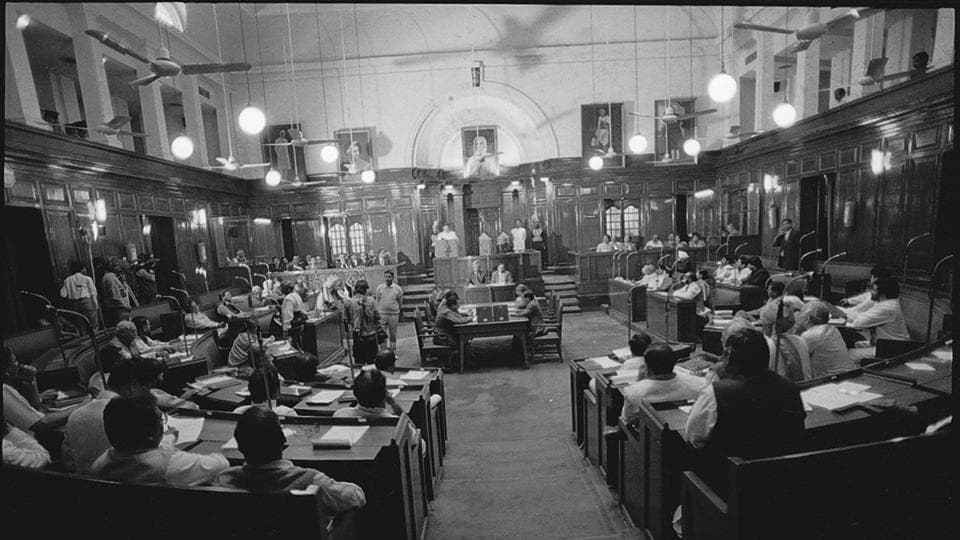
Friday marked three decades of Delhi holding regular assembly elections. To be sure, the first assembly elections in Delhi were held in 1952. But, the Capital could never re-elect an assembly till 1993, as the House was abolished in 1956 with Delhi being turned into a UT.
The first day of the 1993 assembly witnessed scenes reminiscent of a power transfer with Jag Pravesh Chandra, who then headed the Delhi Metropolitan Council – a nominated body that governed the city — sharing a light moment with Madan Lal Khurana of the Bharatiya Janata Party (BJP) who was elected the chief minister, heading a cabinet that also included Sahib Singh Verma (who also served as Delhi CM) and Harsh Vardhan (who later went on to serve as a Union minister)
According to assembly records, Chandra was made the Pro-tem Speaker to administer the oath of office to Charti Lal Goel, who was elected the Speaker of the House.
As an elected assembly of MLAs was taking shape after a gap of 37 years, the momentous occasion was held at the white secretariat building which had also hosted the Imperial Legislative Council under the British Raj and the Central Legislative Assembly (1913-1926) or Parliament and the Metropolitan Council (1966-1990).
According to official records, the assembly elections were concluded in November 1993, with the BJP emerging victorious on 49 of the total 70 assembly seats. Congress was the primary opposition with 14 MLAs, and there were four Janata Dal members and three independents.
Delhi, in the early 1990s, was a city of 9.42 million people, and was continuously drawing people from all parts of the country, enforcing the city’s metropolitan character. Traffic congestion was a problem even then. The city had 2 million registered vehicles – still more than the combined vehicles in the other three metropolitan cities of Mumbai, Kolkata and Chennai. The rising congestion led to demands of a “rail-based transportation system” even as it would still take nine years for Delhi to get the Metro.
Unauthorised colonies were also coming up across the city with rising migration and lack of space in the regular colonies. The Municipal Corporation of Delhi (MCD) was in a suspended state as it was being run by a Centre-appointed bureaucrat rather than elected councillors.
The first Delhi assembly elections were held on March 27, 1952, immediately after the general elections in February that year.
The elections were held on 48 seats with six of the constituencies electing two members and the remaining 36 electing a single member. According to election commission records, the city had 521,766 eligible voters, of which 58.52% exercised their franchise. The Congress won with a majority of 39 seats. The Jan Sangh, Hindu Mahasabha and Socialist Party together bagged 10 seats.
Between 1956and 1990, a 61-member metropolitan council administered Delhi with the lieutenant governor as the head. The council used to make recommendations concerning matters of public importance with the LG making the final decisions.
Subhash Arya, former South Delhi mayor, who served in the metropolitan council for seven years, said that the formation of an assembly was a big leap in terms of Delhi residents attaining their democratic right. “The council was essentially a debating club with no real powers of any kind. The matters related to people including electricity, sewer and water should have always been dealt by the elected members. There were satyagrahs, protests at Parliament and a popular movement which finally led to the reform,” Arya added. The council was headed by a “chief executive councillor”, a CM-like figure, and the city had five such CECs. People who have served in these positions include politicians such as VK Malhotra, Jag Pravesh Chandra and Kedarnath Sahni.
With the people having no direct role in the administration of the city, the demand for the restoration of an elected assembly was raised time and again. The demands led the Union government to set up the Sarkaria Committee (later called the Balakrishnan Committee) in December 1987. Two years later, the committee in its report recommended that “Delhi should continue to be a Union territory but should be provided with a legislative assembly with powers to deal with matters of concern to the common man.” Matters related to public order, police and land were to be kept away from the powers of the assembly.
The Government of India introduced the Constitution (72nd) Amendment Bill to bring into effect these recommendations. While laying down statement of objectives for the bill, the Union home minister Mufti Mohammad Sayeed said, “There has been general demand by the public of Delhi that they should be given effective voice in running their own administration and in order to satisfy the democratic and political aspirations of the people Delhi should be accorded ....at present, according to some, there is lack of accountability of the administration to the people.”
But the bill lapsed.
Finally, Delhi was granted an elected legislative assembly under The Constitution (69th Amendment) Act of 1991. The Act accorded a special status to the Union territory of Delhi by providing for the creation of a 70-member legislative assembly and a seven-member council of ministers for Delhi.
Shoaib Iqbal, who was a first-time MLA then representing Janata Dal, and a member of the current House from the Aam Aadmi Party (AAP), said complexities of governance were there but senior leaders from the ruling side helped juniors to learn legislative governances that made things smoother.
“Mukesh Sharma, Ajay Maken, Raj Kumar Chauhan and I were among the young MLAs. We hardly knew anything about the proceedings of the assembly, were clueless about how to raise issues in the assembly, and the protocols that needed to be followed. We looked up to senior leaders like Jag Pravesh Chandra and Saheb Singh Verma who took personal interest in teaching and helping us,” said Iqbal a six-time legislator.
The Centre constituted a delimitation committee in 1992 which carved out 70 assembly seats in Delhi, paving the way for assembly elections. Finally, Delhi returned to the democratic grind with the city holding assembly polls in November 1993.
While the BJP, led by Khurana won by a resounding majority, PK Dave was appointed as the LG.
Of the 70 members, only three women made it to the House -- Krishna Tirath from Baljit Nagar, Tajdar Babar from Minto Road (both Congress), and Purnima Sethi of the BJP from Kalkaji.
Tirath, who later went on to become deputy speaker of the assembly and minister of state in the Union government after winning the Lok Sabha elections from Delhi, said, “In the old times, there was cross-party camaraderie and MLAs joined hands on specific subjects. It was unlike the current atmosphere of distrust. In those days, members used to meet outside the assembly, and supported each other on issues. Three of us female MLAs often raised women-centric issues together. We got many girls’ schools built in that period.”
She added that among the first businesses of the first House was setting up of the Delhi Commission for Women.
Though the new assembly had many seasoned leaders from the metropolitan council, including Jag Pravesh Chandra, who served as the Pro-tem Speaker, the first session saw a lot of confusion. SK Sharma, who served as the secretary of the assembly for 10 years, said that the first session was a “flop show” with no MLA, officer or chair being aware of how to conduct the affairs of the assembly.
“The new government had called a 19-day session but it did not know what to do with this time. How many speeches can be given? The speaker, Charti Lal Goel, and the chief minister Khurana, approached then Lok Sabha Speaker Shivraj Patil to assign an officer to help them create and understand the framework of rules for the new assembly,” he said.
Patil assigned Sharma, who was sent from Lok Sabha secretariat to frame the rules of procedure and conduct of business. These rules have not changed.
Sharma added that, as per rule, the newly formed assemblies follow the rules of UP assembly which is the oldest state legislature. “The rules were in chaste Hindi and were meant for a bicameral house. Delhi had a completely different set up with division of powers between lieutenant governor, assembly, bureaucracy therefore over the next two years, we made separate rules for Delhi,” he added.
Ram Niwas Goel, the current speaker of the Delhi assembly who was then a Bharatiya Janata Party (BJP) legislator representing Shahdara constituency, said the Charti Lal Goel, the then speaker of the House, used to conduct the House with “firm hand”. “There were few disruptions then as even the opposition played a vital role in running the House with leaders from both the ruling side and the opposition sharing great camaraderie,” said Goel.
In his first address to the House on December 15, 1993, LG Dave underlined the “constitutional and political” importance of the day as Delhi got its own legislative assembly after a “gap of around four decades”.
He also pointed out at the delicate arrangement of powers. “The constitutional arrangement under which this assembly has been formed is very delicate and finely balanced. It will need goodwill and vision on part of all to work this arrangement...For all practical purposes, the government of national capital territory of Delhi will be expected to function like a state government in respect to the function assigned to it.”
Dave’s address also touched on themes of the rate of population growth and strain on civic services due to immigration, deficiency of civic amenities in trans Yamuna area, setting up a new water and sewage disposal board for solving water woes and regularisation of all unauthorized colonies that came up till March 31 1993. “No unauthorised construction will be allowed after April 1, 1993,” he added.
Dave also spoke about the traffic congestion in the city, and the need for a mass rapid transit system. “Since the government has only been in place for a few days, the details of legislative business are yet to be fully drawn,” he added.
Haroon Yusuf, who represented the Ballimaran assembly, said despite differences on political issues, the members shared personal equations which helped in building consensus.
“There used to be long debates on electricity crisis and it actually helped improve things. People could talk. If there were law and order issues, the police commissioner was summoned to the assembly. The personal acrimony was not there. Now all these traditions have been eradicated,” he said.
Yusuf added that lawmakers from across parties used to meet and discuss issues at the Maidens hotel next to assembly. “Now, it only seems like a khwab (a dream). It appears as if two sides in the house are different countries. There is no dialogue.