E-Paper



Delhi fog, mercury 15°C: Is it May or December?
The last time Delhi recorded a lower minimum at Safdarjung, which represents Delhi’s weather, was 15.2°C on May 2, 1982


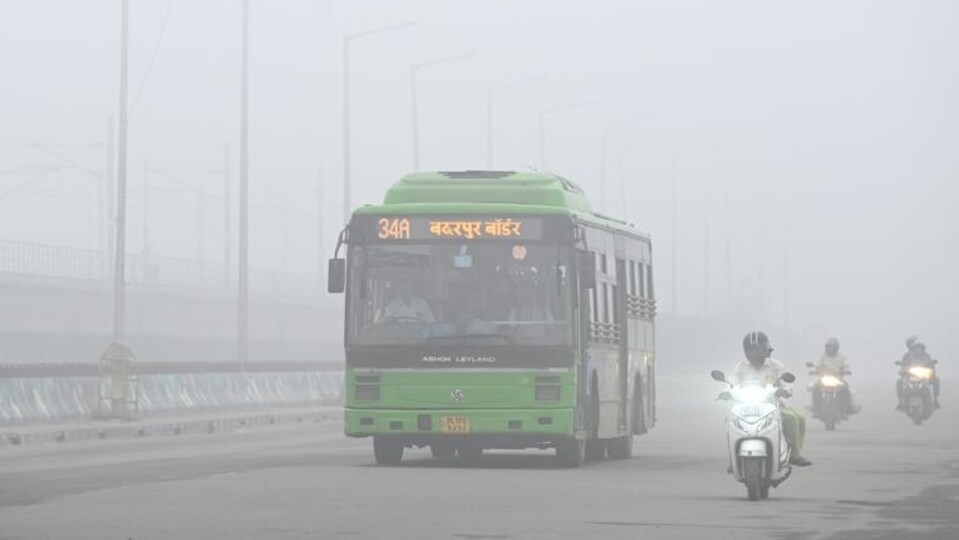
Residents of the national capital region woke up Thursday to a very unusual phenomenon for May—dense fog. As visibility dipped to as low as 100 metres in some areas, Delhi’s mercury clocked 15.8 degrees Celsius (°C), marking the Capital’s coldest May morning in 41 years, according to data from the India Meteorological Department (IMD).
Read here: Cooler May can end up hurting monsoon
The last time Delhi recorded a lower minimum at Safdarjung, which represents Delhi’s weather, was 15.2°C on May 2, 1982. The all-time record for the lowest temperature in the month is 15.1°C on May 2, 1969.
While Palam experienced shallow fog with a visibility of 800 metres, Safdarjung recorded a visibility of 100 metres at 5.30am. IMD classifies fog as “shallow” when visibility is between 500 and 1,000 metres, “moderate” when visibility is between 200 and 500 metres, and “dense” when it is below 200 metres. Fog is “very dense” when visibility is below 50 metres.
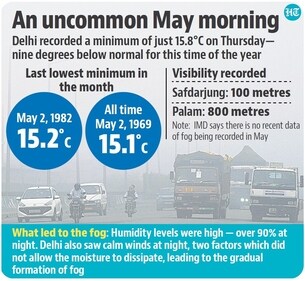
IMD scientist Kuldeep Srivastava said the dense fog lasted for around two hours, with average visibility of around 200 metres at 7.30am. He attributed this phenomenon to a combination of high moisture and calm winds. “It is surprising to see fog at this time of the year, but it occurred because of the high moisture content in the air following Wednesday’s rain. Winds were almost calm at night, and this led to a gradual build-up of fog, which then impacted the minimum temperature,” Srivastava said.
A second met official said it has been 41 years since Delhi last saw such a low minimum, with no recent record of fog in May. “Like this low minimum, It is likely that the last time fog occurred in May was several years ago. It is unusual to see such dense fog forming at this time of the year, as it occurs on account of low temperature and calm winds.”
Among Delhi’s weather stations, the lowest minimum was 14.2°C at the Ridge in north Delhi. Among the Capital’s neighbours, Gurugram recorded a minimum of 16.2°C on Thursday, while Noida recorded a minimum of 17.4°C. IMD said 29.7mm of rain was recorded at Safdarjung between 8.30am on Wednesday and 8.30am on Thursday. No rain was recorded on Thursday after that time.
So far, Delhi has recorded 45.7mm of rain in the first four days of the month, already surpassing the monthly normal average mark of 30.7mm. Last May, Delhi recorded 47.7mm of rain, while in 2021, it received 144.8mm of rain—largely owing to the impact of Cyclone Tauktae. The all-time rain record for May is 165mm, which was recorded in 2008.
Despite the sun coming out on Thursday, Delhi’s maximum remained below normal and was recorded at 32.1°C. The normal mark for this time of the year is 39.3°C. Forecasts show another western disturbance is approaching the region and its impact will be felt from Friday onwards, with chances of drizzle in some areas on both Saturday and Sunday. The maximum is however, expected to continue to rise gradually and clock 37°C by May 10. Delhi’s minimum is likely to stay between 19 and 22°C.
Meanwhile, according to the Central Pollution Control Board’s daily bulletin, Delhi’s Air Quality Index (AQI) was in the “moderate” range on Thursday with a reading of 113, a deterioration from 107 (moderate) on Wednesday.
Forecasts show the AQI is likely to remain in the “moderate” range till Saturday before improving to “satisfactory” on Sunday.
Read here: Delhi witnesses fog and cold winds in the hottest month of the year. See Pics
An AQI reading between zero and 50 is considered “good”, 51 and 100 “satisfactory”, 101 and 200 “moderate”, 201 and 300 “poor”, 301 and 400 “very poor”, and 401 and 500 “severe”.