
 E-Paper



Yamuna nears warning level in Delhi as discharge from Hathnikund spikes
According to the Irrigation and Flood Control (I&FC) department, in the past 63 years, the Yamuna has breached the warning level 53 times — a near-annual occurrence

 Prefer HTon Google


The water level in the Yamuna in Delhi surged by nearly two metres within 24 hours between Tuesday and Wednesday, inching closer to the capital’s official warning mark of 204.5 metres. At 5pm on Wednesday, the river peaked at 204.13 metres before dipping slightly to 204.08 metres an hour later, according to data from the Central Water Commission (CWC). The level stood at 202.24 metres at the same time the previous day, data showed.
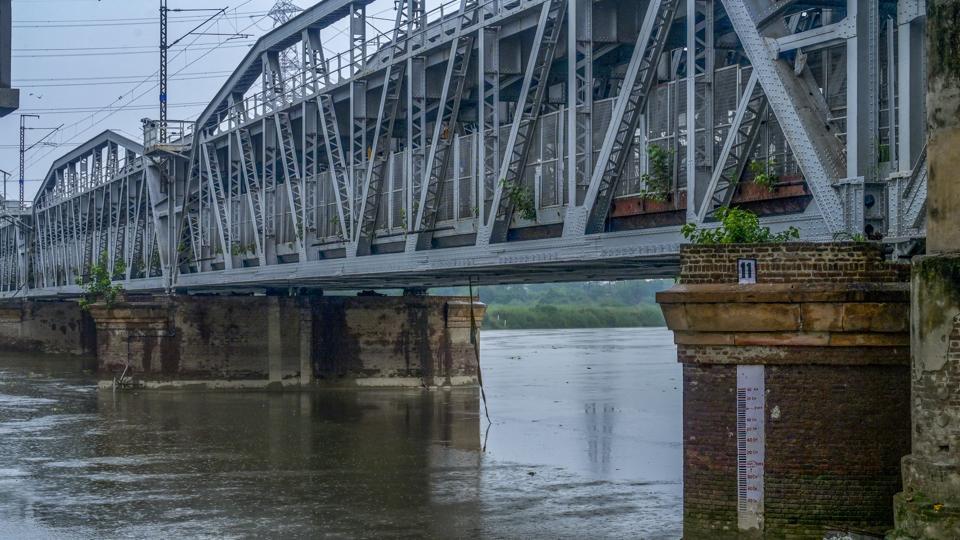
The sudden rise follows a spike in water discharge from Haryana’s Hathnikund barrage, which crossed 50,000 cusecs late on Monday night for the first time this season. Discharge peaked at 54,707 cusecs around 1am on Tuesday. Experts say this inflow typically takes around 48 hours to reach Delhi, meaning further increases in the Yamuna’s level are likely by Thursday.
To be sure, Delhi considers a water level of 204.5m as the warning level and 205.33m as the danger level.
Between Tuesday evening and Wednesday, discharge rates at the barrage oscillated between 10,000 and 25,000 cusecs, the CWC data revealed.
“This is the annual flushing-out exercise, and the river’s water quality has improved automatically due to the increased flow,” said Bhim Singh Rawat, a Yamuna activist and member of the South Asia Network on Dams, Rivers and People (SANDRP). “It is likely to dip marginally again but will keep oscillating as more rain gets recorded in the higher reaches,” he added, pointing out that peak flood levels in the Yamuna are typically recorded in August or September.
The capital narrowly missed breaching the warning mark last year, when the river reached a high of 204.38 metres on September 26, 2024. By comparison, in 2023, the Yamuna crossed the danger level and hit 208.66 metres on July 11 after the barrage discharged a peak of 359,760 cusecs, with multiple intervals of over 100,000 cusecs. Widespread flooding followed, impacting areas such as Mayur Vihar, ITO, Salimgarh Bypass and Civil Lines, and forcing the evacuation of over 23,000 residents.
The surge also forced Delhi Jal Board to shut down three key water treatment plants — Wazirabad, Chandrawal and Okhla — which collectively supply about a quarter of the city’s drinking water.
According to the Irrigation and Flood Control (I&FC) department, in the past 63 years, the Yamuna has breached the warning level 53 times — a near-annual occurrence. It crossed the 205-metre mark in 43 of those years, the 206-metre mark in 14, and exceeded 207 metres in four years, including in 2023.
In anticipation of another surge, the I&FC department issued a flood control order earlier, stating that a first warning will be issued by the Central Flood Control Room if discharge from Hathnikund crosses 100,000 cusecs. “Whereupon the relevant sector control rooms shall start functioning and keep a vigil in their respective areas. The boats will be requisitioned and placed at vulnerable points,” the order said. To be sure, no new directive has been issued so far, since the river has yet to cross the warning threshold.

Stay updated with all top Cities including, Bengaluru, Delhi, Mumbai and more across India. Stay informed on the latest happenings in World News along with Delhi Election 2025 and Delhi Election Result 2025 Live, New Delhi Election Result Live, Kalkaji Election Result Live at Hindustan Times.


