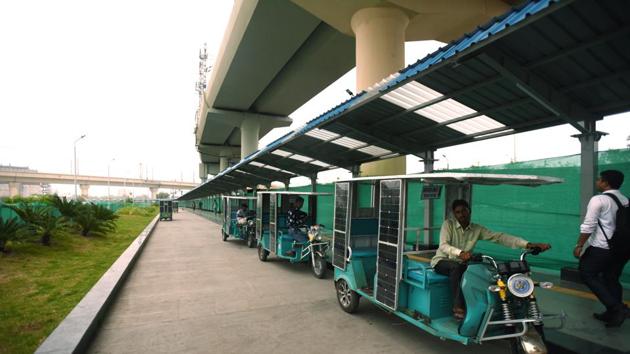
The Environment Pollution (Prevention and Control) Authority (Epca) Monday said it will submit a report before the Supreme Court, seeking its nod on behalf of the Delhi Metro Rail Corporation (DMRC) for plying 15,000 e-autos from Metro stations in the national capital to boost last-mile connectivity.
The move has come after the apex court, which had earlier capped the number of auto-rickshaws in the city at one lakh, asked the panel to examine the issue and submit a report.
The DMRC had earlier filed an affidavit before the Supreme Court, seeking an approval for the registration of 15,000 e-auto-rickshaws to provide last-mile connectivity from all its 184 Metro stations in the city, as the existing e-rickshaws can ply only on selected routes.
During a meeting on Monday with stakeholders, including the Delhi Metro, transport department and Union ministry of road transport and highways (MoRTH), the SC-appointed committee asked them to provide a regulatory framework for operating e-autos, management of charging points and fares, as well as submit a plan for battery disposal.
“While e-autos could be a good step to provide last-mile connectivity from Metro stations, which has been an issue for long, there has to be a regulatory framework for such vehicles to operate. The fear is to not let these become e-rickshaws, most of which are plying illegally with harmful batteries and no laid down process for charging or disposal. There should be a proper mechanism for disposal of batteries so that they do not end up with domestic waste, causing an environmental hazard,” Sunita Narain, member, Epca, said.
{{/usCountry}}“While e-autos could be a good step to provide last-mile connectivity from Metro stations, which has been an issue for long, there has to be a regulatory framework for such vehicles to operate. The fear is to not let these become e-rickshaws, most of which are plying illegally with harmful batteries and no laid down process for charging or disposal. There should be a proper mechanism for disposal of batteries so that they do not end up with domestic waste, causing an environmental hazard,” Sunita Narain, member, Epca, said.
{{/usCountry}}Also, she said DMRC has to provide guidelines on how these vehicles will be monitored and set up a central control room for the same as well as decide where these vehicles will be parked.
According to DMRC officials who attended the meeting, the e-autos will be introduced in phases and will have sophisticated lithium ion batteries, unlike the lead acid batteries used in e-rickshaws.
“E-autos will be operated through concessionaires and GPS-based monitoring will ensure that these ply only in designated areas. Also, we will provide charging facilities at depots as well as at stations,” Narain said.
A MoRTH official told the panel that e-autos are in addition to the one lakh autos permitted by the SC. The ministry had issued a notification on October 18 last year, removing the requirement for permits for battery-operated vehicles.
Stay updated with all top Cities including, Bengaluru, Delhi, Mumbai and more across India. Stay informed on the latest happenings in World News along with Delhi Election 2025 and Delhi Election Result 2025 Live, New Delhi Election Result Live, Kalkaji Election Result Live at Hindustan Times.
Stay updated with all top Cities including, Bengaluru, Delhi, Mumbai and more across India. Stay informed on the latest happenings in World News along with Delhi Election 2025 and Delhi Election Result 2025 Live, New Delhi Election Result Live, Kalkaji Election Result Live at Hindustan Times.