
 E-Paper



Lack of last-mile links leaves New Gurugram locals stranded
With no reliable buses, commuters spend up to ₹5,000 monthly on cabs and autos to reach metro stations and office hubs.

 Prefer HTon Google


Last-mile connectivity remains the biggest hurdle for residents of New Gurugram, especially those living along the Dwarka Expressway and in the city’s southwestern sectors, as they struggle to access major city hubs and public transportation options amid ongoing expansion and development work, residents and officials said.
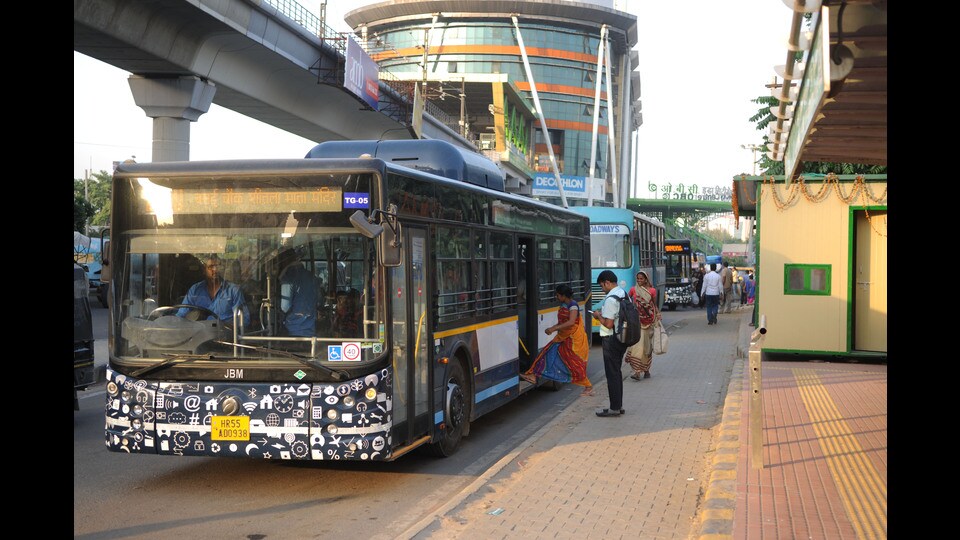
Limited routes bypass key sectors
According to the Gurugram Metropolitan City Bus Limited (GMCBL), about 150 buses are currently operational, covering around 25 routes across the city. However, these services largely bypass newly developed sectors between 95 and 115 along the Dwarka Expressway and sectors 70, 74, 75, 79 and 79A, leaving large residential pockets disconnected from major city centres.
Data available on the GMCBL website and the Gurugaman App shows that sectors such as 95B, 102, 115, and 103/107 (Daultabad Link Road) have either no daily trip or only one trip operating from Rajiv Chowk, the city’s main interchange. In several housing societies, including Emaar MGF Imperial Gardens, residents said they walk nearly two kilometres to reach the nearest bus stop near Amstoria BPTP.
Sparse ops, uneven route coverage
The GMCBL route map shows that the areas facing the worst connectivity gaps are serviced by only 31 daily trips, while other parts of Gurugram have as many as 251 daily trips (up and down). The well-connected routes include 215B (Gurugram bus stand–Dundhera), 218 (Gurugram bus stand–Sohna bus stand), 221A (Gurugram railway station–Badshahpur) and 217 (Gurugram bus stand–Bhondsi police chowki).
Out of the 31 trips covering parts of the new sectors, 14 are currently non-operational, a senior GMCBL official said. “Only two buses as part of route 135 (from Iffco Chowk to Dharoka village) travel daily to new sectors built along Dwarka Expressway,” the official acknowledged, requesting anonymity.
Poor roads, missing schedules delay expansion
When asked about the lack of bus schedules in Gurugram areas, the official said digital route information will be introduced in phases once the new electric fleet is operational. For instance, route 254 (Farrukhnagar bus stand–Mahaveer Chowk on Gaushala Road) has been non-operational for the past two years because of damaged stretches. “Broken internal roads and encroachments prevent buses from running smoothly in these areas,” the official said.
Multiple buses have been deployed on overlapping routes, such as 213, 215B, and 221A, which cover the same stretch from the Gurugram bus stand towards Badshahpur before diverging, resulting in uneven route coverage and neglect of outlying residential zones.
Low ridership from Dwarka Expressway corridor
The limited routes currently serving the vulnerable sectors—127, 127B, 254, 217, 234A, 133, and 114B—were designed to connect newly developed sector areas and peripheral villages. However, poor frequency and low coverage have forced commuters to rely on shared auto-rickshaws or costly commercial services.
According to estimates from the Gurugaman App and GMCBL’s 2023 data, average ridership stands at 45,000–50,000 passengers per day across Gurugram, but fewer than 5% of those originate from the Dwarka Expressway corridor, highlighting the sharp imbalance in connectivity.
The Gurugram Metropolitan Development Authority (GMDA), which holds 50% stake in GMCBL, had in its Comprehensive Mobility Plan (2020) acknowledged that at least 600 additional buses were needed “on an immediate basis” to cater to the city’s expanding population and extended geography.
A senior GMCBL official said a proposal to add 200 new electric buses is being finalised. “By November, the new fleet will become operational with a special focus on societies and colonies in New Gurugram where last-mile connectivity is still lacking,” the official said.
Residents face steep commuting costs
Sunil Sareen, vice-president of Imperial Gardens RWA (Sector 102), said commuters spend ₹300–400 daily on taxis and autos to reach city hubs. “Reaching offices in either the old city or boarding a metro from HUDA City Centre, we spend approximately ₹4,000–5,000 every month,” Sareen said.
He added that about 3.5 lakh residents across 50 societies and eight villages along the northern Dwarka Expressway corridor face the same issue. “After relentlessly fighting for three years, we got merely one bus, which started one and a half years ago. It took no time to shut down due to poor roads and lack of schedule information, leaving us helpless,” he said.
Praveen Thakur, a resident of Habitat (Sector 99A), said three new buses were introduced a year ago, but only one remains operational. “No one here is aware of the timings of the bus service; forget about the onboarding and ticketing process,” Thakur said.
Ashok Dutta, social activist and resident of Paras Dews (Sector 106), said connectivity issues have made living in the area difficult. “We made a mistake by deciding to settle in this area. The only way to quickly develop the country is by establishing connectivity,” he said.
Dutta added that residents must change three buses covering 37 stops in 90 minutes to reach Rajiv Chowk, compared to shorter rides via app-based cabs. “To board the only bus in the area, we must walk a kilometre to the stand opposite Conscient One mall, which is unsafe due to no lighting. We have requested the local councillor multiple times to fix it, but nothing has been done,” he said.
Similarly, on route 254 (Farrukhnagar–Mahavir Chowk), commuters travel 8 km from the Wazirpur Road bus stand to Khetwas (Sector 88) due to a lack of closer stops.
In contrast, Old Gurugram areas such as Sadar Bazaar, Civil Lines, and Railway Station are covered by over 300 trips across four core routes, with stops at every major junction. Residents there said buses arrive every 15–20 minutes on average.

Stay updated with all the Breaking News and Latest News from Mumbai. Click here for comprehensive coverage of top Cities including Bengaluru, Delhi, Hyderabad, and more across India along with Stay informed on the latest happenings in World News.


