
 E-Paper



Mix, rebottle, supply: The big liquor swindle in NCR
A 750ml bottle of Black Label retails around ₹3,000, but several online sellers and stores in Gurugram are happy to sell it for ₹1,800, even less. How?

 Prefer HTon Google


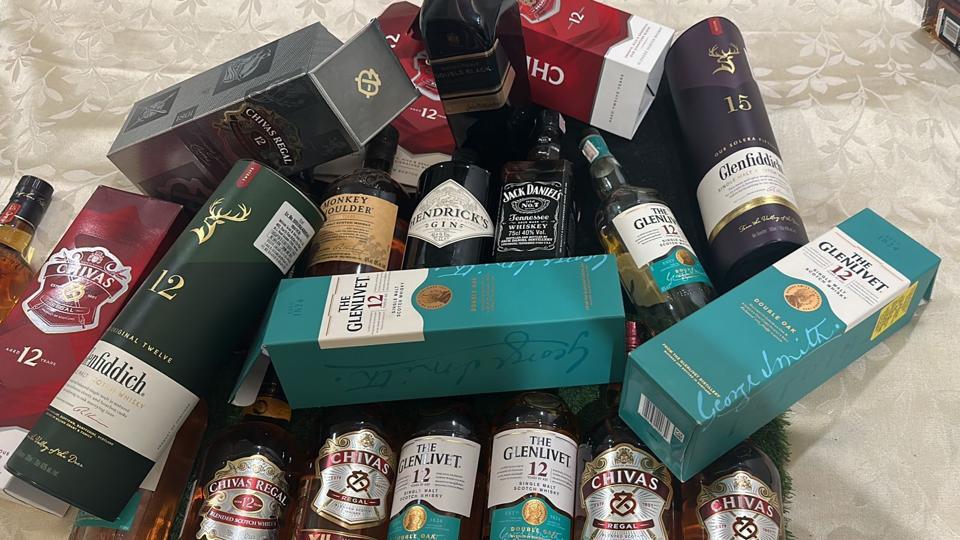
On April 29, when the police burst into the basement of Charan Singh’s house in Faridabad, they found empty bottles of high-end whisky, including single malts — Black Label, Glenlivet, Macallan and Amrut Greedy Angels. The last is India’s most expensive whisky. They also found the paraphernalia of Singh’s trade — bottle caps, corks, paper and vinyl labels, large syringes, and some entry-level Indian whisky.
Put the extremes together for what may well be the secret of inexplicably low liquor prices in a bunch of stores in Faridabad and Gurugram.
For 12 years, Charan ran an “illegal rebottling unit” in his basement. He poured cheap whisky into used bottles of expensive brands, sealed them shut, and sold them across 18 liquor stores in Faridabad.
So, this begets the question: Are you really pouring yourself Black Label from a bottle of Black Label?
While the customer is led to believe that they’ve bought a premium bottle of whisky at a fat discount, that’s not always the case. Sample this. A 750ml bottle of Black Label retails around ₹3,000, but several online sellers and stores in Gurugram are happy to sell it for ₹1,800, even less, while still managing to earn over ₹1,000 a bottle. How?
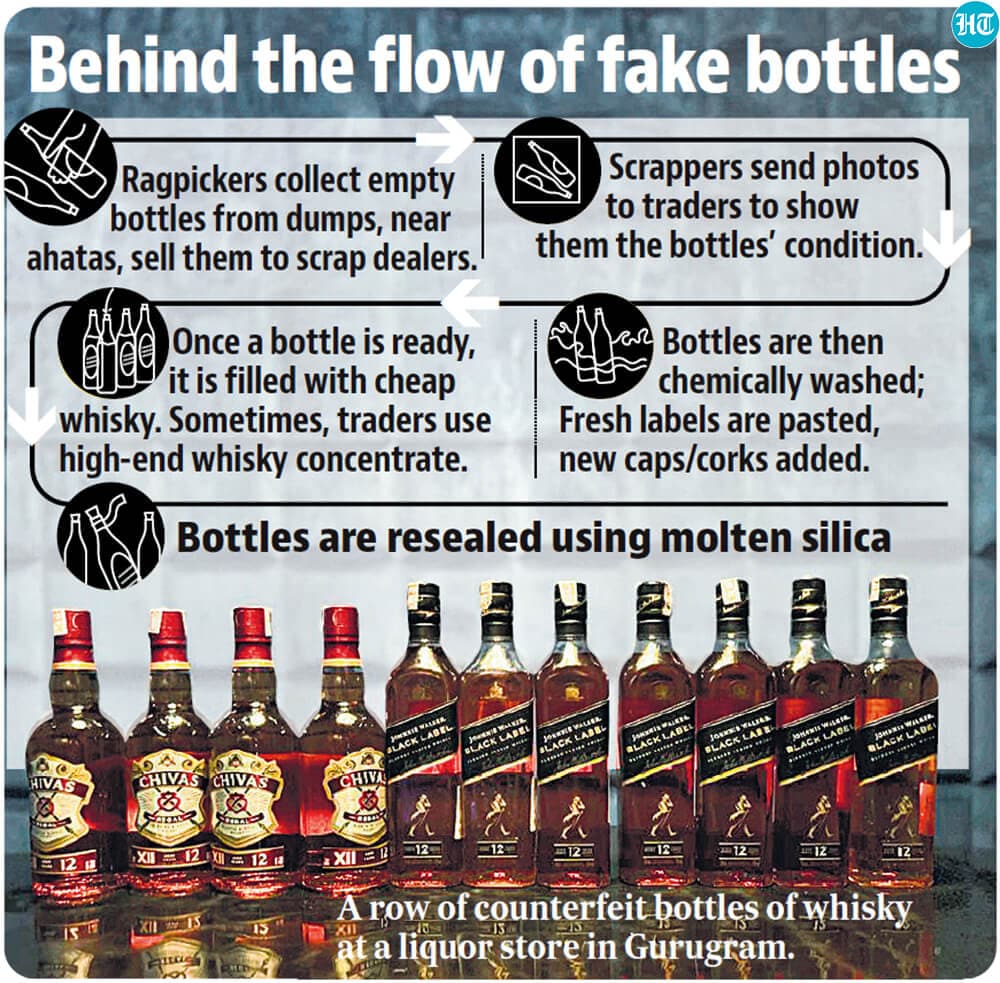
A trader buys a bottle from a scrap dealer for ₹300. They clean it up, plaster on a new label and screw on a fresh cap — each costs around ₹50 . Finally, they pour in bottom shelf whisky worth ₹350, and seal it.
This bottle cost the trader ₹750. The unsuspecting customer, paying for a discounted Black Label, shells out ₹1,800 for the bottle.
These operations have spread across the National Capital Region (NCR), finding footholds in liquor stores in Faridabad, Gurugram and Delhi. At the heart of it is a well-oiled nexus between scrap dealers, label makers, liquor shop owners, even bar managers.
Delhi excise department officials and a member of a national restaurants association claimed that while the practice of putting cheap alcohol in premium alcohol bottles is common, it mostly happens outside the regulated liquor market (licenced retailers, licenced hotels, clubs, and restaurants).
“We have cracked down on at least 50 such units. Most of the bottles seized were of premium brands — Chivas Regal, Red Label, Glenfiddich, Glenmorangie, Black Level, Double Black, and Jack Daniel’s, among others,” said Vijay Pratap Singh, deputy superintendent of police (crime), Gurugram.
An official from Diageo India — the global liquor firm that produces brands such as Johnnie Walker Black Label, Red Label, and Double Black — denied that such counterfeits were produced and said these were “unsubstantiated rumours ahead of the festival season.”
But in a bid to understand what’s in your drink, HT spoke to cogs in the wheel that powers the business — a scrap dealer who recently sold 625 empty high-end alcohol bottles for ₹1.87 lakh, a club owner who clandestinely re-bottles behind the bar each night and an online liquor seller. HT also spoke to an angry customer, Gurugram police officers, members of the Haryana chief minister’s flying squad, and excise officers to understand the extent of the rot.
Bhumit Yadav’s father was a scrap dealer in Gurugram. Once he turned 18, he picked up the same work, with a slight difference. He is now a vital cog in an illegal rebottling operation.
“What my father earned in two years, I earn in a month,” he said, seated inside his office in Chakkarpur, 6km away from Golf Course Road in Gurugram.
Every day, over 50 ragpickers and small-time scrap dealers in Gurugram sell him empty liquor bottles – at prices ranging from ₹5 to ₹600 per piece.
“Most ragpickers buy the bottles from the Gurugram municipal corporation’s material recovery facility (MRF). They also collect bottles from empty grounds near ahatas on Golf Course Road, Golf Course Extension Road, Sector 29, and MG Road,” said Yadav.
Once the bottles are with Yadav – he gets almost 500 a day – he sends photos to the traders, so they know what condition they’re in. “Last week, I sold 625 bottles for ₹1.87 lakh. The trader paid me an advance of ₹10,000. He was desperate since it’s festival season,” he said.
This wasn’t always the case. Earlier, Yadav sold premium bottles for as little as ₹10. “The people who bought them from me taught me the difference between a cheap bottle of whisky and an expensive one,” he said.
Naresh Kumar, joint commissioner of the Municipal Corporation of Gurugram (MCG), told HT that authorised vendors and ragpickers have informed them about people buying expensive liquor bottles from them for rebottling.
“More than 1,000 empty liquor bottles of premium brands are collected from the city every day, and most make it back to the shelves,” said Kumar.
The bottles that Yadav receives often have torn or scratched labels and broken caps. That provides the cue for the second link in the chain . A member of an illicit liquor trade gang explained to HT how the bottles are cleaned to look as new as possible.
“They are washed with chemicals. After that, label makers are brought in. These ‘artists’ make labels that mimic the originals and paste them using a machine,” he said, asking not to be named.
Once the bottle is ready, syringes — used to inject animals — are pulled out and bottles of cheap whisky brought in. Gurugram police said suspects reseal the bottle using molten silica.
This activity is not limited to dingy basements. Even some clubs in Gurugram pull off this stunt.
“All premium alcohol bottles have a plastic contraption at the mouth. We carefully inject the cheap liquor into the bottle using the syringe. It’s a time-consuming exercise and requires patience. People want packages of ₹850 per person (for a night out or a party) and want scotch (at that price). This is the only way (for us) to make money,” said the owner of a club in Gurugram who asked not to be named.
The police suspect that some of the traders dealing in counterfeit liquor have worked in bars before. “The first two pegs (served in some bars and clubs) will be the original stuff. After that, it’s cheap alcohol. Other than seasoned drinkers, most can’t spot the difference,” said a man who waits tables at a pub in Sector 29.
An official of the chief minister’s flying squad told HT that these refilled bottles are sold to online sellers, bars and clubs, and liquor shops.
But is it that difficult to tell if you’re drinking Royal Stag in a Black Label bottle? Yes and no.
Over the last two years, over 50 people have complained to excise officials regarding spurious liquor being sold online and at liquor shops.
Dilip Singh, who moved to DLF Phase 3 after a decade in Singapore, is one of the complainants.
“I bought a bottle of Black Label from a shop in Gurugram, and I was shocked. It tasted horrible. I could tell it was not the real thing. I complained to the shop, but to no avail. I met the deputy excise and taxation commissioner (DETC), who tried to sell a theory to me that the water tastes different in India and that impacts the taste of the liquor too. I have stopped buying liquor from Gurugram,” he said.
Fraudsters even have techniques to keep even discerning drinkers from figuring out they’re drinking fakes.
“There are concentrates (spirits) that we use to refill bottles. These are made abroad,” said an illegal liquor trader.
“Sometimes, the bottles are diluted with the real thing too,” he said.
The Diageo India official, however, said, “We are quite surprised to see such rumours (mixing in premium brands by gangs) doing the rounds in Delhi-NCR and Haryana. This seems to be an unsubstantiated rumour ahead of the festive season. We have not received any complaints from consumers, nor have we found any spurious liquid in our rigorous routine testing.”
The official added, “We have stringent mechanisms in place to safeguard our product, including a robust blockchain-based track-and-trace system for every bottle wherein smart tamper-proof labels help us track each transaction as the product moves through the entire value chain right till a customer’s shelf. This mechanism enables the consumer to scan the code on the label to check authenticity and origin of the product easily at point of purchase. We urge our consumers to buy from authorised retail outlets only.”
To be sure, that assumes that people buying expensive liquor will bother to scan the code and check the authenticity.
For people in the trade, it’s simply a question of caveat emptor.
For the last two years, Parikshit Singh has been selling and delivering alcohol to people’s homes in Gurugram — often with lucrative offers or by telling them that the bottles are from embassies or the airport.
“The prices we offer are not realistic. We sell Black Label for ₹1,400 and Glenlivet for ₹2,400. The retail prices are ₹2,400 and ₹3,300. How can we sell at this cost if it is original? ”

In the last nine months, Gurugram police have conducted multiple raids to nab those selling spurious liquor but almost always, it’s the small fish that are netted. In July, the CM’s flying squad arrested two people who were caught refilling bottles at a Sector 29 club.
A Delhi excise department official said that a similar raid was conducted in Delhi and a gang was busted six months ago. “The practice has, however, reduced in Delhi and the mixing market has shifted to the outskirts of Haryana. Mostly, the bottles seized during a raid in Delhi have ‘for sale only in Haryana’ written on them,” said the official.
Over the past year, the Excise Intelligence Bureau of Delhi, as part of its crackdowns, has registered 479 cases, recovered 2,819 litres of foreign liquor, 30,520 litres of Indian Made Foreign Liquor (IMFL), arrested 483 people, and seized 172 vehicles in the Capital.
Gurugram excise officials said these illicit units work out of the fringes of Gurugram — Badshahpur, Farrukhnagar, Pataudi and Manesar.
Amit Bhatia, Gurugram’s deputy excise and taxation commissioner (west), said the landing cost of a bottle of Black Label is over ₹780, after which duties and tax are added. “It is not possible to sell a Black Label for less than ₹1,800, but these sellers often offer discounts to shopkeepers, which are passed on to consumers,” he said.
Once a rebottling operation is busted, excise officials inform the companies concerned and get lab tests conducted, said an official. However, these tests amount to nothing.
“There is no mechanism to test and detect the brand of liquor,” said an excise official who asked not to be named.
Another challenge facing police officials is the sale of alcohol online, which is illegal as per the Haryana Excise Act.
“Ahead of the festive season, we have increased checking and have found that many people are selling spurious liquor online using the name of prominent liquor shops. The liquor shops have complained to the police but it is difficult to do anything,” said Bhatia.
Neeraj Sachdeva, director of Lakeforest Wines, said that there are two ways to avoid buying spurious liquor. “First, buy only those bottles that have a hologram. Second, never buy online as there is no provision in the excise policy to deliver liquor at your doorstep,” he said.
Last year, Sachdeva started a campaign to get people to destroy liquor bottles at home . “‘Break the neck, break the chain’ was a campaign to spread awareness and expose liquor adulteration. We also offered discounts to our customers who recorded their videos while breaking the bottles to claim their reward,” said Riya Sachdeva, media and marketing head at Lakeforest Wines .
Charan Singh’s basement is testament to the fact that it didn’t work.
(Inputs from Alok KN Mishra)


