
 E-Paper



Global Sanitation Summit in Pune: Innovations draw attention to affordable and maintainable toilets
Ideas from over 30 innovators were discussed and deliberated upon at the global meet.


PUNE: There is a growing demand for our V-Trap pan system in Vidarbha, Nashik, Nagpur and Pune. So much so, that we have established a manufacturing unit in Chakan to meet the demand,” said Diago Ishiyama, director (marketing and technology), Sato, Lixil, a Japanese-based firm that makes water and housing products
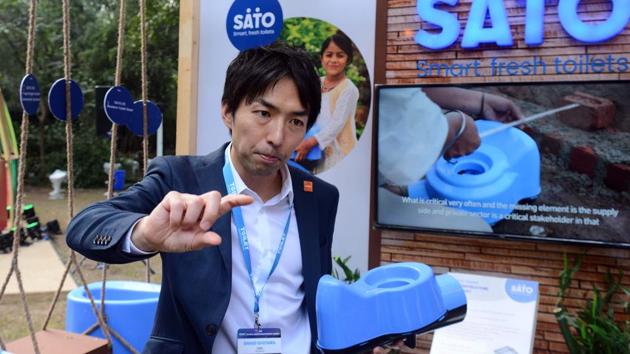
He was speaking while presenting a demonstration of the innovative Sato toilet at an exhibition of innovative products in sanitation on the occasion of the ongoing Global Sanitation Summit. More than 30 innovators presented their designs at the Tata Management Training Centre (TMTC) here.
Sato is one of the innovative designs in affordable and maintainable toilets cited in the Raghunath Mashelkar Committee on Sanitation, instituted by the Union government. It is recommended under the innovative technology for water conservation.
Explaining the V-Trap, Ishiyama said the innovative trapdoor technology uses less than 1 litre water and is now deployed in 10 states under the Swachcha Bharat Mission.
“Under the Swachha Bharat Mission, we have installed many of our products and have also helped retrofit in colleges. Our target is to reach 100 million people by 2025 and this can only be done by creating awareness among the younger generation,” said Ishiyama.
As part of the ongoing summit, Sato is also mentoring another innovator, Tiger Toilets. The Sato design solutions recently won the Good Design Award 2018, and Red Dot Award 2018
Lixil, maker of pioneering water and housing products which has partnered with Toilet Board Coalition (TBC) to host Global Sanitation Economy Summit in Pune, announced formation of its India Chapter, named Toilet Board Coalition India Association, to deal with India’s sanitation crisis.
City-scale sanitation
In the city-scale sanitation session, experts spoke of how sanitation could be helpful in raising the economic factor of a city in terms of making the city governance self-sustaining and resourceful for sanitation.
In his presentation, Johann Clere of Veolia, a French transnational company with services in water management, waste management and energy services, spoke of their pilot project for Kenya government where they hope to serve one million people in Nairobi with proper sanitation drive and efficiency in managing the sewage system by 2025.
Pune’s Ajeet Oak of TBF environmental solutions, who designed tiger toilets and faecal slush treatment plants, said the rising demand for households toilets in slums can be met only with proper funding and planning and for city level partnership is vital for its success.
Maria Angelica Sotomayor, practice manager, World Bank, said the future of sanitation would develop better with public-private partnership.
Sanitation and women
The session “For women, by the women” stressed upon women leaders shaping the sanitation economy and future. Ulka Sadalkar from TI toilet bus; Megan Woodworth from Loowatt (waterless toilet technology firm) and Sue Coates from WSSCC (Water Supply and Sanitation Collaborative Council), UN’s partner sanitation body, discussed what it means to design systems, products and services for women in a sustainable society.
“Usually and historically speaking, public spaces were designed keeping men in mind, but the Ti model of toilet buses are designed keeping women in mind and have it run by the women as it opens up a lot of opportunities for her to have her own identity,” said Sadalkar.
“It has worked out very well for us and though initially women were not proud to be associated with them, but now they take pride in being a part of our model,” she said.
Sue spoke about social inclusion of everyone even the informal sector, minorities, LGBT, etc. “It is important that the team contributes in whatever share possible as all of them are as much a part of the solution as the participants in the module. Women power is a part of the solution and this leads to not disempowerment of men, but better participation of the other spectrum of the population as well,” she added.
Megan highlighted the stigma of sanitation being undignified work. “The perception for it needs to be changed and improved. Women in job sector have more presence and awareness about the already existing issue and what solutions are needed,” she added.


