
 E-Paper



'Dream it, make it happen’
Smarajit Jana, a pioneering AIDS activist, mined the power of the collective to set up cooperatives. He died on May 8, 2021 due to Covid-19

 Prefer HTon Google


It was late-1991. The 49-year-old sex worker couldn’t recollect the exact date but the Dura puja festivities had just ended and it was work as usual in Sonagachi, one of Asia’s largest red-light districts in north Kolkata, where she lived.
Then 18, she was one of the youngest in the area that now records around 12,000 registered workers.
“He was around 40 years old. He was wearing shoes, a half-sleeve shirt tucked into his trousers, and a pen in his pocket. When he approached us, he didn’t say that he would like to work for us. Instead, he asked us about our health and hygiene issues and asked us if we would like to work for ourselves,” she said.
Little did the woman and her co-workers know at that time that the man, Dr Smarajit Jana would shape the sex workers’ rights movement in the country and spearhead the first rights-based HIV intervention programmes.
After approaching the group of sex workers in 1991, Jana, an epidemiologist and an expert in social and preventive medicine, spent the next few days handpicking women to launch a Sexually Transmitted Disease-Human Immuno Virus (STD-HIV) prevention project in Sonagachi on February 15, 1992. Twelve agreed to work as educators.
This paved the way for the Durbar Mahila Samanwaya Committee (DMSC), the largest sex workers’ community in India seeking rights and dignity, formed in 1995. It is now a collective of 40,000 sex workers across West Bengal.
Jana died of Covid-19 on May 8, 2021. He was 68 years old.
“During informal gatherings he used to tell us to close our eyes for a few minutes and dream. We used to share the dreams and then he used to discuss it with us to give it a shape,” said Bisakha Laskar, president of DMSC, who started working with Jana in 1992.
That’s how the Usha Multipurpose Cooperative Society (UMCS) — a bank exclusively by and for sex workers — was formed in July 1995.
“We told him that each time we go to a bank to open an account they ask for an identity document and an introduction from another person. Who would introduce us? People don’t treat us like human beings. We asked him if we can have something like a bank and he said “why not?” and that’s how we came up with the idea of a cooperative society,” said another sex worker who worked with Jana.
The UMCS only permits sex workers to be its members; even children of sex workers are not allowed to be a part of it. At present there are 12,000 account holders.
“He really did change the nature of how communities can organise themselves and agitate and advocate for their own health and welfare,” Kevin O’Reilly, an associate professor at the department of psychiatry and behavioural science at the Medical University of South Carolina, USA, and formerly with World Health Organisation’s department of HIV/AIDS was quoted as saying in the obituary published in the Lancet in 2021.
Understanding the national impact left by Dr Jana
Jana’s impact was not just restricted to West Bengal. He was a member of the National AIDS Control Organisation’s (NACO) steering committee (2007 – 2012) a board member of the Bill and Melinda Gates Foundation India AIDS Initiative (2004 – 2009) and an executive member of the UN regional partnership forum on sex work (2005 – 2007) among other positions.
He was a member of NACO steering committee when the organisation had launched the third phase of the National AIDS Control Programme.
“He propagated for community mobilisation and ownership building. He was the voice of sex workers and helped them understand their own wellbeing,” said Dr Pratim Roy, who knew Jana since the early 1990s.
Jana was also a member of the Supreme Court-mandated commission which, in 2016, recommended legal recognition for sex workers by issuing them ration and voter cards and decriminalising sex work.
In September 1999, a sex worker in Kolkata was brutally murdered by a man named Buddhadev Karmaskar. The case went all the way up to the Supreme Court of India. The apex court used this case to appoint two senior lawyers as amicus curiae to study the condition of sex workers across the country. On their recommendations, both DMSC and UMCS were made parties to the case in 2011. The court later appointed a panel to make recommendations on how to prevent trafficking, alternative livelihood options for sex workers who wanted to quit the profession and how those, who wanted to continue, could live a life of dignity.
Jana was a member of the panel representing DMSC. The panel filed its final report to the court in 2016. Jana gave substantial inputs including on the violence faced by sex workers, the importance of condoms as an aspect of their occupational safety as well as the shortcoming of a rehabilitation approach that ends up putting them in detention. The SC sought responses from the government and the panel's report began to gather dust.
In 2011, the SC had ordered that sex workers should be issued ration cards without the need to reveal their profession or identity. A decade later, the order wasn't complied with and in 2020, when the pandemic struck, sex workers were left without work or access to welfare measures due to lack of documents like ration cards and Aadhaar cards. Jana filed an application during the pandemic and lockdown stating that sex workers were on the brink of starvation and needed immediate help. The SC passed an order that sex workers were to be given ration without cards.
“Dr Jana played a major role as it was on his suggestion that the SC directed all state governments to provide ration to sex workers without any documents. It was probably not done anywhere in the world. The distribution process was monitored by the apex court on a monthly basis and all states had to file reports. While this was going on, the apex court noted that its 2011 order was still not complied with and directed the states to issue ration cards, Aadhaar cards and election photo identity cards to sex workers while ensuring their confidentiality,” said Tripti Tandon, who represented DMSC in SC.
“I remember, when the lockdown was announced because of Covid-19 he would work for hours in the office. It was on his plea that during the country-wide lockdown, that the Supreme Court ordered the centre and the states to provide free ration to sex workers,” the second woman quoted above, said.
Uncovering the social change by Dr Jana
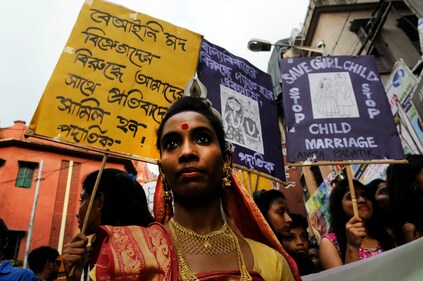
Every year, the red light district of the city witnesses a flurry of activity — idol makers come to Sonagachi to collect the soil from the doorsteps of the residents, following tradition that no Durga idol can be made without it. Yet, ironically, the area did not have its own mandal for the longest time.
“For many years we had been telling sir (Dr Jana) that even though Durga Puja can’t be done without the soil from the red-light area, we are shunned from the pujas. He said ‘let’s do it’ and we started our own in 2013,” Laskar said.
Despite severe objections from local residents who didn’t want a Durga Puja organised by sex workers inside the red-light area, the DMSC started its own puja.
“We have been organising the puja every year now. Last year, the state women and social welfare minister Shashi Panja inaugurated the puja. Several noted persons including IPS officers, lawyers and doctors now come to attend the inauguration,” Laskar said.
Jana launched a football academy for the children of sex workers as well as underprivileged sections of the society including tribals in 2015.
“The football academy which he set up now has around 25 girls and around 70 boys. While the girls take part in tournaments in the under-17 age group, the boys take part in the under-13 and under-15 sections. There is also a home for the children of sex workers at Baruipur in South 24 Parganas,” said Dr Pratim Roy, who has known Dr Jana since the early 1990s.
“He was like a father figure to us who used to scold us whenever we did something wrong but even apologised if he found that he was wrong. Life goes on but his absence will always be felt,” said Laskar.
Jana was the architect of the Network of Sex Workers in India, which resulted in the formation of National Network of Sex Workers and All India Network of Sex Workers.
The NNSW was formed by a group of sex workers’ organisations and support organisations as a network to articulate the voices of sex workers. The organizations were formally registered as AINSW.
While Dr Roy mostly looks after technical part, the organisation is now looked after by others, including Laskar.
“We were a team and he was the leader. Of course, his loss can never be replaced, but it is not that everything has come to standstill. We don’t have the reach at the national and international levels that he had and hence the work that might have taken him a day may now take us three days. He gave us innovative ideas and guided us throughout even though the team executed the ideas," Laskar said.


