
 E-Paper



Fishing cats: Is Bengal doing enough to protect its state animal?
It is included as a Schedule I species in Wildlife (Protection) Act and hence enjoys the highest level of protection equal to that of tigers, lions and elephants

 Prefer HTon Google


KOLKATA: On January 20, conservationist Chitrak Pramanik was told that at least three fishing cats have been found dead at Bagnan in West Bengal’s Howrah district. Pramanik rushed to the spot and found they had been poisoned a few days earlier. The carcasses were dumped near a paddy field with the legs of the cats tied with ropes. “They were all females,” said Pramanik.
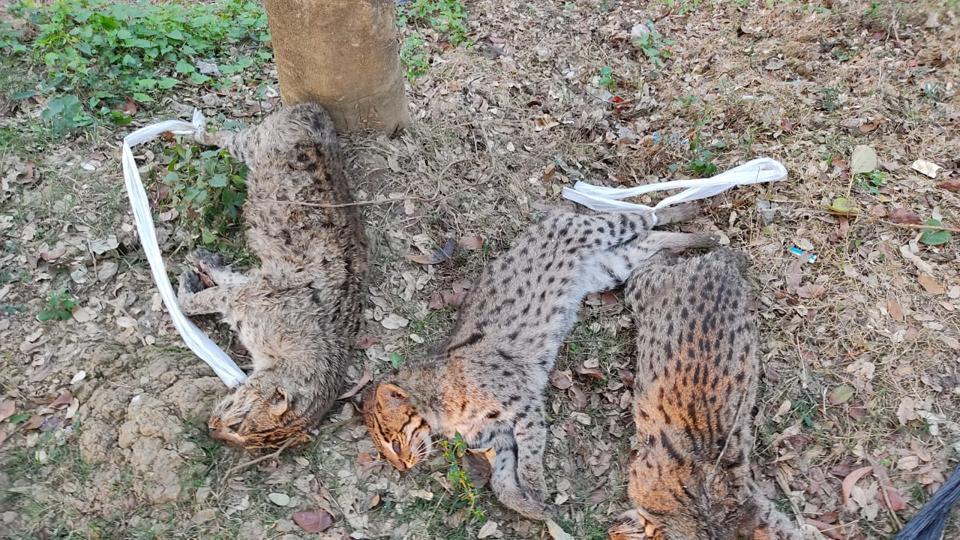
The killings shocked conservationists seeking to protect the state animal of West Bengal. “Earlier too fishing cats have been killed in the state or their bodies were found on highways after being run over by speeding vehicles. But this is for the first time that we found three animals being killed and their bodies dumped,” said Pramanik.
The state forest department started an inquiry and found the involvement of local residents Prabhas Patra and Pratap Patra. Their houses were raided but both were absconding. An arrest warrant has been issued against them and the police are looking for them.
In 2009, the fishing cat was declared the state animal. It is also included as a Schedule I species in Wildlife (Protection) Act and hence enjoys the highest level of protection equal to that of tigers, lions, and elephants.
“Imagine the hue and cry we would have seen had it been three tigers or lions being killed. But when it comes to the state animal, there has been hardly any concerted effort to protect it, barring a few local NGOs, conservationists or researchers working to save these smaller cats,” said Tiasa Adhya from the International Union for Conservation of Nature (IUCN)’s Species Survival Commission, which has been researching on the cats for over a decade.
According to a study conducted by The Fishing Cat Project as part of a WWF grant, at least 27 cases were reported from Howrah and Hooghly alone wherein fishing cats were found dead. Most of the cases pertained to retaliatory killings.
According to a recent report published in CATnews, a biannual newsletter of the IUCN-SSC Cat Specialist Group, between January 2019 and February 2021, 11 such cases were reported. In February 2020, villagers at Shyampur in Howrah allegedly skinned a dead fishing cat for meat and even sold a portion of it.
About twice the size of a typical house cat, the fishing cat primarily preys on fish in wetlands and marshy lands. In India, fishing cats are mainly found in the mangroves of the Sundarbans, on the foothills of the Himalayas along the Ganga and Brahmaputra river valleys, and the eastern coast up to Andhra Pradesh.
Even though cats living in national parks and wildlife sanctuaries are protected, a huge population of the fishing cats in marshes and wetlands outside the parks along the floodplains of the Ganga are vulnerable and under threat.
To date, there has been no proper estimation of the animal’s population outside protected areas despite being the state animal. “We are not doing enough to protect it. An animal listed under Schedule I... denotes that its population is on the decline. Loss of habitat is its primary threat... The land mafias are after wetlands... Only a handful of local NGOs and local conservationists are working on them even as the entire focus of the administration and big NGOs still remains on larger animals and key species such as tigers, elephants, and lions among others,” said Biswajit Roy Chowdhury, secretary of Nature Environment and Wildlife Society, an NGO.
Experts want the government to play a more proactive role to protect and conserve the fishing cat and its habitat as it is listed as an endangered species on the IUCN’s Red List.
“The animal is protected but its habitat is not. Unlike the US, where a law prevents changing the nature of land with protected species, we do not have such laws in India. The disappearance of the habitat of the fishing cat is the main reason behind the decline in population. ...some animals such as leopard, elephant, wolf, fishing cat live in areas which overlap with human habitat and increases their vulnerability,” said Debal Deb, chief wildlife warden, West Bengal.
The report of a West Bengal Biodiversity Board study on fishing cats last year identified the threats to the animal even as it has faced criticism. “During the study, only 28 camera traps were placed across 80 locations. From such a low data set, the study concluded that Murshidabad district has the highest relative abundance of fishing cats. This is wrong because they are extrapolating site-specific results to the level of the district. Secondly, jungle cat kittens were misidentified as fishing cat kittens which casts doubt on the survey results,” said Adhya.
Forest officials and researchers said the only way to conserve these animals is to protect their habitat, wetlands, and marshy areas, with a socio-ecological approach. Generating awareness, liaisoning with local conservationists for stricter enforcement of the law is necessary, they say.
Experts said one way of protecting their habitats is by tagging them as Biodiversity Heritage Sites under the Biological Diversity Act. This can be done because there are many local practices endemic to that region that helps to protect the cat’s habitat. A reed locally called khari is found in their habitat. Khari is cultivated to support betel leaf cultivation. Another plant named hogla is used to pack vegetables and fruits. Both of these provide habitat to the cat.
“It is difficult to estimate their numbers outside protected areas but through satellite mapping we can always estimate the areas of wetlands and marshy lands. An estimation of their habitat would be a good enough indicator of the status of their populations,” said Adhya.


