
 E-Paper



Bulls, bulldozers and ‘ann shapath’ spiced up the poll narrative
“Jinnah, Pakistan, kabristan (graveyard)” and the Ukraine-Russia war found their way into the poll narrative while manifestos also shaped the political discourse


LUCKNOW The resource-rich Bharatiya Janata Party (BJP) kept setting the poll narrative throughout the seven-phase Uttar Pradesh election, with big rallies and beneficiary-outreach campaigns while the opposition too spiced up the bitterly contested polls by coming up with strategic moves timed to catch the BJP by surprise.
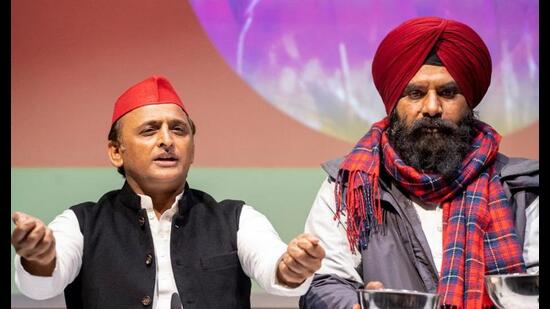
Narratives were shaped by the Samajwadi Party alliance’s ‘ann shapath (pledge over foodgrains)’ and the BJP’s ‘dhokha nahi denge, namak khaya hai (won’t ditch, have eaten their salt)’ pledge.
“Bulls and bulldozers” also entered the campaign while “double-engine sarkar, double ration”, “lal topi (red cap) and lal potli (red bundle)”, “bua, babua behen” and “kaka and baba” vied for attention. Besides, “Jinnah, Pakistan, kabristan (graveyard)” and the Ukraine-Russia war found their way into the poll narrative.
Poll manifestos shaped the discourse too as parties went out of their way to convince voters that they would keep their promises in an election where candidates kept hopping parties even after being named candidates.
Political experts said union home minister Amit Shah claimed that the BJP fulfilled 92.6% of the promises made in 2017 election manifesto.
“He may well have done his homework and come up with an exact number but whether or not it was exact, by quoting a number that wasn’t 100%, but close to it, appeared part of an ‘imaandaar sarkaar (honest government)’ pitch,” said Irshad Ilmi, a political observer who felt that psychological posturing played a big role in shaping up this election.
The first bipolar contest in virtually three decades saw the BJP and the SP releasing their manifestos on the same day, the former releasing its ‘sankalp patra (commitment letter)’ first, followed by the latter’s ‘vachan patra (pledge letter)’. The Congress came up with three manifestos – with the first titled ‘naari vidhaan’, being an all-women manifesto that party general secretary Priyanka Gandhi topped with her decision to field 40% women in UP polls.
The Congress promised 40% jobs to women, if voted to power. The BJP and the SP came up with near-matching offers.
The BJP also sent reminders to the masses through musical pitches like ‘bhool nahi jaana re (hope you don’t forget)’ song, shot on the lines of the viral Sri Lankan ditty ‘Manike Mage Hithe’ as well as ‘aayenge toh Yogi hi (only Yogi will come to power)’. A song ‘jo Ram ko laaye hain, hum unko laayenge (those who brought Lord Ram will be voted to power) also became popular while SP’s musical counter went like this: ‘Jo saand ko laye hain, hum unko hatayenge, (those who unleashed bulls would be removed).
SP’s ‘Jai Jai Samajwadi (hail Samajwadis)’ also became popular. The Congress launched a musical ‘Tu hai gazab UP, teri kasam UP (you are fabulous UP, I swear by you UP)’ set to the tune of popular song ‘Srivalli’ from Telugu film Pushpa. The BSP’s campaign song went thus: ‘Aa rahin hain sabki behenji (everyone’s sister is staging a comeback)’.
Prime Minister Narendra Modi fuelled the BJP campaign with high-pitched rallies, talking of his government’s beneficiary outreach and positioning himself as a person who had seen poverty from up close and hence understood the pain of the poor. In each of his rallies, Modi would talk in detail about the double engine BJP government’s various pro-poor initiatives and interact with his audience to make a comparison between work done by chief minister Yogi Adityanath for the poor vis-a-vis work done by “pehle ki sarkaar (previous government)”.
Chief minister Yogi Adityanath kept the adrenaline flowing with his hard hitting speeches like “10 March ke baad garmi shaant kar denge (we will quieten the aggression after March 10)” and SP chief countered them with ‘compressor’ jibe.
The SP had captured the opposition space early by putting together a caste-specific alliance of several smaller parties with pockets of influence.
But, political experts agree it was UP’s labour minister and OBC heavyweight Swami Prasad Maurya’s resignation from the Yogi Adityanath government on January 10, two days after the election commission announced the election schedule, that triggered a phased spate of resignations, mostly of OBC lawmakers and ministers, helping the SP dictate the media narrative for a week.
The defectors kept consuming media space until the BJP hit back with a damage control plan that involved triggering counter defections from the SP.
The BJP kept on getting other lawmakers, but in the middle of the campaign, it was former union minister and Congress leader RPN Singh’s switch to the saffron party that again saw the ruling party taking an edge on the perception battle which continued until the last phase when SP inducted Mayank Joshi, son of BJP lawmaker Rita Bahuguna Joshi into the party.
Before the polls were announced, several BSP lawmakers headed towards the SP, in what then were early indications of the 2022 UP polls readying for a bipolar ‘BJP alliance vs SP alliance’ contest, a first in three decades.


