E-Paper



Dussehri mango farmers in UP village bitter over water stress amid a hot election
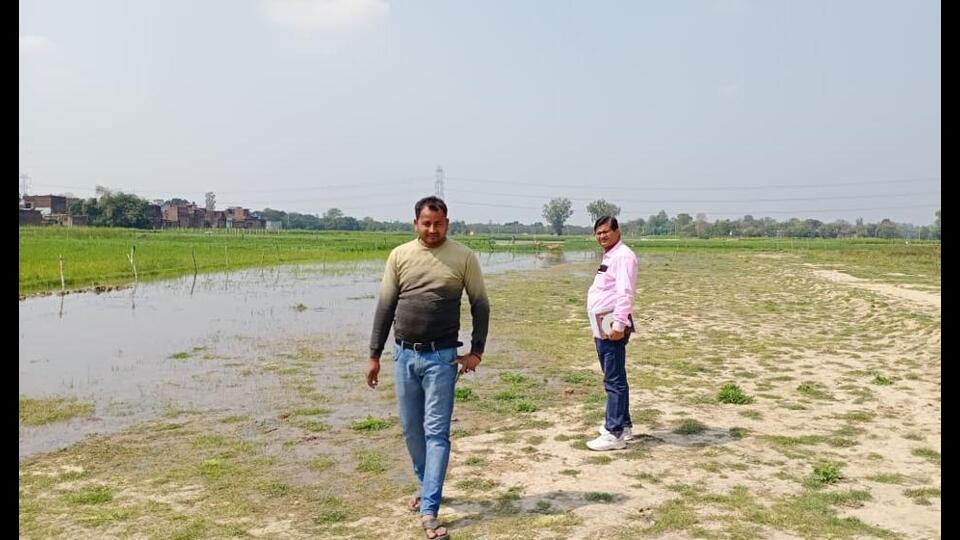
The stream, which was once a source of groundwater recharge for hundreds of mango trees and other agricultural activities in Dasheri village, has turned into a dry pit, lament growers

 Prefer HTon Google


DASHERI Even though Dussehri mangoes have made a mark globally for their sweet taste, pulp and aroma, farmers in its place of origin – Dasheri village - feel neglected amid an election season that coincides with heat and water stress. They say the stream, which was once a source of groundwater recharge for hundreds of mango trees and other agricultural activities in the village, has turned into a dry pit and no efforts have been made to rejuvenate the water body over the years.
Nearly a 21-km drive from Lucknow, the village is situated near Kakori under the Mohanlalganj constituency, waiting to go to polls on May 20.
Dasheri village is named after the said mango variety and has the over two-century-old ‘Dussehri mother plant’, believed to be the source of all trees producing this variety in India.
Mangoes from this village are exported to Singapore, Hong Kong, The Philippines, Malaysia, and other countries in South-East Asia, but Dussehri mangoes are falling victim to political apathy, lament villagers.
On an average, 2 to 2.5 lakh metric tonnes of mango crop is produced in this region every season. But the demand for the revival of the 2-km- long stream is pending for years.
“The 2-km-long stream was full of water two decades back. Most of it has dried up, leaving only a portion of it with water - that too with hyacinth,” said village pradhan Kanchan Yadav, 35. “In 2015-2016, approximately ₹2.5 crore was proposed for the revival of the stream, which was part of the I-Sparsh Amart Gram Yojna. But things haven’t moved ahead,” said Yadav, adding that if the stream is restored, it will again be a lifeline for mango farms.
As per a government record, ‘I Sparsh Yojana’ is aimed at providing better farming techniques in select villages of the state. The project also includes developing local art and skills of the area aligned with promoting innovative works suiting that village’s needs. Tourist places, if any, in a village will be developed and workers from villages with famous handicrafts will be encouraged.
URBANISATION AT ITS PEAK
In addition to the lost stream, urbanisation of the village, due to proximity to Lucknow, is affecting its agricultural land.
“There was a time when this village had 50% agriculture and 50% farmland for mango cultivation. However, with time, urbanisation led to farmers selling their land and plotting them,” said Hari Pal, 68, who saw his village changing. “Mango farming has decreased from 50% to 30% as cultivators face problems of crop threat and water issues, often incurring them losses,” said former village pradhan Manoj Yadav.
“With decreasing opportunities in mango farming, villagers are left with no option but to sell their land when money is required,” said Geeta Gautam and Rekha Rawat, who run a self-help group in the village.
Villagers said there were 29 ponds in and around the village, but all of them are now dried up and have been encroached.
TURN IT INTO TOURIST DESTINATION
A number of people visit the village to get a glimpse of the ‘Mother Dussehri tree’ here, believed to be 250 years old and 35 feet tall.
As per the villagers, it was planted by Abdul Hameed Khan Kandhari aka Baba-e Amba (father of mango) who brought it from Iran. Currently, it is nurtured by Sameer Zaidi, and the products belong to Mohammad Ansar Saheb. Locals said it was also decided to turn the village into a tourist destination with beautification of the stream, roads construction, establishment of an inter college, etc.
“However, nothing has been done in years. Governments come and go but the plight of the village remains the same. There is only one primary and high school and no inter college,” said Ashish Kumar, a villager.
The villagers suggested that tree plantation be expanded, along with efforts to develop selfie points, benches, and ghats.
FACT SHEET
124.442 hectare - area of village
4200 - population of village
1717 eligible voters
Lok Sabha - Mohanlalganj
Vidhan Sabha - Malibhadad