E-Paper



Crashing prices force a few potato farmers to crush crops
A price crash has inverted the economics of farming: it now costs more to dig, bag and transport potatoes to the mandi than the market is willing to pay

 Prefer HTon Google


KANPUR In a stark symbol of agricultural distress, a few farmers across Uttar Pradesh’s potato belt are driving tractors over their standing crops and abandoning cold storage stocks. A severe price crash has inverted the economics of farming: it now costs more to dig, bag and transport potatoes to the mandi than the market is willing to pay.
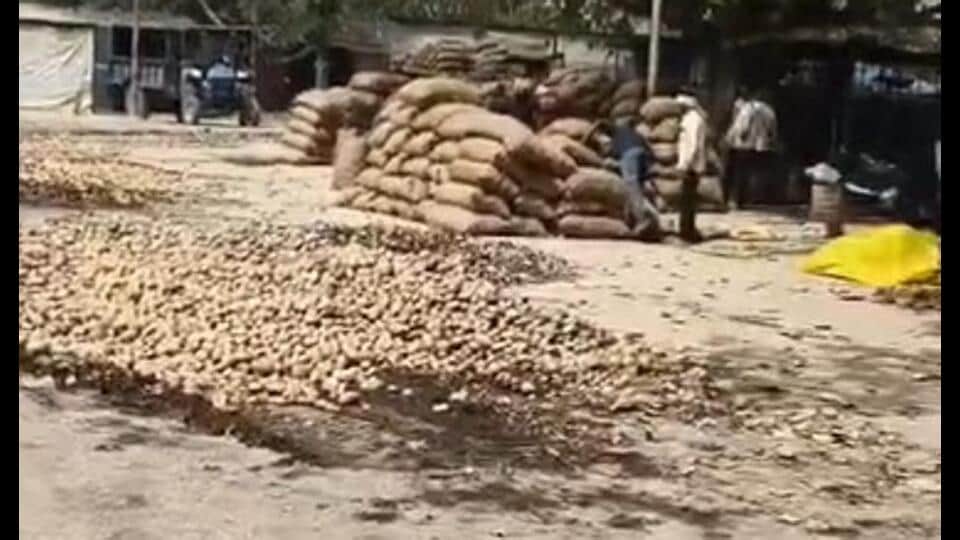
Farmer Amarjeet of Nadsaa village recently made a grim calculation. Realising the math was entirely against him, he destroyed two bighas of his potato crop rather than take it to market. A few kilometers away in Bharatnagar, Shabban Khan walked away from five bighas worth of potatoes sitting in cold storage, opting to plough his field over instead.
Across the belt stretching from Kannauj to Hathras, mandis are choked, commission agents are paralysed by unmoving stock and some farmers are dumping sacks on roadsides after dark.
The financial breakdown is devastating for a few local growers. Ajay Mishra, who has 500 sacks of Chipsona potato stranded in a Farrukhabad cold storage, laid bare the crisis.
“Cultivation costs run to ₹10,000-11,000 per bigha, while current prices return around ₹7,000. New potatoes are trading at a mere ₹350-400 per quintal and old stock is failing to fetch even ₹100 a sack,” he added,
A viral video from Saurikha in Kannauj purportedly showed sacks being tipped off a vehicle onto a road. Seventeen sacks of potatoes were quoted at ₹1,780 at the mandi. Getting them there, including digging, bagging and transport, had cost the farmer ₹2,600.
The immediate trigger for the crash is a succession of bumper harvests. Spurred by last season’s profitable returns of ₹1,000 per quintal, farmers planted heavily. Farrukhabad alone saw output jump by more than two lakh metric tonnes from the previous year.
This oversupply hit a saturated market just as a crucial seasonal demand window slammed shut. Mild temperatures kept summer vegetables in markets longer than usual, eliminating the traditional Diwali-season demand spike for potatoes.
Compounding the misery are soaring cold storage costs. Sanjay Samwadi, president of the Kannauj Cold Storage Owners’ Association, cited global supply chain issues. “Unrest in West Asia affected ammonia supply and refrigeration costs rose,” he explained, noting that local diesel disruptions further drove up generator costs.
When farmers compared storage expenses with any realistic sale price, many chose not to retrieve their crop. For farmers like Shri Krishna Katiyar from Bilhaur, the math is impossible. While growing a bigha costs ₹5,500, storing that harvest now costs a staggering ₹15,000.
With no buyers in sight, unsold stock is increasingly being diverted to gaushalas as cattle feed or illegally dumped at night to avoid disposal fees.
The administrative response has been largely procedural. Following complaints of rotting potatoes attracting cattle, pigs and generating a foul stench, the UP Pollution Control Board issued notices to Kannauj cold storage owners. District magistrate Ashutosh Mohan Agnihotri confirmed the notices and advised burying discarded stock for compost.
Because cold storages are classified under the green industrial category, direct punitive action is limited, though officials have indicated that licence renewals could be affected if dumping continues. No government procurement or relief mechanism has yet been announced.