E-Paper



Global warming behind increasing lightning strikes, say experts
Experts suggest that global warming is behind the increase in lightning strikes, as hotter temperatures combined with rain lead to more intense thunderstorms and lightning. The residents of Lucknow, India experienced a harrowing night of lightning and thunder, with the weatherman reporting lightning for 11.5 hours intermittently. The Indian Institute of Tropical Meteorology is studying lightning characteristics to help reduce losses due to lightning strikes.

 Prefer HTon Google


Lightning! Thunder! And the frequent sound of Nature’s monsoon music!
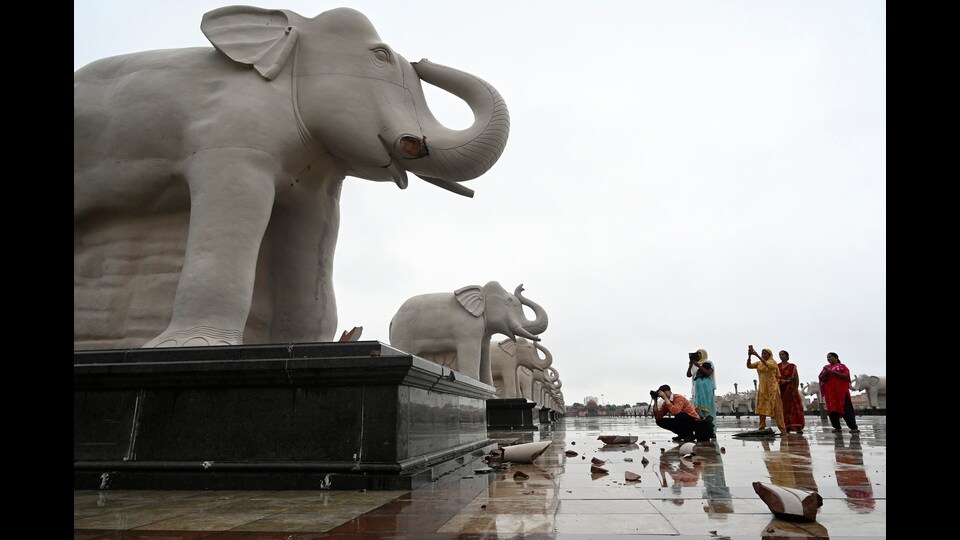
While the crackle of lightning and thunder on Sunday night remained a topic of discussion all day on Monday with netizens sharing videos of the terrifying experiences they underwent, experts said more than localised weather factors, it’s the global warming behind increasing lightning strikes.
Although lightning with thunderstorms is not unusual, the residents of Lucknow faced a harrowing night because of high frequency. The weatherman said there was lightning for 11 and half hours intermittently from 7.40 pm to 7.10 am. However, the IMD does not have data on the number of lightning strikes between these hours and any previous records.
Prof Sunil Gupta, who works at the Data Institute of Fundamental Research in Mumbai, said, “Owing to global warming, we are observing the increasing number of hot days in a year which, when combined with rain, leads to occurrence of more intense thunderstorms and lightning of greater intensity.”
“Sometimes, the top of the cloud becomes highly positively charged and the bottom negatively charged which causes a large voltage to develop across the cloud which is called thunder cloud. This voltage continues to rise and until the air breaks down and then the lightening discharge happens and sound produced by it is known as thunder,” said Gupta, who is one of the pioneers behind establishing Cosmic Ray Laboratory in Ooty that works on lightning
“This does not mean that is the only explanation but it is one of the possible ways we can understand the frequent and intense occurrence of thunder and lightning in Lucknow the previous night,” he said.
Atul Kumar Singh, senior scientist at IMD Lucknow, said that movement of cloud mass is comparatively slower during monsoon than other seasons. As cloud movement was negligible, the charge builds up in the cloud and density of lightning increases primarily because there is a large probability of development of potential difference within the cloud top (negative) and cloud bottom (positive).
“Cyclonic circulations over north-west MP and the monsoon trough was slightly to the south of its normal position due to which there was abundant moisture supply from Bay of Bengal over the state of UP in the lower troposphere. At the same time there was an active western disturbance in the middle troposphere which was interacting with low level easterly due to this synoptic setting up this kind of rainfall activities in U.P,” he said.
Noted environmentalist Prof Venkatesh Dutta from Department of Environmental Science of Babasaheb Bhimrao Ambedkar University said, “Lightning occurred owing to the fact of intense heating of the Earth’s surface and atmosphere. They are most common in areas where the weather is hot and humid. The dry and hot August definitely added to this thunderous lightening and rains. Such type of extreme weather events undoubtedly reflects the impacts of rising atmospheric temperature and climate change. August was the hottest-ever recorded in Lucknow and U.P, and the heat intensified cloud activities.”
Professor Pankaj Jain, an expert in space, planetary and astronomical science and engineering at IIT Kanpur, said that he too discussed the matter with his colleagues.
He said, “Cosmic ray laboratory in Ooty has done a plenty of work on thunder and lightning to which he is a member and collaborator. This is a global phenomenon and is taking place everywhere. Thunder and lightning is due to cosmic rays that are coming from the galaxy which could be contributing to it. “
Prof Ashok Kumar Singh, dean faculty of engineering, Lucknow University, who is a solar physicist and has worked in lightning said, “It is nothing unusual. People are giving a lot of attention to all of this due to increasing scientific awareness.”
Retired deputy director, Geological Survey of India, Virendra Singh Yadav said, “Lucknow and adjoining areas may also experience an increase in the severity and frequency of these incidents in future. Hence, there is a need for prevention, preparedness and to invest in Disaster Risk Reduction (DRR) which will save lives, livestock, property and infrastructure. It’s a wakeup call to us by nature.”
He said , “The Indian Institute of Tropical Meteorology (IITM), Pune, has initiated a project to study the characteristics of lightning by using Lightning Location Network (LLN) which would be of great help in reducing the losses due to lightning in the country.
He said, “Lightning is of three types. The first is thundercloud or intra-cloud lightning. The second is cloud-to-cloud or Inter-cloud lightning and third is cloud-to-ground lightning (CG). The third type of lightning takes a toll on lives and property, and therefore, is of more concern to us. However, inter-cloud and intra-cloud lightning are also dangerous as they may hit aircrafts. Its peak power and total energy are very high, with the peak power discharge in the order of a 100 million watts per metre of the channel and the peak channel temperature approaching 30,000 °C. Peak currents in a lightning discharge range up to hundreds of kilo amperes (kA) with its typical value being 40 kA. Predicting the precise time and location of lightning is very difficult.”