
 E-Paper



In U.P’s Prayagraj, UIT team turns old car into an electric one
Developed by United Institute of Technology’s (UIT) department of electrical engineering in collaboration with department of mechanical engineering, the e car was launched for on-campus rides on July 30

 Prefer HTon Google


With the aim of developing an eco-friendly but economical ride for their campus as part of a hands-on learning mission, a team of students and teachers of Sangam city’s United Institute of Technology (UIT), Naini, has succeeded in transforming a regular old petrol-driven car into a non-polluting and non-fuel using electric (e) car.
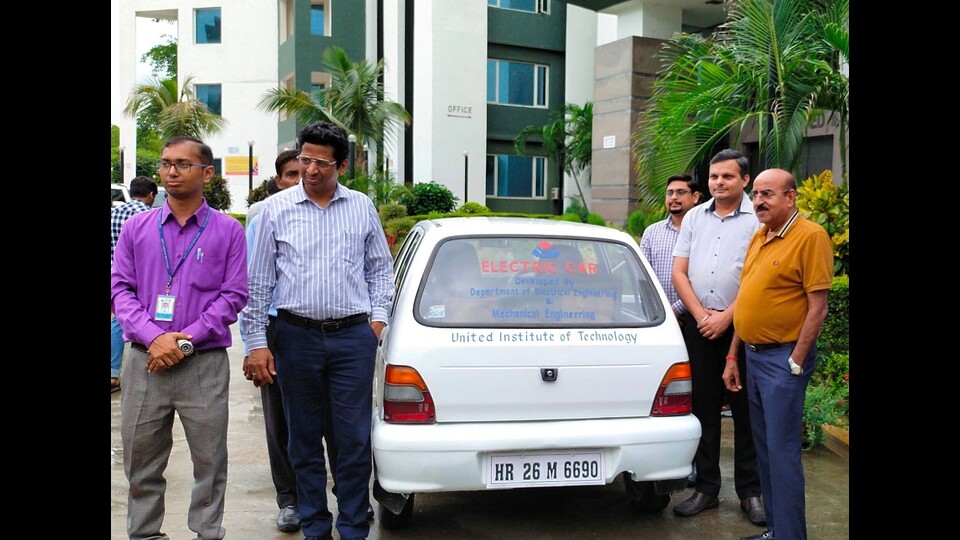
Developed by UIT’s department of electrical engineering in collaboration with department of mechanical engineering, the e car was launched for on-campus rides on Saturday. Vice-chairman, UGI, Satpal Gulati launched the electric car in the presence of UIT principal Prof Sanjay Srivastava and other dignitaries. He also praised the team for the innovation.
Best wishes were extended to head of electrical engineering department Prof Swaroop Mallick and academic coordinator Mohammed Shabeeh for the innovation. Mallick also demonstrated the working of the electric car.
Prof Sanjay Srivastava said earlier this was a petrol-driven Maruti 800 car lying unused for years on the campus. “It has now been completely refurbished and transformed into an electric car operated by battery backup. The petrol engine has been replaced by a 48-volt 3-kilowatt brushless DC motor along with motor controller fed from 4 units of 12-volt lead acid batteries which is used to run the electric car. The brushless DC motor is coupled with the gear box and the external controller is used for controlling the speed of the DC motor,” he said.
He further said the car can carry four people at a time and can run up to 50 km on single charge at an average speed of 30 km per hour. Prof Swaroop Mallick said at the initial part of this initiative a group of students of fourth year electrical engineering branch were also involved for surveying different types of motors along with their specifications available in the market as per suitability for the electric car.
“It took around five months for the complete transformation of the car and cost around ₹80,000. The main purpose is to develop an environment friendly electric car capable of running inside the college campus and to establish connectivity with the different adjacent campuses of United Group when needed,” he added.
Prof Mullick said now efforts would be made to improve the e car’s mileage as well as its top speed. “We are also trying to develop a way to charge its battery using solar panels so as to make this vehicle completely dependent on renewable energy,” he said.


