
 E-Paper



Interest overtakes donations as Ram Temple Trust builds ₹1.8K-cr corpus
The financial statements, accessed by Hindustan Times, provide the first comprehensive picture of the trust’s finances at a time when its donation-counting mechanism is under investigation by a Special Investigation Team (SIT) over the alleged theft of devotees’ cash offerings. The accounts also highlight the scale of the trust’s financial operations, underscoring why investigators described strict compliance with security protocols in the donation-counting process as critical.


The Shri Ram Janmabhoomi Teerth Kshetra Trust earned substantially more from interest on its investments than from fresh donations by devotees in 2025-26, underscoring the transformation of the Ram temple into one of the country’s most prominent religious institutions. Unaudited accounts show the trust earned ₹151.80 crore as interest against ₹98.24 crore in donations during the year, while building a corpus of ₹1,876.30 crore, including over ₹1,770 crore parked in fixed deposits. It also spent ₹514.50 crore on temple construction and pilgrim infrastructure.
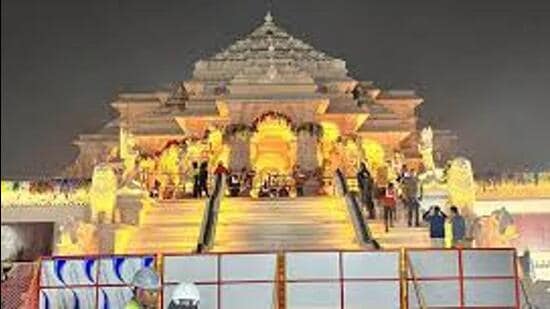
The financial statements, accessed by Hindustan Times, provide the first comprehensive picture of the trust’s finances at a time when its donation-counting mechanism is under investigation by a Special Investigation Team (SIT) over the alleged theft of devotees’ cash offerings. The accounts also highlight the scale of the trust’s financial operations, underscoring why investigators described strict compliance with security protocols in the donation-counting process as critical.
The ongoing SIT probe has already pointed to serious lapses in the implementation of mandatory safeguards during donation counting, raising broader questions about financial oversight.
The trust reported total income of ₹250.04 crore during the financial year ending March 31, 2026. Devotees contributed ₹98.24 crore through cash offerings and online donations, while the trust earned ₹151.80 crore as interest on its deposits and investments.
The figures show that nearly 61% of the trust’s annual income came from investment returns, while fresh donations accounted for the remaining 39%, reflecting the growing contribution of its accumulated corpus to recurring income.
Among voluntary contributions, ₹66.55 crore came through temple donation boxes, ₹21.05 crore through donation counters, ₹9.70 crore through online donations and ₹94 lakh under the Foreign Contribution (Regulation) Act.
The dominance of cash offerings is significant, with nearly 68% of donations received through physical donation boxes—the very stream now under investigation following allegations of systematic cash pilferage during counting.
Massive investment portfolio
The accounts show the trust overwhelmingly parked its corpus in fixed-income instruments.
As on March 31, 2026, it held ₹791.04 crore in State Bank of India (SBI) fixed deposits, ₹652.88 crore in Punjab National Bank (PNB) fixed deposits, and ₹327.30 crore in Bank of Baroda (BoB) fixed deposits.
Together, these deposits total ₹1,771.22 crore, representing almost 94% of the trust’s total corpus. Apart from fixed deposits, the trust also held ₹87 crore in mutual funds, ₹10.87 crore in auto-sweep deposits and ₹4.77 crore in savings bank accounts. Despite processing almost ₹100 crore in annual donations, the trust reported only ₹77 lakh in physical cash at the end of the financial year, including ₹9 lakh at donation counters and ₹68 lakh in the hundi counting room, indicating that collections are routinely transferred into the banking system.
Construction remains the biggest expense
The trust spent ₹514.50 crore during FY26, more than twice its annual income, drawing on accumulated reserves to finance ongoing expansion. Capital expenditure accounted for ₹422.74 crore, nearly 82% of total spending. Temple construction alone consumed ₹375.40 crore, reaffirming that completion of the Ram temple complex remains the trust’s principal financial priority.
Other major capital works included ₹21.53 crore on land acquisition; ₹9.81 crore on the L&T canopy project; ₹4.83 crore on the Yatri Swagat Kendra; and expenditure on dormitories, temporary structures and other infrastructure around the temple precinct.
Rising operational costs
Apart from construction, the trust spent ₹91.76 crore on recurring operational expenses associated with managing one of India’s busiest pilgrimage destinations. Major expenditure included ₹12.85 crore on bhog, prasad and pooja arrangements, ₹11.49 crore on security services, ₹10.48 crore on the temple Dhwajarohan (flag-hoisting) ceremony, ₹9.26 crore on the Ann Kshetra, ₹8.98 crore on employee benefits and several crores on cleaning, electricity, locker facilities and maintenance. The spending pattern reflects the increasing cost of operating a large pilgrimage complex while simultaneously expanding infrastructure.
Land bank, precious metals grow
The trust continued expanding its land holdings by acquiring 2.57 acres through 14 purchase and agreement transactions, spending about ₹20.16 crore on properties around the temple complex.
Its inventory of donated precious metals also grew significantly.
As on March 31, 2026, the trust held 1,518.925 kg of silver, including 849.272 kg of refined silver bricks of 99.99% purity, and 32.259 kg of gold-like items received from devotees.


