
 E-Paper



Kashi’s mini-Tamil Nadu symbolises centuries-old bond between two cultures
The uniqueness of Hanuman Ghat Mohalla stands out more than ever in the context of the Kashi-Tamil Samagam that aims at the revival of cultural and traditional links between Varanasi and Tamil Nadu.


Called mini-Tamil Nadu by locals, the Hanuman Ghat Mohalla in Varanasi is a vibrant symbol of the centuries-old bond between Kashi and Tamil Nadu.
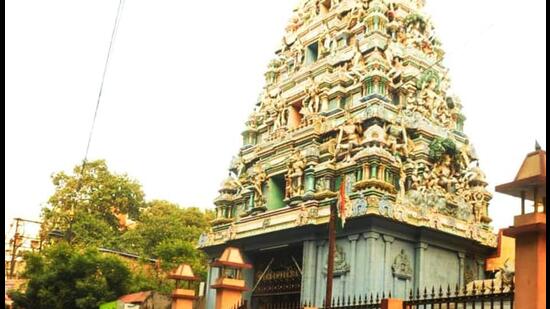
The uniqueness of Hanuman Ghat Mohalla stands out more than ever in the context of the Kashi-Tamil Samagam that aims at the revival of cultural and traditional links between Varanasi and Tamil Nadu. Prime Minister Narendra Modi will formally inaugurate the event on Saturday.
Home to about 70 Tamil families, the locality is at a stone’s throw from the Hanuman Ghat along the Ganga.
Visibly different from other areas in the city, it has a temple with Dravidian architectural design. The houses have plenty of greenery on the outdoors, spacious verandas decorated with terracotta sculptures, wooden swings and bright colours indoors -- common features of traditional houses in Tamil Nadu.
“Our mohalla (locality) was just like any other in Varanasi. But, with the Kashi-Tamil Samagam taking place, it has suddenly come into the limelight,” says Narayan Ganpathi, 45, resident of Hanuman Ghat Mohalla.
Kashi-Tamil Samagam is the first-of-its-kind initiative of the Union ministry of education in collaboration with IIT Madras and Banaras Hindu University (BHU).
The month-long event would see the participation of more than 2500 delegates from all walks of life.
Ganpathi, a local priest who claims to be the fifth generation of his family living here, says, “We are happy that efforts are being made to revive the cultural ties which only we Tamilian families were keeping alive. Now the world will be aware of the rich cultural bond between Kashi and TN.”
Ganpathi says his family was among the 200 families who embarked upon a pilgrimage from Tamil Nadu to Varanasi, some 120 years ago, on foot.
“On reaching Kashi, they paid homage to Lord Shiva and settled down here in their quest to attain moksha,” he adds.
VS Chandrashekhar, who claims to be the manager of a Kanchi Shankaracharya Math, says he is happy the mega event is happening.
“This will help in highlighting the contribution of Tamilians in the history of Varanasi,” he says.
Despite staying in U.P. for generations, Tamil families have kept their tradition and culture alive, he adds.
“The first and the most basic thing that we do to keep our culture alive is to speak in our mother tongue Tamil. We make sure that we celebrate our festivals, including Pongal, along with the other festivals of the North. In fact, we consider ourselves fortunate that we celebrate the festivals of North and South both,” Chandrashekhar says.
Kedar Shastri, another local Tamilian, says the importance of Tamil culture and tradition can be gauged from the fact that till date it’s priests of Notkottai Satram math who perform aarti (religious ceremony) twice a day at the famous Kashi Vishwanath temple in Varanasi.
Professors at BHU’s department of ancient Indian history, culture and archaeology say the ties between Kashi (Varanasi) and Tamil Nadu (TN) are more than 700 years old.
These bonds got strengthened further when spiritual leaders from TN established a tradition of pilgrimage from Rameswaram in Tamil Nadu to Varanasi in Uttar Pradesh.
Pravesh Srivastava, senior professor with department of ancient Indian history, culture and archaeology, BHU, says Indian history has several references to Tamil Nadu in the context of Varanasi.
One such reference, also said to be the oldest one, is linked with the establishment of Sivakasi, a city in Virudhunagar district of Tamil Nadu, that is famous for fireworks, matchbox and printing industry.
According to legend, in the early 15th century, the Pandyan King Harikesari Parakkirama Pandyan, who ruled the southern part of Madurai region that includes modern-day Sivakasi, wished to construct a temple of Lord Shiva in his region. The king travelled all the way to Varanasi, then called ‘Kasi’ to bring the Shivlingam to his estate. On his return journey, the tired king decided to rest under a grove of the vilva tree, which according to Hindu mythology, is lord Shiva’s favourite tree. After a while, when the king decided to leave the place, the bulls carrying the prized Shivlingam refused to move an inch. When all efforts to move the pair of bulls failed, the king realized that the wish of Lord Shiva is not to leave the site. He placed the Shivlingam at the same place. Since the Shiva lingam was brought from Kasi (Kashi), the place came to be known as Sivakasi, professor Srivastava says.
“Another Pandyan king, Adhivir Ram Pandyan, built a grand temple of Lord Shiva in Tenkasi after returning from Varanasi in the 19th century. Also, Sant Kumara Gurupara from Thoothukudi district had negotiated with the princely state of Kashi to get a place for the consecration of Kedarghat and Vishvesvaralingam in Varanasi. He also composed Kashi Kalambagam, a collection of grammar poems on Kashi,” the professor adds.


