
 E-Paper



Old City poised to lose a fragrant heritage landmark
The district administration’s fiat to shift the 200-year-old ‘phool mandi’ to Kisan Bazar in Gomti Nagar after Moharram has perturbed both flower traders and heritage enthusiasts

 Prefer HTon Google


Lucknow The iconic 200-year-old ‘phool mandi’ near Chowk, one of the oldest markets and the only traditional flower market in Lucknow, is set to be relocated to Kisan Bazar in Gomti Nagar. The decision has stirred emotional disturbance among the flower traders who regard this shift as the end of a ‘fragrant chapter’ in the Old City’s history.
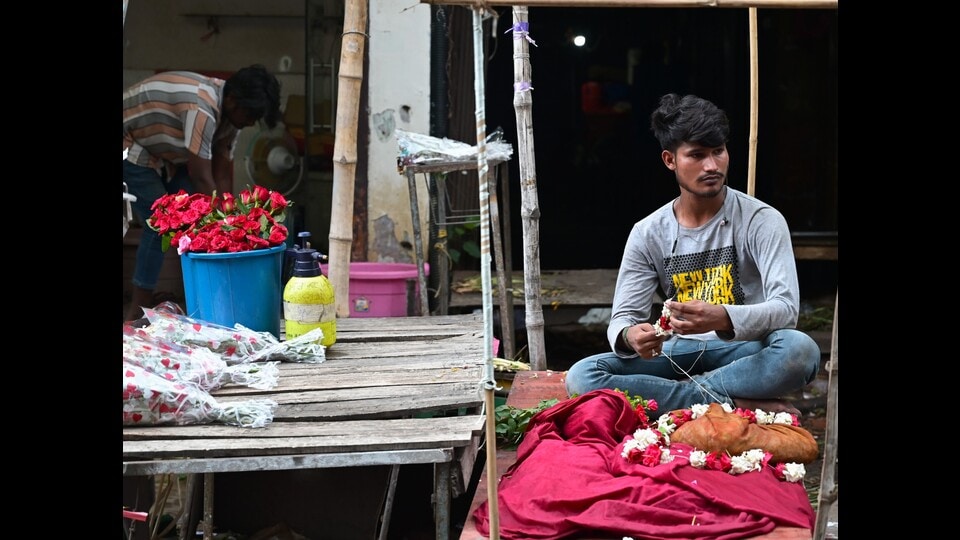
It is pertinent to mention here that the flowers from this mandi ( wholesale market) were transported to Ayodhya at the consecration ceremony of the Ram temple this year. The flowers being sold at most religious places in the state capital are sourced from this mandi, as per a local flower trader. The shift to Kisan Bazar in Gomti Nagar marks the end of a historic and fragrant era that has been an integral part of Lucknow’s cultural landscape for over two centuries, say traders.
For years, there have been discussions about relocating the phool mandi to Kisan Bazar, with proposals dating back to 2018. But the flower traders have managed to retain their place in Chowk, citing various reasons to delay the move. However, this time the Hussainabad Trust of the district administration has issued a final notice to nearly 100 flower traders, mandating their shift to Kisan Bazar or face legal action. District magistrate Suryapal Gangwar said , “The shifting will start after Moharram, as many flower traders requested us to stall it till Moharram was over.”
Reflecting on the impending move, a trader said , “It is not only the Nawabi era structures dotting the Old City that make the area a heritage nerve centre of UP. The traditional markets, cuisines, culture and many othet things have contributed to Lucknow’s history. The traditional flower market near Chowk is no exception.”
The exact origins of the flower market remain uncertain, but historians believe it dates back to the reign of Nawab Asaf-ud-Daula, beginning in 1775. Initially located in Phool Wali Gali in Chowk, the market has played a vital role in Lucknow’s history.
Historian Ravi Bhatt said, “Phool Wali Gali holds a lot of importance in Lucknow’s history. It came into existence with the Chowk market, which is one of the state’s oldest markets serving as a window to Lucknow’s rich cultural heritage.”
Bhat explained that initially, Phool Wali Gali was known exclusively for ‘gajras’ – garlands of jasmine flowers preferred by the royals. Over time, especially after the Nawabi era’s decline, florists began selling a variety of flowers. The market of Chowk was not only famous for flowers but also for authentic zari work, chikankari, handmade jewellery, handcrafted decor, items of wood, bamboo, and ivory, nagras (shoes), ittar (perfume), revri, khastas,katchauris, makkhan, nahari, kebabs and other items.
Over the years, the number of florists in Phool Wali Gali increased manifold, causing congestion. Therefore, the administration directed the flower shops to shift to Kanchan Market in Chowk in 2000. The market’s proximity to Phool Wali Gali meant the move did not significantly impact business.
However, the new directive from the district administration has faced strong opposition from the florists. The new plan involves relocating the market to Kisan Bazar in Gomti Nagar, a move that traders argue will severely impact their business. “Shifting the flower market to Gomti Nagar, which is around 18 kilometres away, is not a feasible idea. This will not only increase transportation costs but also create other problems for those engaged in flower trade,” a trader Nadeem said .
Flower traders like Hari Ram feel that the current location of the flower market is advantageous for flower farmers who generally come from Barabanki, Hardoi Road, Mal, Malihabad, Kakori, Gosainganj and Sultanpur Road to sell their flowers. Some florists argue that the administration’s assertion that relocating to a posh area like Gomti Nagar would fetch higher prices for flowers is flawed.
Lucknow’s traditional phool mandi deals in a variety of flowers, including sunflowers, gladiolus, roses and ‘rajnigandha,’ which are dispatched across the country. According to the florists, gladiolus flowers from this market are of superior quality compared to those available in Delhi or Mumbai, with a shelf life of around 8 to 10 days, whereas flowers from Delhi or Mumbai last for 4 to 5 days.
Despite the resistance from the traders, the district administration officials have confirmed that the shifting will start soon after Moharrum. District magistrate Suryapal Gangwar said , “The city’s flower market will be shifted to Kisan Bazar – a dedicated place for farmers that will benefit them in many ways. We will ensure that all the flower traders are shifted to Kisan Bazar after Moharrum.”
The relocation of the traditional flower market has sparked concerns among locals about the impact on the city’s cultural heritage. Sanjay Mishra ‘Shauq’, noted poet and resident of Khadra, an old-timer, lamented, “The shifting of the traditional flower market would also mean the shifting of city’s rich heritage. If a midway is found like modernisation of the place rather than relocation by improving the infrastructure, then it will help in preserving the frangrance of Chowk.”


