
 E-Paper



Tulsidas defied Akbar not with sword but through Ramleela, says Yogi Adityanath
Chitrakoot will be developed into hub of faith, safety and self-reliance, says Uttar Pradesh chief minister Yogi Adityanath

 Prefer HTon Google


Chief minister Yogi Adityanath on Thursday said that while many kingdoms bowed before the might of foreign powers, it was spiritual personalities like Tulsidas who chose the path of silent resistance during turbulent chapters in India’s history.
He also reaffirmed his government’s commitment to the cultural revival and economic uplift of Bundelkhand, asserting that Chitrakoot would be developed into a hub of faith, safety and self-reliance. He reiterated plans for expressways, riverfront development, and religious tourism circuits intended to link heritage with livelihood in the region.
The chief minister was addressing gatherings during Tulsi Jayanti celebrations and the Tulsi Sahitya Sammelan in Chitrakoot.
“Several kingdoms surrendered before him (Akbar), but there were those who, without pausing or yielding, kept illuminating the world through bhakti. Tulsidas stood among them,” he said.
“Who does not know that Akbar maintained a soft face for the public, but behind it lay cruelty. That same face of oppression can still be seen today,” Adityanath said.
“Yet even in those times, our saints challenged tyranny—not with swords, but by bringing Ramleela into every household. That was Tulsidas’s way of resistance.”
“While Akbar’s court lured poets and scholars into its fold, Rambola, later known as Tulsidas, refused to serve any king. He dedicated his life solely to Lord Ram,” the chief minister said.
He stressed that the Ramcharitmanas, authored by Tulsidas, was not merely a spiritual epic but a civilisational document that reinforced India’s cultural and moral compass during a period of political instability and external rule.
Recalling his visit to Mauritius in 2017, Yogi Adityanath spoke about the spiritual resilience of the Indian diaspora during colonial rule.
“When our ancestors were taken abroad as indentured labourers, they carried with them no wealth or status—only the verses of the Ramcharitmanas. It was their source of solace and cultural survival,” he said.
“Today, their descendants lead nations, yet the Manas has remained central to their lives.”
Chitrakoot, the site of the Tulsi Jayanti celebrations, holds particular significance as the place where Lord Ram is believed to have spent a major portion of his exile.
“This land was once home to sages and seers. It nourished the roots of the Ramayan and the Ramcharitmanas,” Adityanath said.
He lauded the contributions of Jagadguru Rambhadracharya and Ramkatha exponent Murari Bapu, both present at the event, for their continued efforts to keep Tulsidas’s legacy alive.
The chief minister conferred the Tulsi Award and Ratnavali Award on the Ramkatha narrators. “This recognition is not just ceremonial, it’s a salute to those who uphold the values of Sanatan Dharma,” he said.
He also criticised those who seek to manufacture controversy around spiritual leaders.
“Those who live in the shadow of their own irrelevance attempt to defame what they cannot comprehend. We must not let such distractions divide us,” he said.
He urged all sections of the society to remain united in protecting India’s civilisational heritage.
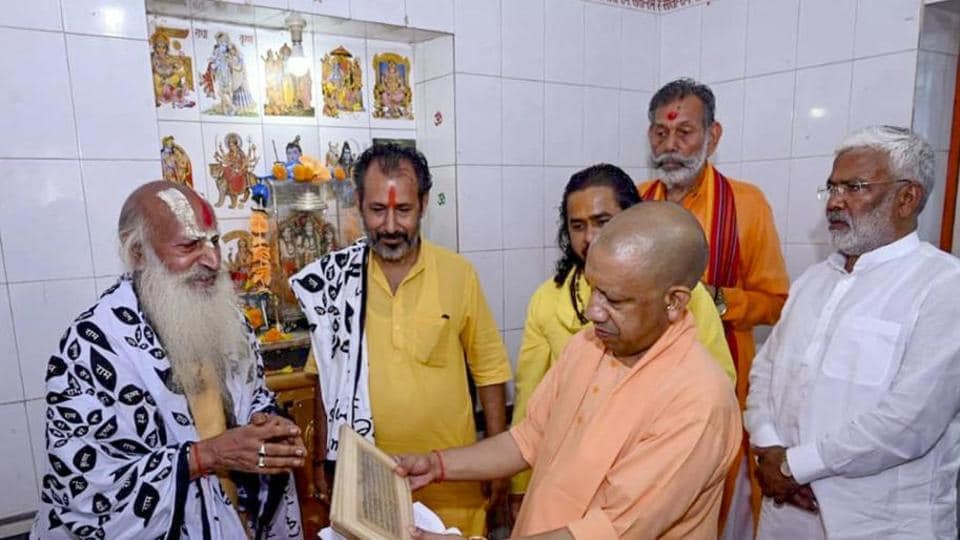
He also visited Rajapur, birthplace of Goswami Tulsidas, paid his respects at Tulsi Janmkutir and viewed the original handwritten manuscript of the Ramcharitmanas, preserved at the Manas temple.
Adityanath also unveiled a statue of Tulsidas at the Krishi Vigyan Kendra in Ganiwan, participated in plantation drives and held interactions with children at a local ashram school. He also toured agriculture exhibitions.


