
 E-Paper



UP govt implements SOPs to prevent mishaps: Action within 24 hrs if open manholes found
A dedicated complaint redressal system/helpline number will be established by the local body to receive public complaints regarding open manholes, and efforts will be made to widely publicise it


LUCKNOW The state government has implemented extensive standard operating procedures (SOPs) to prevent accidents caused by open manholes and ducts and asked local bodies to enforce stringent measures to safeguard public safety.
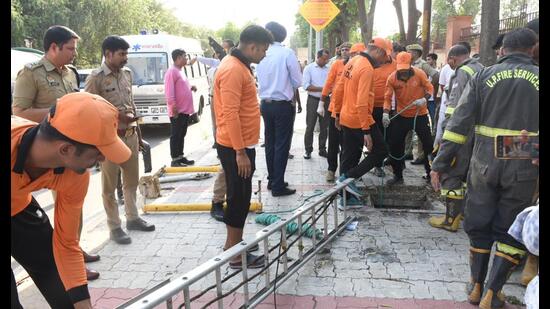
Additionally, district magistrates have been instructed to form technical committees at the local body level and promptly cover open manholes/ducts. The Directorate of Local Bodies has issued this SOPs to all DMs in the state, emphasizing the urgency of implementation.
On April 23, an eight-year-old boy died after falling into an open manhole, a few hundred metres from his house near the Abdul Kalam Technical University in Sector 7 of Jankipuram area of Lucknow. The tragic incident took place when the child slipped into the manhole while walking towards a ‘bhandara’ in the area along with his two sisters.
The government expressed concern and directed the implementation of stringent measures to address the issue effectively.
WEEKLY INSPECTION
According to the SOPs, technical committees will be formed to promptly address complaints regarding open manholes and ducts. At the municipal corporation level, each zone will have a committee chaired by the zonal officer, appointed by the municipal commissioner. The committee will comprise assistant engineer/junior engineer (Jalkal) as member-secretary and zonal secretary officer as member, said director of Local Bodies Directorate, Nitin Bansal.
At the nagar palika parishad/nagar panchayat level, a technical committee will be set up by the DM. It will be chaired by the local body in-charge, with the executive officer serving as the member secretary along with assistant engineer/junior engineer as members.
These committees will conduct weekly inspections of the sewer system. If open manholes or ducts are discovered during these inspections, immediate action will be taken to cover them within 24 hours. Until the manholes are secured by the technical committee, personnel equipped with red flags will be deployed to prevent any mishap.
PEOPLE CAN COMPLAIN ABOUT OPEN MANHOLES
Nitin Bansal mentioned that a dedicated complaint redressal system/helpline number will be established by the local body to receive public complaints regarding open manholes, and efforts will be made to widely publicise it.
He highlighted that the Government of India’s helpline number for such issues is 14420, and the government’s helpline number is 1533. Calls to these numbers will be directed to the respective local districts, where complaints can be registered. Additionally, the technical committee will coordinate with local corporators to gather information about open manholes within their wards.
The committee will aim to resolve complaints about open manholes received from cleaning staff, supervisors, public, council members, and other sources within 24 hours. Following resolution, if any accidents occur due to open manholes, disciplinary action will be taken against the committee responsible.
SALIENT FEATURES
To prevent accidents during regular cleaning or maintenance of open or damaged manholes, strict adherence to these points will be enforced:
*Manhole covers undergo corrosion from traffic on the upper surface and gases from sewer emissions below. It’s essential to periodically open the covers, assess their physical condition, and replace them as per requriement.
*During manhole construction, it’s crucial to install footsteps according to standards. These steps facilitate rescue operations in case of accidents involving individuals falling into manholes.
*For sewer lines exceeding 600 mm in diameter, it is recommended to use meshed (perforated) manhole covers. This allows gases produced in the manholes to vent out continuously, preventing erosion of the cover surface due to gas accumulation.
*Sewer cleaning should be done at a time when the amount of sewer in the sewer line is minimum.
*Prior to commencing sewer cleaning, the work area must be fully barricaded. A prominently displayed board stating “Sewer work in progress” should be installed to deter public curiosity and ensure safety.
*Manholes should be covered within 12 hours after sewer cleaning. Enough manhole covers should be stocked for this purpose. If manhole covers are unavailable, dummy covers made from welded BRC fabric or wire netting can be used as a temporary measure.
*To enhance vehicle safety, bushes, information boards, lights, and light reflectors should be utilized, particularly during nighttime operations.
*During sewer cleaning activities, the use of equipment that generates smoke or sparks within or near open manholes should be strictly prohibited to prevent potential hazards.
*Mapping of the sewage system should be done so that the complaint area can be identified, and the work can be completed as quickly as possible to resolve the complaints of open manholes and ducts.


