
 E-Paper



Vision 2051: LDA plans surface water grid in Uttar Pradesh State Capital Region to check groundwater dip
Pipelines will connect Lucknow, Barabanki, Unnao, Hardoi, Sitapur and Rae Bareli under ‘Flagship Project–2: UP-SCR Surface Water Grid’, source supply from the Ghaghra and Ganga


Amid concerns over future water availability due to a steep fall in groundwater level, the Lucknow Development Authority (LDA) has devised a 25-year plan for a shift to a surface water-dominated grid to strengthen drinking water supply across the state capital and adjoining districts in the State Capital Region by sourcing water from the Ghaghra river in Barabanki and the Ganga in Unnao, officials said.
Groundwater extraction currently meets nearly 80% of the demand.
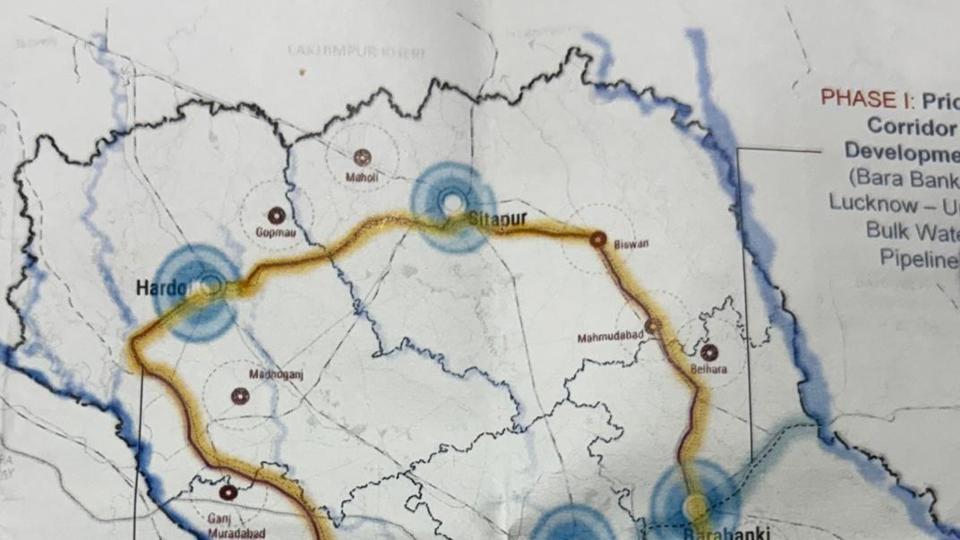
Pipelines will connect six districts – Lucknow, Barabanki, Unnao, Hardoi, Sitapur and Rae Bareli – under “Flagship Project–2: UP-SCR Surface Water Grid” to meet the region’s future water demand with a long-term vision up to the year 2051, a senior LDA official said, sharing the proposal with Hindustan Times on Wednesday.
The LDA plan targets ensuring reliable and equitable water distribution across the Uttar Pradesh State Capital Region (UP-SCR).
Authorities believe this transition to a surface water-based system will help restore depleting groundwater levels while ensuring assured bulk water availability for domestic, institutional, and industrial use.
LDA has divided the project into two major execution phases.
Phase 1 Priority Corridor (Barabanki–Lucknow–Unnao bulk water pipeline):
Under this phase, the authority plans to establish a bulk water transmission corridor connecting Barabanki, Lucknow, and Unnao. Officials have proposed constructing intake structures, water treatment plants (WTPs), and large-diameter bulk pipelines. The corridor will serve as the main transmission backbone for supplying treated surface water to major urban clusters.
Earlier, the state ground water department reported sharp groundwater depletion across Lucknow between pre-monsoon 2013 and 2023. Deendayal Nagar recorded the steepest fall of 20.30 metres, followed by Para and Mahanagar. Several other localities, including Chowk and Faizullahganj, also witnessed alarming declines, raising concerns over future water availability.
Phase 2 – Regional Circular Grid (Integration with Proposed Rajya Rajdhani Mala):
In the second phase, LDA plans to develop a regional circular grid that will interconnect key districts, including Hardoi, Sitapur, Raebareli, Unnao, Barabanki, and Lucknow. This circular grid will allow flexible water movement across districts, ensure hydraulic balancing, and enable equitable water distribution across the region.
Authorities have also planned to integrate existing water treatment capacities within the UP-SCR framework to maximise infrastructure utilisation.
Officials projected a significant increase in water demand by 2051 due to rapid urbanisation and infrastructure growth in Lucknow and surrounding districts. The proposed grid aims to cater to nearly 80% of the total projected demand through surface water sources. By creating an interconnected bulk water system, LDA intends to provide reliable supply even during peak demand periods.
The authority assessed land requirements for intake structures, WTPs, reservoirs, and pumping stations. LDA plans to implement the project in phases over an estimated period of five to ten years, depending on approvals and funding.
Preliminary estimates indicate that the project will involve an investment of several thousand crore rupees. Furthermore, LDA plans to coordinate with state government agencies and technical departments for funding support, approvals, and execution.
Through this flagship initiative, LDA aims to secure long-term water sustainability for Lucknow and the larger UP-SCR region while building a resilient and integrated water supply network for future generations.
Water works department (Jalkal) general manager Kuldeep Singh revealed that the underground water strata has decreased with time. He said, “Now, we are able to extract water after boring till 220 feet.”
THE PROPOSAL: NEW STRUCTURES ON CARDS
Construction of new intake structures at river sources.
Establishment of multiple Water Treatment Plants.
Installation of bulk transmission mains and pumping stations.
Development of storage reservoirs and balancing tanks.
Implementation of a SCADA-based monitoring and control system for efficient management.


