
 E-Paper



A 700-kilometre trek easier than seeing families starve, say migrants leaving Mohali
Digital illiteracy, lack of documents, not wishing to wait for too long for train tickets are some reasons why migrants workers leaving the district are not relying on the government-approved processes to reach their home states


The migrants from the district, some with small children, are moving in hordes towards the railway stations and highways, not to catch a train or a bus, but to walk or cycle along the rails and roads hoping to reach home soon.
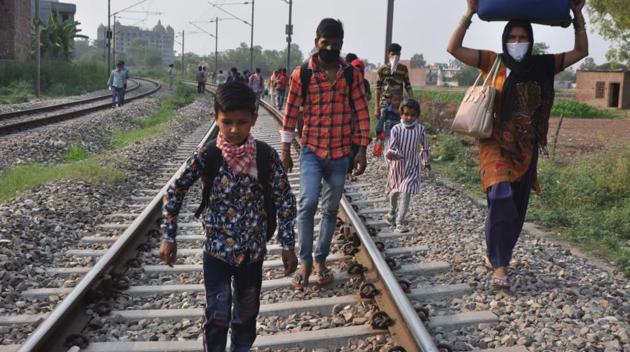
Yes, they are aware of the special trains, but most of them do not have valid documents to apply for a ticket. Even for those with documents, digital illiteracy and long wait are deterrents that they are not ready to tackle; walking or cycling seems an easier bet.
Two trains carrying 2,582 migrant workers left for Uttar Pradesh on Saturday from the Mohali railway station. The morning train left for Hardoi with 1,341 passengers and the evening train carried 1,241 migrants to Gorakhpur. More than 20 students were sent to Jammu on a bus from Kharar on Saturday.
Alongside, a large number of migrants continued to walk or cycle their way home.
Pratap Bhushan, a migrant who used to work with a packing factory in Zirakpur, said he purchased a new cycle with his savings and started for Sitapur in Uttar Pradesh on Saturday. “There is no work, and whatever little I had, is being saved to reach back home safe. I don’t have an Aadhaar card, so getting registered for a train ticket was out of question,” added Pratap, who along with a bag full of belongings is carrying a pump in case the tyres get deflated. He left Zirakpur in a group of five persons, all of whom were staying together on rent and had purchased new cycles.
‘NO OTHER OPTION’
“There is no other option,” said Nand Lal, who along with his family of five left Zirakpur on Friday. “We are struggling to get two square meals, so how can we pay rent? Back in the village at least children will not have to sleep on empty stomachs,” he said.
“To get cooked food, we had to stand in a line for two hours. The food was not sufficient to feed all the members of the family,” Lal said, adding, he will rather walk more than 700 kilometres than see his family starve.
“There is no work and the landlords are asking for rent,” said Rashpal, a construction labourer, who is walking to Gorakhpur along with his 10 friends.
Another migrant, Bhushan Thakur, said “Walking on the track is easy and the police do not stop you. I will go back to farming the small landholding I have.”
ONLINE REGISTRATION NO GUARANTEE OF RAIL TICKET
“We came to Punjab 10 years ago in search of work, but now with no money, we want to go back,” said Radhey, a migrant who has been waiting for the last five days for tickets for his family to arrive, so they can board the train to Hardoi, just like the one that left Mohali railway station on Saturday.
Getting registered online does not guarantee tickets considering the limited number of seats and long lists of migrants waiting to get in. Radhey said, “Last time we could not get the ticket, so we decided we are not moving from here (the station). We are sleeping under the open sky, but what other option do we have.” He has two minor sons.
Shyam Lal and his family, with three children, have been outside the screening since Friday. “Despite having received a message, I was not allowed inside for screening. They say it is only for people staying in Dera Bassi or Zirakpur. Where do I go now,” asked Shyam Lal, who wants to go back to Bareilly. He was staying in Panchkula and reached Zirakpur after his relative informed him that a train was leaving from Mohali.
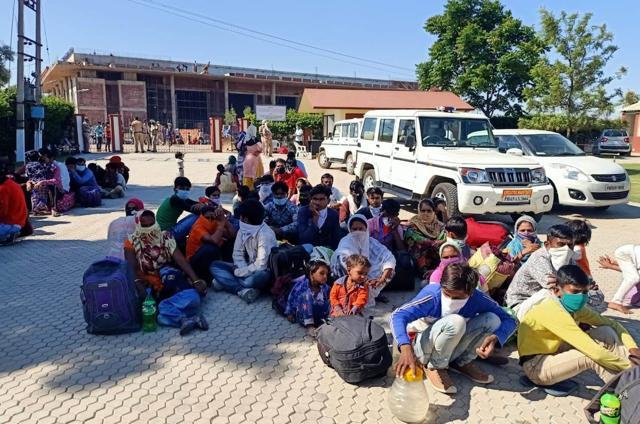
RUSH AT SCREENING CENTRES
“The migrants from colonies near Nada Sahib and slum areas near Sector 20 in Panchkula have been pouring into Mohali to board the trains. This is leading to a rush outside the screening centres,” said Kuldeep Bawa, sub-divisional magistrate (SDM) of Dera Bassi.
The migrant families have been allowed to sit outside the screening centres as many have handed over the keys of their rented accommodations back to the landlords, the SDM said. Some leave after a day or two while others continue to wait for the next screening, he added.


