
 E-Paper



20 years of teaching Mumbai the value of silence
Even before I started out, the central government had amended the stringent Noise Rules of 2000, which mandated that loudspeakers could not be used during night time (defined as 10 pm to 6 am), and permitted loudspeaker use for 15 days a year until midnight. In July 2005, the Supreme Court passed a landmark order upholding the original Noise Rules but on an application from the government, overturned its own order in October

 Prefer HTon Google


By 2023, it was all too familiar… the crush of people and loudspeakers, the deafening noise and the blinding lights while I recorded noise levels at Ganpati visarjan on September 29 and at the Eid-e-Milad celebrations the next day. The needle on my orange-and-grey noise meter soared with the corresponding din.
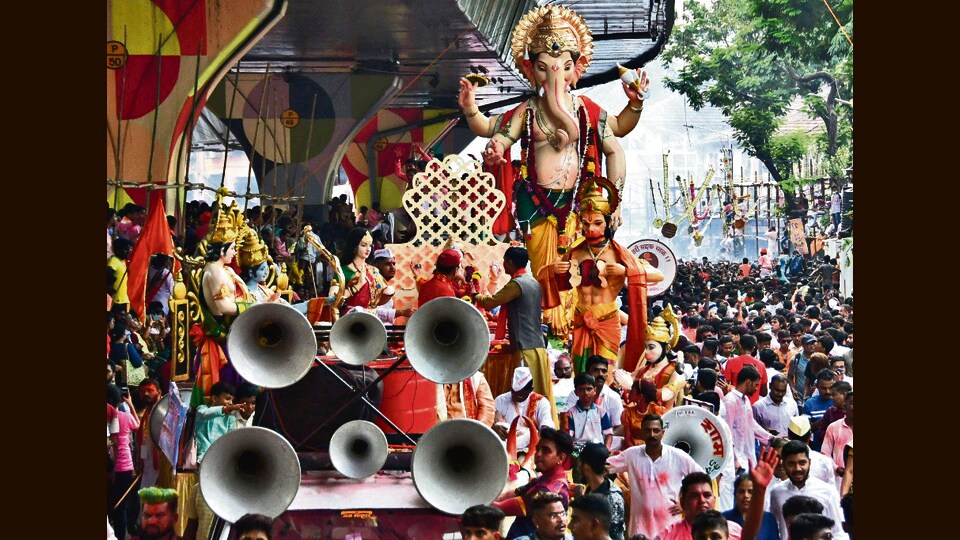
This was my twentieth year of recording noise pollution during Mumbai’s festival season. Back in 2003, my readings were the only data available—based on them and in the absence of any official data, the Bombay high court passed its first order, directing that no loudspeakers could be used in silence zones. The order was followed by effective police action and resulted in a significant reduction of loudspeaker use in the remainder of the festival season.
The outreach generated by press reports resulted in many complaints coming in from beleaguered citizens. Although it was physically impossible to go to all areas, I did my best and redirected those I couldn’t reach to the police. The police then set up effective systems—which are still continuing—to tackle citizens’ complaints.
But even before the euphoria of my initial success faded, I realised that the implementation of court orders would not be uniform. Although the police were more or less effective in controlling noise from private events, violations continued, predictably from functions hosted by politicians, socialites, Bollywood stars and the police themselves.
There were other pitfalls. Even before I started out, the central government had amended the stringent Noise Rules of 2000, which mandated that loudspeakers could not be used during night time (defined as 10 pm to 6 am), and permitted loudspeaker use for 15 days a year until midnight. In July 2005, the Supreme Court passed a landmark order upholding the original Noise Rules but on an application from the government, overturned its own order in October.
Meanwhile, I continued to receive complaints from people, and in the absence of official action, somehow, monitoring became my responsibility. But official agencies were gradually coming into the picture. The Maharashtra Pollution Control Board began recording noise levels on the personal initiative of member-secretary Dilip Boralkar and provided the official data and informed policy and implementation since then. Following further orders of the Bombay high court, the police too acquired decibel meters and started recording noise levels.
However, while time limits were enforced, decibel limits were not. It also became clear that the police would not take action against noise from religious places even though the rules and court orders are uniformly applicable to all.
In 2010, when the then environment minister Jairam Ramesh was apprised of the problems with the implementation of the Noise Rules, he amended these to make them more stringent. In the absence of implementation, I continued to receive complaints from people who would sometimes cry on the phone, lament that their pets wouldn’t eat and that elderly people were suffering. One man even threatened to die by suicide as a festive procession neared his house.
Hearteningly, some complainants now began to file independent PILs like paediatrician Mahesh Bedekar, who went to court to protect the patients of his nursing home in Thane. Justice Abhay Oka tagged his petition along with Awaaz Foundation’s allied petitions and passed numerous stringent orders. However, instead of complying with these, the government abolished silence zones all over the country, an act which dragged the anti-noise campaign back by 15 years.
But even as politicians resisted, awareness continued to increase. Even before the 2020 lockdown was imposed, Ganpati mandals said they would not use DJs and would comply with the Noise Rules. Muslim community leaders urged their followers to abstain from using loudspeakers or playing music during Eid-e-Milad. The Jama Masjid in Mumbai even asked its followers to conduct azaans on mobile phone apps and not to use loudspeakers.
After 2022, which was one of the noisiest festival seasons, coming as it did after a prolonged lockdown, peak noise levels decreased once again this year. Very few DJs were visible. Some of the highest decibel levels recorded were by politicians making speeches and playing music after the midnight deadline but revellers themselves seem to have much greater awareness of the need to safeguard the environment.
Although much has changed in the past two decades, the challenge to control noise pollution continues. Twenty years after I took the first measurements of decibel levels, implementation of the anti-noise campaign is still blowing in the wind of political whim.
(The author is the convener of Awaaz Foundation.


