
 E-Paper



200 YEARS OF URDU JOURNALISM
Jam e Jahnuma too, faced many closures. In fact, recounted Sarfaraz Arzoo, editor of western India’s oldest newspaper, the Hindustan Urdu Daily, and convenor of the programme, Urdu journalism was part of the struggle against the British, with fines as high as ₹50,000 imposed on publishers


Mumbai The foundation of Urdu journalism was laid by two Hindus: Harihar Dutta and Sadasukh Lal, publisher and editor respectively of the country’s first Urdu newspaper, Jam e Jahan Numa, brought out from Kolkata in March 1822. On Saturday, journalists from across Maharashtra gathered at the Haj House to celebrate 200 years of Urdu journalism.
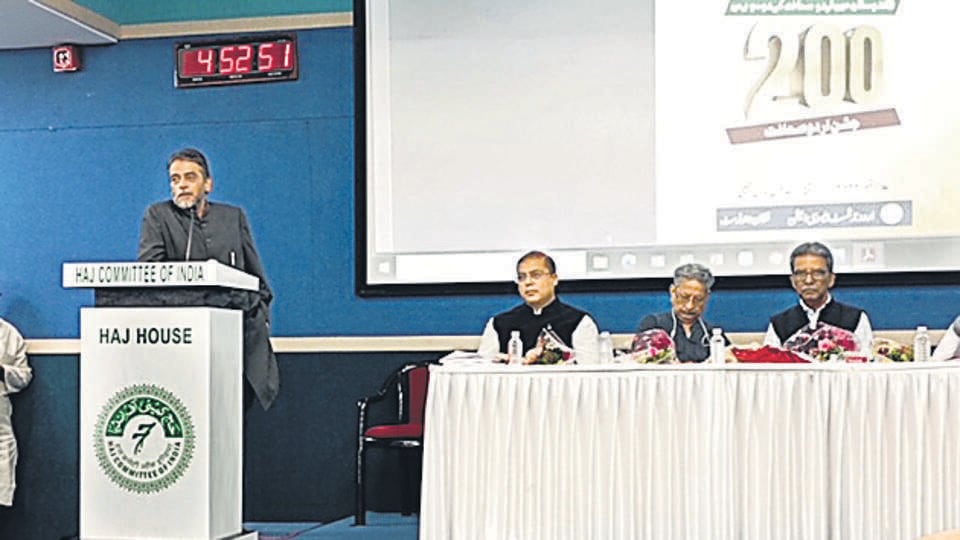
“Our past is glorious, our present dim and our future bright,” said veteran columnist and former editor of Urdu Blitz Hasan Kamal. The “glorious past” could be traced back to 1857, when Maulvi Muhammad Baqar became the first journalist to be killed by the British. He was editor of Delhi’s first Urdu newspaper, the Delhi Urdu Akhbar, which reported on the first war of Independence.
Jam e Jahan numa too, faced many closures. In fact, recounted Sarfaraz Arzu, editor of western India’s oldest newspaper, the Hindustan Urdu Daily, and convenor of the programme, Urdu journalism was part of the struggle against the British, with fines as high as ₹50,000 imposed on publishers. One Urdu newspaper from Benares saw 11 of its editors arrested and sent to “kalapani” or the Cellular Jail in the Andamans. Its advertisement for new editors cited one qualification: a readiness to be deported to kalapani.
Before Independence, pointed out Arzu, Urdu was the chosen language of the Arya Samaj, of the Bengal Renaissance writers and also had Sikh devotional verses written in it.
Further proof of Urdu journalism’s role in the freedom struggle as well as its composite legacy was cited by other speakers. Senior Gujarati journalist and Indo-Pak peace activist Jatin Desai recalled that Lala Lajpat Rai had brought out his nationalist newspaper Vande Mataram in Urdu, Bhagat Singh wrote in Urdu, and famous anti-emergency journalist and editor Kuldip Nayar started his journalistic career in an Urdu paper. Head of the West Bengal Urdu Academy Nadimul Haque added to this list by citing a couplet in Urdu written by Hindutva icon Veer Savarkar.
Urdu journalism’s “dim” present was ascribed by Hasan Kamal to the weak financial position of stand-alone Urdu newspapers which had neither a corporate nor a big media house backing them. Few proprietors could afford the minimum annual investment of ₹one crore needed to bring out a professional newspaper. Two years of the pandemic had made matters worse.
Urdu journalism’s “bright future” lay in going digital and audio-visual, said Kamal. The number of those who could understand Urdu was way more than those who could read it, he pointed out, and these Urdu lovers were spread across the globe, and belonged to all faiths. The investment needed to set up an Urdu news portal which would have all the features of a newspaper was affordable, he said.
According to Sarfaraz Arzoo, the future of Urdu journalism lay in going “hybrid” - newspapers needed to have both print and digital editions.
Shahid Latif, the editor of Mumbai’s largest Urdu daily, Inquilab, struck a different note altogether. Muslims needed to acknowledge that Urdu would never be a means of earning a living, he said; and new generations would have to study in English. “If Urdu journalism has to be kept alive for another 200 years, Urdu as a language must survive,’’ he said. But he was not pessimistic. “It’s up to us to preserve the language by making it a point to speak Urdu at home, and avoid the temptation of using English words for commonplace objects.’’ But even if Urdu-speaking Muslims failed in their duty, he was confident Urdu would survive. “After all, no Urdu-speaking Muslim set up Rekhta,’’ he pointed out.
Rekhta is a web portal dedicated to the promotion of Urdu literature, which claims to have the world’s largest collection of Urdu poetry. It was founded by Sanjiv Saraf in 2013.
Nadeemul Haque advised Muslims to learn from the Hindus who kept their language and culture alive under Muslim rule. “The great artistes: Birbal, Tansen, the learned Brahman scholars who were part of the Mughal court and administration, had to know Persian, which was then the official language. But at home, they kept their own language alive.’’


