E-Paper



Fear of flooding in Navi Mumbai as civic body awaits permission to desilt ponds
The NMMC has encountered challenges in obtaining permissions from the Maharashtra Coastal Zone Management Authority for cleaning activities

 Prefer HTon Google


Navi Mumbai: With nearly a month to go for the monsoon season, the Navi Mumbai Municipal Corporation (NMMC) is grappling with the challenging situation of a possible flooding of several areas as its efforts to clear as many as 11 holding ponds remain in limbo due to legal complexities surrounding mangrove conservation. These holding ponds were constructed by CIDCO as a buffer between the stormwater drain and the creek. The pond holds the storm water during rains and it is released after the high tide recedes, preventing flooding of the area. However, over the years, these ponds have been accumulating silt resulting in the growth of mangroves which will result in flooding during the monsoons.
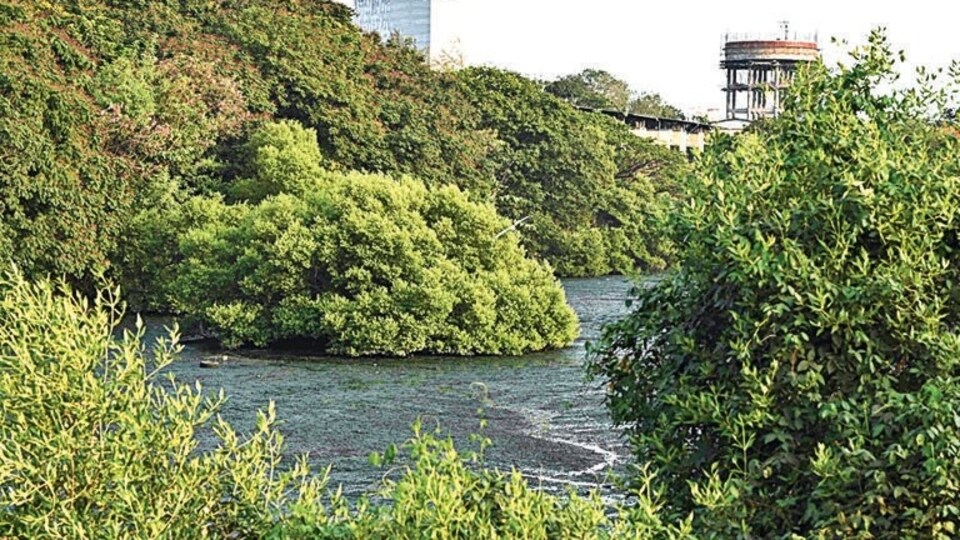
The NMMC, in its bid to avert flooding, has encountered challenges in obtaining permissions from the Maharashtra Coastal Zone Management Authority (MCZMA) for cleaning activities. The Mangrove Conservation Act, enforced since 2005, prohibits activities in mangrove areas, hindering the cleaning of 11 holding ponds.
Taking into account that the region is located below sea level, CIDCO, while developing Navi Mumbai in the 1970s, constructed 11 holding ponds in every node it planned. The presence of holding ponds, based on Dutch technology, ensures the water naturally flows into the holding ponds during high tides in the creek that runs along the city, thereby not ending up in the residential areas.
“We have prepared a proposal to remove the silt from the holding ponds to increase their water holding capacity. We are following up with MCZMA for permission. The holding ponds are a much-needed protective shield for the city,” said Kailas Shinde, municipal commissioner. “There have been instances of flooding in 2020 when there were heavy rains coupled with high tides. The threat remains.”
Former corporator Dr Jayaji Nath, who had approached HC in 2020 seeking the shifting of mangroves. said, “We have explained to the court that these are man-made ponds where mangroves have come up later. The mangroves at the under-construction Navi Mumbai airport area have been shifted though they were in natural areas. The same shift can be done here too.”
Adding, “The court then allowed removal of silt from the ponds in areas where there are no mangroves. This has allowed partial cleaning of the ponds, but a permanent solution is needed urgently.”
As part of the premonsoon work, NMMC has installed pumps at the ponds to remove silt as well as flap gates to remove impediments in the flow of water. At Belapur pond, two boats were deployed to remove the silt.
Sanjay Desai, city engineer, NMMC said IIT-Bombay and Salim Ali Centre for Ornithology and Natural History (SACON) have undertaken studies as directed by MCZMA. “The SACON interim report is out, while the IIT report is expected after June end and will be submitted accordingly. We are hopeful of getting the requisite permission thereafter,” he said.
Goldin Quadros, principal scientist at SACON, said there were no mangroves when holding ponds were constructed in the 70s. “For 20 years, the ponds have not been managed in terms of mangroves. The water would come in bringing the seeds and they grew, reducing the holding capacity of the ponds. That creates a problem when the floods come. There was never any flooding in the city prior to 2012-13,” said Quadros. “Protection of mangroves is important, but human life also needs to be considered. The need is for a balanced sustainable solution through a proper management strategy, ensuring the laws are followed.”