
 E-Paper



Khopta bridge reopens after a year, restores vital link to Uran port and industrial belt
The 240-metre-long bridge, which underwent a ₹10-crore structural restoration, is now open to light vehicles and commercial vehicles weighing up to 16 tonnes

 Prefer HTon Google


NAVI MUMBAI: The old Khopta bridge in Uran has reopened for traffic after remaining shut for nearly a year, restoring a crucial road link serving the Jawaharlal Nehru Port Authority, Dronagiri Industrial Area and surrounding container yards. The reopening is expected to ease congestion on the adjoining bridge, which has been handling the diverted traffic since the old structure was closed in November 2025.
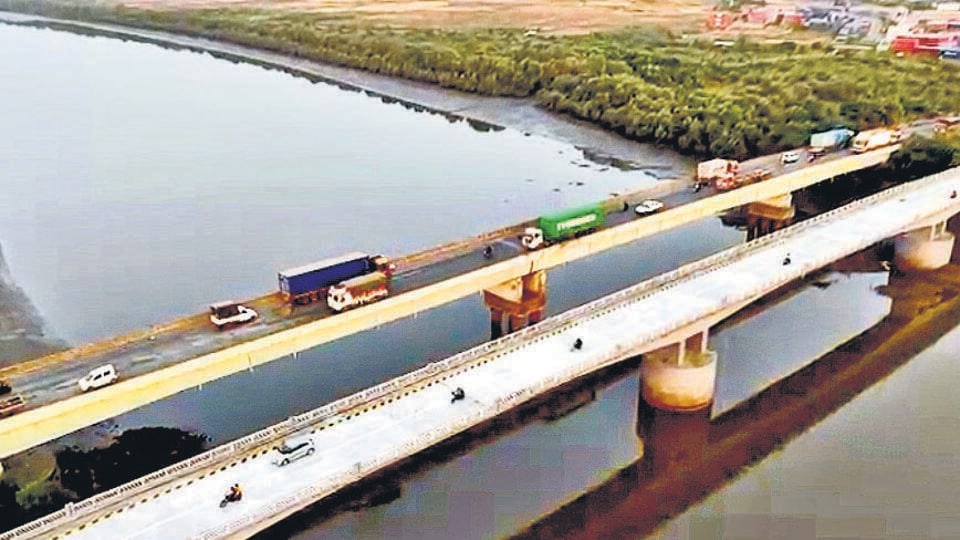
The 240-metre-long bridge, which underwent a ₹10-crore structural restoration, is now open to light vehicles and commercial vehicles weighing up to 16 tonnes. Its reopening also improves connectivity for commuters and residents of 25 villages in Uran’s eastern belt.
Constructed in 1990 during the tenure of then chief minister A R Antulay, the 7.5-metre-wide bridge was originally designed for light vehicles and local passengers. However, the expansion of port and industrial activities over the years brought increasing commercial traffic onto the structure. The resulting stress led to structural deterioration, with inspections revealing cracks in internal portions and damage to bearings, eventually prompting its closure in November 2025.
The closure forced additional traffic onto the adjoining bridge, increasing congestion for residents, industrial workers and transporters. The restoration is therefore significant for Uran’s port-led logistics network, where container movement and industrial activity have steadily increased.
The public works department (PWD) began restoration in December 2025 with an initial administrative approval of ₹5 crore and technical approval of ₹4.60 crore. The work was initially expected to be completed within three months. However, engineers found that the internal portions required more extensive intervention than anticipated, leading to an additional ₹5 crore being made available and taking the overall funding to ₹10 crore.
The technically challenging work involved strengthening all five spans, replacing four central hinge bearings and eight roller rocker bearings, installing new expansion joints and reconstructing the deck slab. Since the original bearings were no longer commercially available, replacements had to be specially manufactured.
Engineers also created separate access arrangements to reach the underside of the bridge, as the original structure lacked adequate access provisions between its spans. Damaged portions were treated through groove cutting and epoxy grouting, while carbon laminates and fibre wrapping were used to reinforce the structure. New railings were also installed.
A major feature of the restoration was the use of Ultra High-Performance Fibre-Reinforced Concrete, an advanced concrete technology based on Malaysian methods. The specialised material, containing higher proportions of cement and fibre, has reportedly been used at only a handful of locations in the country, including Mumbra and Pune. The deck slab was constructed using M-80 grade concrete, with approximately 268 metres of concreting undertaken as part of the restoration.
Maintaining the required temperature during concreting was a particular challenge. The work was carried out at night, with ice used to control the temperature and ensure that the concrete achieved the required strength.
“The bridge restoration has been completed using modern technology. It has been opened for light vehicles and vehicles weighing up to 16 tonnes,” said Damodar Patil, deputy engineer, PWD, Uran. PWD officials expect the strengthening work to extend the bridge’s structural life by at least 15 years.
The restoration has also highlighted the larger infrastructure challenge facing Uran. According to PWD officials, the existing bridge infrastructure handles around 7,500 vehicles daily, with traffic projected to exceed 15,000 as port-related and industrial activities expand. The department has consequently highlighted the need for a new six-lane cable-stayed bridge, on the lines of the Bandra-Worli Sea Link, to accommodate future traffic.
Stay updated with all the Breaking News and Latest News from Mumbai. Click here for comprehensive coverage of top Cities including Bengaluru, Delhi, Hyderabad, and more across India along with Stay informed on the latest happenings in World News.


