
 E-Paper



Inside the Maharaja’s treasure chest
The unique ashtray sits alongside 11th century sculptures and paintings by celebrated artists such as Anjolie Ela Menon, SH Raza, MF Husain, VS Gaitonde, Shiavax Chavda, B Prabha, KH Ara, GR Santosh and Mario Miranda housed across the four floors of NGMA

 Prefer HTon Google


MUMBAI: A prized possession sits right at the centre of the dome at the National Gallery of Modern Art, which is currently home to the exhibition, Maharaja’s Treasure: Select Works of Art from the Famed Air India Collection.
Safely whisked away in a glass box, an unglazed porcelain ashtray, designed in the 1960s by the master Spanish surrealist Salvador Dali is based on a work that the artist had produced in 1937, called Swans Reflecting Elephants. In his own words: “The reflection of the elephant appears to be a swan and the reflection of the swan appears to be an elephant. That is what I have done for the ashtray. Thus, the swan upside down becomes an elephant’s head inverted and the elephant inverted becomes a swan.”
Dali created the limited-edition ashtray for Air India’s select clientele, in return for a handsome sum and a baby elephant. It reflects the vision, enthusiasm and openness with which the airline collected and commissioned art.
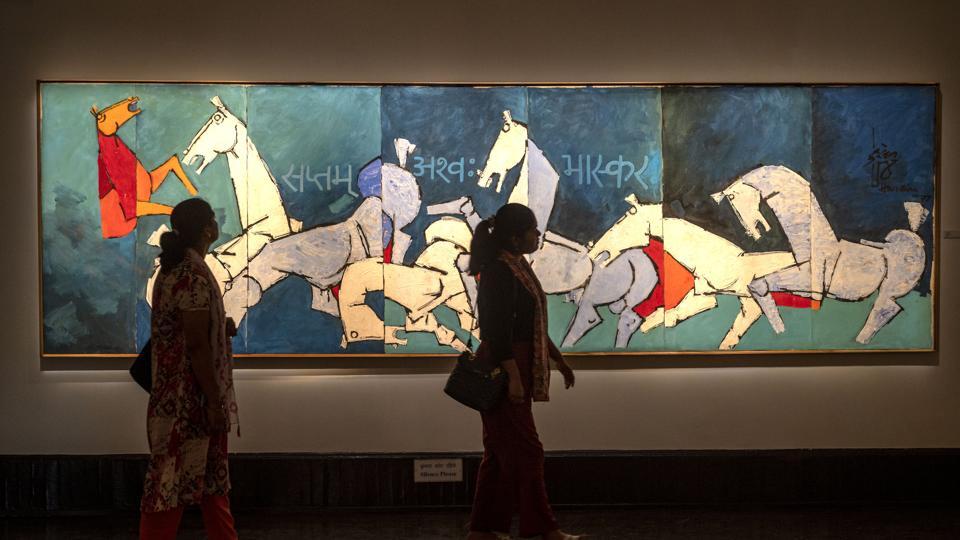
The unique ashtray sits alongside 11th century sculptures and paintings by celebrated artists such as Anjolie Ela Menon, SH Raza, MF Husain, VS Gaitonde, Shiavax Chavda, B Prabha, KH Ara, GR Santosh and Mario Miranda housed across the four floors of NGMA.
With nearly 190 objects on display, what strikes the viewer is the sheer breadth of the collection, which has a strong focus on craftsmanship. At the opening of the exhibition last Tuesday, the current NGMA director Nazneen Banu shared: “Air India played a crucial role in the promotion of art and culture at a critical juncture in the country’s history. We have tried to focus on the important pieces in the first exhibition, which has works of masters, and one section devoted to women and their contribution to society.”
AI, along with the Taj Mahal Palace and Tata Institute of Fundamental Research (TIFR), were the three strong corporate collectors through the 1950s and 1960s. In fact, in a previously-conducted interview, gallerist Mortimer Chatterjee, an art consultant with the Taj hotel, who also curated TIFR’s landmark exhibition of its paintings in 2010, recounted being shown an internal memo within TIFR from Dr Homi Bhabha’s art advisory committee informing him that AI was interested in the same sculpture by A Davierwalla. “The nature of the collecting pattern at that time was involving small groups of collectors,” he shared. “These collections remain the gold standard of corporate collecting at the outset of the post-Independence moment and, in the absence of institutional collecting, they became the de facto museum collections of their day.”
How did the Maharaja become an avid art collector?
Fuelled by AI founder JRD Tata’s philosophy that all their booking offices abroad should showcase the best of India, AI’s commercial department, under the aegis of its then director Bobby Kooka, began collecting art. The collection was spread over their Nariman Point building, at their foreign offices and residences of senior employees. Besides, all their booking offices were embellished with paintings from the 1940s until the 1990s, the decade when Air India stopped buying art. From B Prabha’s paintings to MF Husain’s cut-outs in Geneva to NS Bendre’s work in Brussels, the aim was to give travellers a slice of the Indian heritage.
At a panel discussion inspired by the AI exhibition at the NGMA last week, gallerist and auctioneer Dadiba Pundole, insisted, “It definitely takes a certain visionary to build a collection of this scale.”
In Jal Cowasji, AI found that visionary.
Cowasji, who worked under Kooka, was initially the man responsible for all the acquisitions. A regular at all the art openings, Cowasji was the man artists looked forward to having at their openings.
When veteran artist Gulam Mohammed Sheikh had his first solo show in 1961 at Jehangir Art Gallery, Cowasji bought one of his works. Husain too became a close friend of Cowasji. Husain would sit for hours in the office and take out unframed canvases from his bag, open it up and approach AI directors to buy them.
Uttara Parikh, Air India’s former deputy commercial director (advertising, special promotions, and product development), once recalled how a young JJ School of Art student, B Prabha, walked into Air India’s Jal Cowasji’s office with eight paintings that depicted various facets of Indian women. Impressed, Cowasji purchased each painting for ₹87.50. Those days, AI would have specially designed menus and a young Prabha’s first lot of works featured in them. Later, when the airline refurbished their famous London booking office on Bond Street, Prabha’s paintings embellished its walls.
AI also acquired works from other modernists such as S B Palsikar, Laxman Pai, V S Gaitonde and H A Gade. The second method of acquisition was called a transportation service contract, where tickets were bartered for artworks. Artist Jitish Kallat, who had his first international exhibition when he was 22, was one of the beneficiaries, for instance. The exhibition was called ‘Innenseite’ in Kassel, Germany, and had several well-known artists in it. To support his travel the curator took help from Air India. Kallat later gifted AI a painting as a gesture of appreciation. One of Kallat’s paintings features in the current exhibition, too.
Built over six decades, the collection now comprises nearly 8,000 pieces of art and artifacts including modern, contemporary, company school paintings, folk artworks, miniatures, sculptures, textiles, costumes of India, photographs, antique clocks, even silverware and crockery that were created by an English ceramic firm, Royal Doulton, which created a special range inspired by the calico designs on the interiors of the plane.
In March 1983, the collection was brought out – in most of its entirety— for the first time when the Non-Aligned Meet took place. A separate terminal was created at the Delhi airport, made for the 102 heads of state who attended the conference. Veteran designer Rajeev Sethi was brought on board by AI to execute the interior. He commissioned Husain to create six murals of doves and pigeons, and Anjolie Ela Menon, to work within a window frame. Several media reports maintain that some of those works have gone missing over the years. The airline has found itself marred in controversies pertaining to such claims.
Following the sale of Air India to the Tata Group in October 2021, the government, which retained the airline’s non-core assets, had created a Special Purpose Vehicle called the Air India Assets Holding Limited, to transfer the airline’s art collection to the Ministry of Culture. Earlier this year, the entire collection was handed over to NGMA through a Memorandum of Understanding signed between the Ministries of Civil Aviation and Culture. Its first exhibition, curated by the in-house team of NGMA with support from the ministries, has allowed the citizens a rare glimpse into AI’s iconic collection.


