E-Paper



Pagdi tenants worried as state govt fails to defend them in court
To address concerns surrounding the alleged reluctance of the state government to act, discussions were held with Rahul Narwekar on Tuesday

 Prefer HTon Google


MUMBAI: Lakhs of pagdi tenants are concerned about their tenancy rights due to the state government’s inaction in a crucial case against the Property Owners’ Association, set to be heard by a nine-judge constitutional bench of the Supreme Court in mid-April. With the government’s failure to intervene, there is a looming threat of the Maharashtra Rent Control Act being nullified, potentially allowing landlords to impose market rates or evict pagdi tenants.
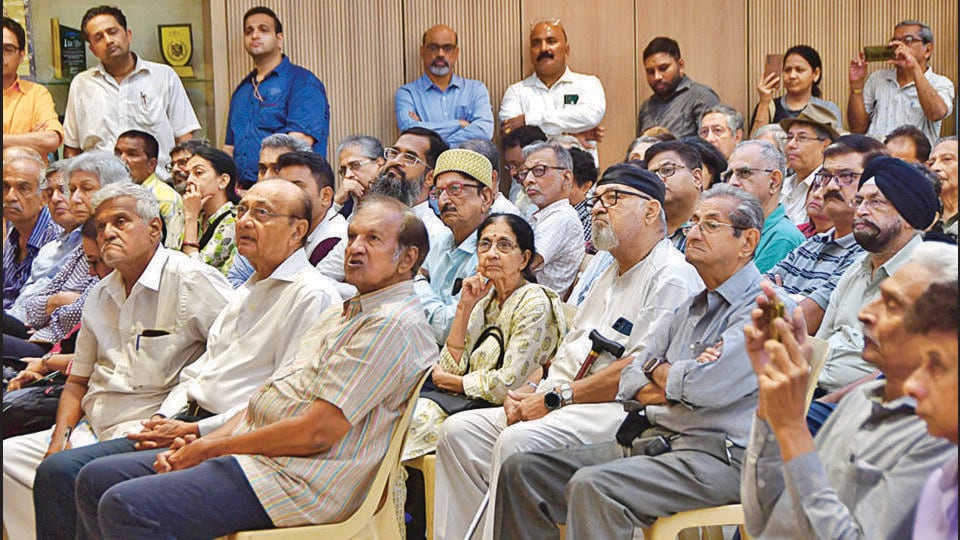
To address concerns surrounding the alleged reluctance of the state government to act and its potential ramifications for pagdi tenants statewide, discussions were held with Rahul Narwekar, speaker of the Maharashtra vidhan sabha, on Tuesday by the Pugree Tenants’ Action Committee (PTAC). “Their immediate concern was about the litigation pending in the SC, to which the state government is a party,” said Narwekar. “We assured them that we would get the government to vehemently defend this litigation and ensure that the Rent Control Act is upheld.”
Disregarding the historical context of pagdi payments made at prevailing market rates by original tenants, landlords are invoking their constitutional right to property to contest the state government’s authority in rent regulation under the Maharashtra Rent Control Act. They have also challenged the 1986 MHADA law permitting the acquisition of pre-1940 cessed buildings by compensating landlords with a lump sum equivalent to 100 months’ rent.
Despite the urgency of the matter, the Maharashtra government is yet to file its submissions in the case, the deadline for which was December 4, 2023. Since the SC’s decision on October 20, 2023 to establish a nine-judge bench, efforts have been made to persuade the government to defend its own legislative measures regarding cessed buildings and the Maharashtra Rent Control Act.
“As the state is the main respondent, we request it to take steps to impress upon the apex court that the legislation is within the framework of the Constitution,” said advocate Prerak Choudhary, who is representing PTAC. “There are over 30 lakh people affected by the Rent Control legislation, most of whom have paid pagdi. The landlords are not justified in denying the factum of pagdi. We are confident that the state government will do its bit. Any adverse development would create housing havoc in the state.”
Vidula Warawdekar, a pagdi tenant, harked back to the history of the pagdi system. “Before the Housing Societies Act of 1962, individuals did not have the option to collectively purchase land to build homes,” she said. “Instead, they had to rely on landowners to sell them portions of their properties. Since the total taxes levied on such sale deeds amounted to 107%, many landlords were reluctant to sell and opted to rent out their properties instead.”
Under the Bombay Rent Control Act, 1947, properties were sold for cash, with the landlord receiving almost the entire market value of the property while retaining ownership. The tenants remained responsible for paying water and property taxes, creating a form of ownership not formally recognised on paper but commonly referred to as pagdi. “Landlords not only received a lump sum but also earned a 30-40% share of the price of the property through subsequent resales,” said Warawdekar.
With rising property prices in Mumbai, the Property Owners’ Association went to court in 1992. In 1999, the Maharashtra Rent Control Act was enacted, giving due recognition to the pagdi system. This kicked off a spate of legal battles, culminating in a nine-judge Supreme Court bench ruling on October 20, 2023. Surprisingly, despite the deadline on December 4, 2023, the Maharashtra government failed to file submissions to defend the Maharashtra Rent Control Act in court, raising concerns among pagdi tenants.
The tenants emphasised that pagdi tenancy differs significantly from regular leave-and-license arrangements, as pagdi tenants essentially have ownership rights and cannot afford market rents. They opined that it could trigger widespread evictions not only in Mumbai’s elite island city but also in areas like Palghar, Vasai and Virar, and various peth areas including Shukravar peth and Budhwar peth in Pune, as well as Nashik, Kolhapur, Sangli and Satara.
“Notably, associations like the Darukhana Metalworks Association in Mumbai were established through pagdi tenancies,” added Warawdekar. “Any displacement of pagdi tenants would result in considerable chaos.”