
 E-Paper



Panel blames IPS officer, officials for Ghatkopar hoarding collapse
The panel’s report stated that the sequence of events showed collusion between private parties and officials to circumvent the BMC’s regulations.


Mumbai: A Maharashtra government-appointed panel that investigated the Ghatkopar hoarding collapse incident has blamed IPS officer Quaiser Khalid, civic officials, and others for the “illegalities” and regulatory violations that led to the deaths of 17 people in May 2024.
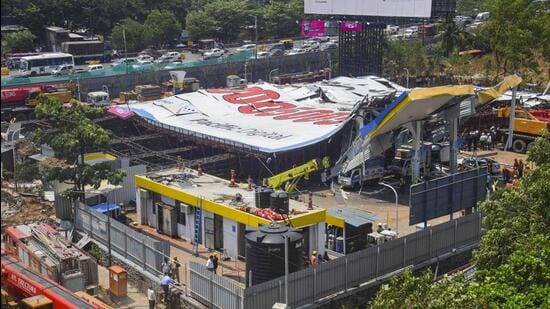
The panel’s report, tabled in the Maharashtra assembly on Tuesday, stated that the sequence of events showed collusion between private parties and officials to circumvent the Brihanmumbai Municipal Corporation’s (BMC’s) regulations.
Seventeen people died and 74 others were injured after a massive, illegal hoarding collapsed on a petrol pump in Ghatkopar during a dust storm on May 13, 2024. The incident, one of Mumbai’s deadliest infrastructure failures in recent years, triggered widespread scrutiny of illegal hoardings and regulatory oversight. Following the collapse, the state government set up a committee to investigate the roles of all entities involved.
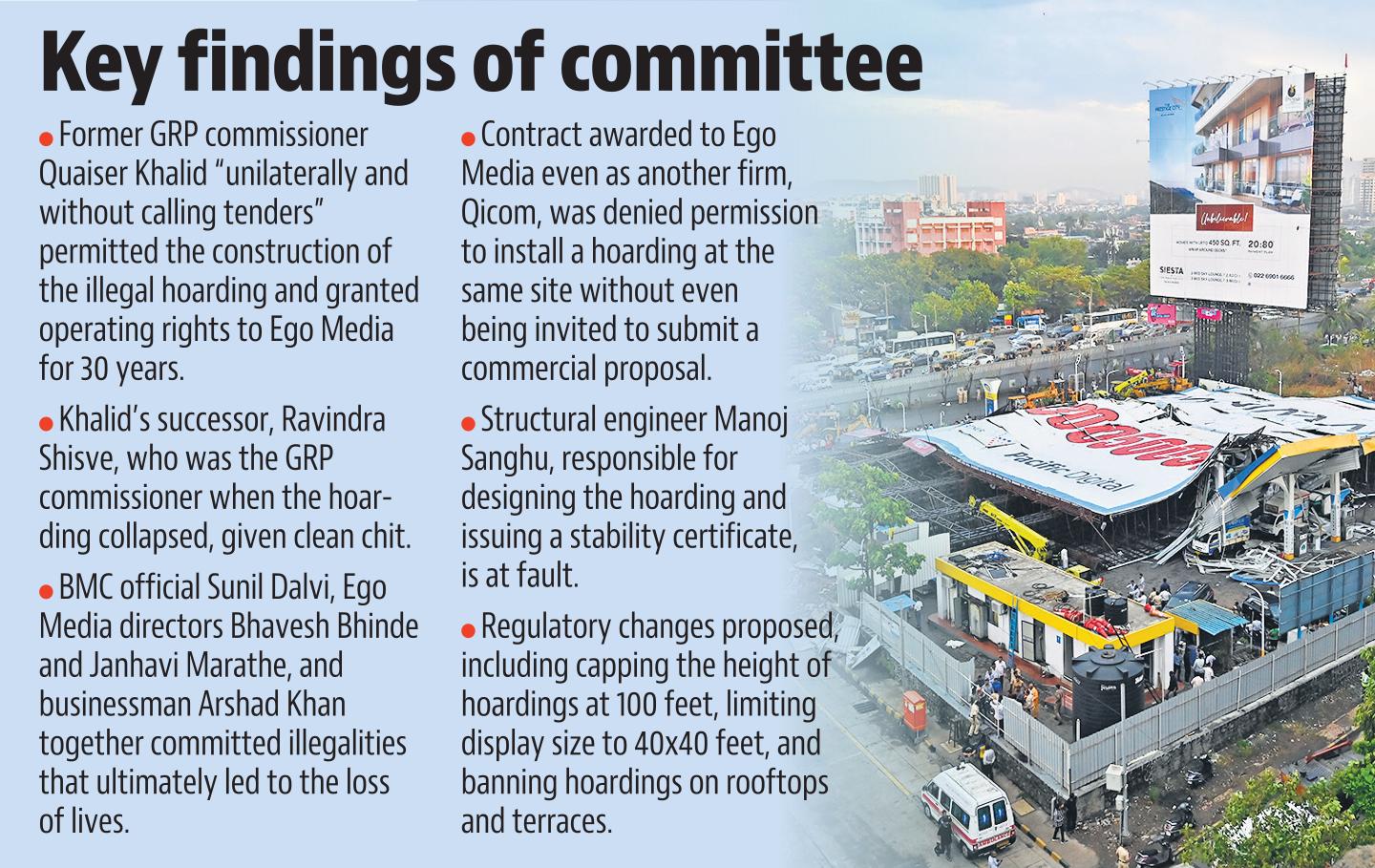
The committee, headed by former Allahabad High Court chief justice Dilip Bhosale, found that former Government Railway Police (GRP) commissioner Khalid “unilaterally and without calling tenders” permitted the construction of the illegal 120x140-feet hoarding and granted operating rights to advertising firm Ego Media for 30 years. It added that permissions were also granted to increase the size of three other hoardings without the required approvals, thereby compounding safety risks.
Khalid bypassed civic rules that cap hoarding size at 40 ft x 40 ft, the report said. It added that this was done by incorrectly claiming the land belonged to the Railways. The committee gave a clean chit to Khalid’s successor, Ravindra Shisve, who was the GRP commissioner when the incident occurred.
The report claimed that BMC official Sunil Dalvi, Ego Media directors Bhavesh Bhinde and Janhavi Marathe, and a businessman, Arshad Khan, together committed illegalities that ultimately led to the loss of lives.
“The sequence of events not only points the needle of suspicion towards a criminal conspiracy hatched between Mr Khalid, Mr Bhinde, Ms Marathe, Mr Dalvi and Arshad Khan, in order to perpetrate illegalities and circumvent the BMC regulations, but it also seems that they have actually committed illegalities, which untimely led to loss of 17 lives in the incident on May 13, 2024,” the report said.
The panel rejected Khalid’s defence that the site fell under railway jurisdiction and was therefore exempt from BMC rules. It said the land was owned by the Maharashtra government and the Police Welfare Corporation, not the Indian Railways. “It is therefore clear that the treatment of the said land as ‘Railway’ was only a clever device set up to circumvent the BMC regulations concerning erection of hoardings,” the report noted.
The inquiry also found that the contract was awarded to Ego Media even as another firm, Qicom, was denied permission to install a hoarding at the same site without even being invited to submit a commercial proposal. The report added that the decision was taken despite opposition from the BMC and Bharat Petroleum Corporation Limited.
The panel held structural engineer Manoj Sanghu responsible for designing the hoarding and issuing a stability certificate. “Sanghu was either aware that the design of the hoarding structure was deficient or he turned a blind eye and did not properly examine the design. In either case, he is at fault because it was his responsibility to do proper examination of the hoarding structure and then issue a certificate,” the report said.
The committee proposed sweeping regulatory changes, including capping the height of hoardings at 100 feet, limiting display size to 40x40 feet, and banning hoardings on rooftops and terraces.
“No hoarding should be permitted on the terrace or rooftops of buildings as they negatively impact the strength of the building. Any existing licences permitting hoardings or advertisements on the terrace or rooftops of buildings ought not to be renewed,” the report said.
“Special provisions ought to be made for construction and erection of hoarding structures in the densely populated areas. Given the additional risk of loss of life and limb which is inherent in such areas, smaller permissible hoardings size may be prescribed by the authority or regulatory bodies in such areas,” it added.
The 854-page report was tabled by chief minister Devendra Fadnavis in the state assembly on Tuesday.

Stay updated with all the Breaking News and Latest News from Mumbai. Click here for comprehensive coverage of top Cities including Bengaluru, Delhi, Hyderabad, and more across India along with Stay informed on the latest happenings in World News.


