
 E-Paper



Patients left stranded by shortfall in ambulances and poor management
The BMC currently operates only 81 ambulances across the areas under its jurisdiction. The number is a far cry from the mandate of one ambulance for one lakh people, by the National Health Mission, under the union health ministry

 Prefer HTon Google


MUMBAI: A perfectly ordinary day in May spiralled into a nerve-racking situation by nightfall for 29-year-old Mankhurd resident Aarti Prakash Chandragupta. Her husband, 34-year-old Prakash, stepped out of their home around 10.30am to buy supplies for his pani-puri stall, and was not seen through the day. By 9pm, Aarti learnt that Prakash had been run over by a train at Mankhurd station.
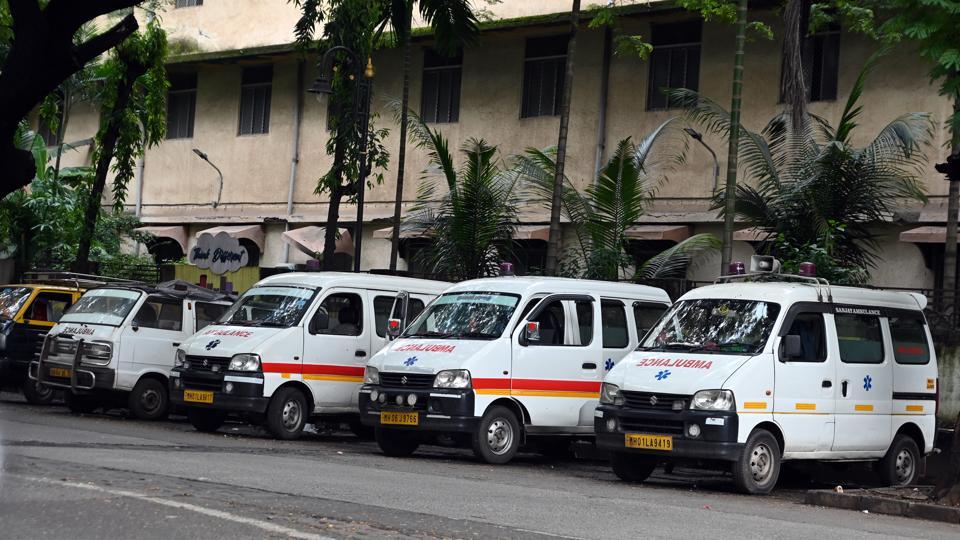
A patient suffering from a mental health condition, Prakash had ended his life, unable to cope with his condition. His body was then taken to Rajawadi hospital, Ghatkopar, for post-mortem. The next morning, when it was time to take him for the last rites, the hospital said ambulances were unavailable to transfer him home.
Aarti recalled seeing a row of private ambulances waiting along the hospital, charging anxious families of patients or grieving members between ₹2,000 and ₹5,000. A Brihanmumbai Municipal Corporation (BMC) owned ambulance service is either provided free or at best charges ₹50 for a single run.
“I had to wait for three hours to negotiate with one that would not fleece me, and finally located a driver who was ready to go on ₹2,000, which was still exorbitant for us. We make a living selling vada pav,” said Aarti, who finally managed to bring Prakash’s body home by 3pm. “There was no help desk or anyone at the hospital that we could turn to in this situation,” she said. “The government should step in at such moments.”
There are many families such as Aarti’s across Mumbai who often find themselves at a loss in situations of emergencies, thanks to the city’s crumbling and mis-managed ambulance network.
The BMC currently operates only 81 ambulances across the areas under its jurisdiction. The number is a far cry from the mandate of one ambulance for one lakh people, by the National Health Mission, under the union health ministry.
Major hospitals such as KEM, Sion, Nair and Cooper each have only two contractual ambulances each, in addition to two BMC ambulances, which many patients that HT spoke to said are often dysfunctional. The situation is worse in peripheral hospitals such as Rajawadi or Shatabdi, where services are either unavailable or outright refused.
“The city needs at least 130 ambulances (if one considers Mumbai’s population is 1.3 crore) for basic services, including at least 20 advanced life-saving ones. What we have is grossly inadequate,” said Dr Abhay Shukla, national co-convenor, Jan Swasthya Abhiyan, an organisation that works towards public health for the underprivileged. “The city’s peripheral areas severely lack the services. Ambulances must be placed in an equitable balance as many patients from the outskirts do come to the central regions for treatments due to lack of infrastructure.”
In dire situations, said Mankhurd-based social activist Baban Thoke, families often end up bargaining with private ambulance operators to even transport bodies for funerals. “Drivers demand ₹1,000 just for wrapping the body, and another ₹3,000 to ₹5,000 for transportation. They exploit families in their most vulnerable moments. It is inhumane on the part of the civic body to not have ambulances in corporation-run hospitals,” said Thoke.
Why is 108 inaccessible?
Dharavi-based social activist Atual Khan said even ambulances that run on the 108 helpline, under the Maharashtra Medical Emergency Services, respond delays are routine, while BMC’s ambulances are hardly available.
“When you call for a BMC ambulance, you are told that they will either not ply to certain hospitals or are busy. Internal transfers between BMC hospitals are almost impossible unless you wait hours. Private ambulances on the other hand charge heavily,” he said.
There is a fleet of 91 ambulances that ply through 108. But Shukla said, “Reaching within the Golden Hour is not possible with these ambulances, as they fail to pick up patients on time.”
According to Dr Rita Savla, founder of RADHEE Disaster and Education Foundation, which works for healthcare accessibility, the fleet under 108 records around one patient per ambulance every day in the city. Beside this, she said, NGOs and charitable institutions also run services for people. “A major problem is that citizens are not told where to contact or how to approach these services in cases of emergencies. There is a need to streamline the process,” said Savla.
Medical professionals however, denied that there are any challenges to access ambulances.
Chandrakant Pawar, chief superintendent of all peripheral hospitals, said, “We have not been informed of any such cases. We had conveyed our requirement to the central agency, and have accordingly floated a tender. Ambulances are always used for inter-hospital patient transfers.”
A senior doctor from a BMC-run hospital added, “Major hospitals are equipped with four ambulances, which are not only meant for patient transfers but are often deployed during special occasions, such as mass protests or religious functions. Ambulances run by the BMC do not deny services. Ambulances are always put on standby for cases of disasters. In case of patient transfers, which usually happens in the day, we manage through networking and can even coordinate with the local police station if required. Three or four ambulances are always available at night.”
Dr Mohan Joshi, dean of Sion hospital, said, “Ambulances are meant for inter-hospital transfers and not for taking patients home after treatments. We charge only a minuscule amount to transfer deceased members within municipal limits. We do not face any problem at Sion hospital, as five ambulances are available at all times.”
HT has learnt from people in the know that BMC has floated tenders for 22 new basic ambulances and three advanced cardiac ambulances for its 16 peripheral hospitals. Deputy municipal commissioner (health) Sharad Ughade did not respond to HT’s calls, to speak on the matter.
It took this family over 3 hrs to get an ambulance
A Saki Naka-based family was given the run-around for over three hours last week, in the face of paucity of ambulances from BMC and exorbitant cost of private services.
In the morning of September 19, Shahid Ali, 48, started feeling uneasy, restless, and sweating profusely. When his condition escalated to chest pain, the family rushed him to Rajawadi hospital in Ghatkopar at 11pm. “But the doctors told us that there were no ICU beds available, following which, he was placed on a stretcher in the hospital, without any help,” said Mohammad Ateeq Khan, his brother.
Khan alleged that the doctors at the hospital also refused to refer the family to another hospital. “We were begging them for a referral and a note for an ambulance. However, they refused saying no ambulances were available,” said Khan.
The family then decided to take Ali to Lokmanya Tilak Municipal General Hospital in Sion, which was 12 kilometers from their home, and began the search for an ambulance. It turned out to be a futile endeavour.
“While a few BMC ambulance drivers refused to drive us without a referral from a hospital, others said they were too busy to transfer us. We then turned to private drivers standing nearby,” Khan added. But to his dismay, the private players proposed exorbitant rates of around ₹6000 to take the patient from Rajawadi hospital to Sion hospital. It would normally cost no more than ₹50 to make the trip. “After bargaining, we got an ambulance driver to agree to ₹4,500, and finally managed to take my brother to Sion hospital at around 2.30 am,” said Khan.
Four days on, Ali is doing well, awaiting surgery, said his family.

Stay updated with all the Breaking News and Latest News from Mumbai. Click here for comprehensive coverage of top Cities including Bengaluru, Delhi, Hyderabad, and more across India along with Stay informed on the latest happenings in World News.


