
 E-Paper



Navroze Contractor: The cinematographer and motorcyclist dedicated his gift to fight for needy
One of the tearful and admiring messages on WhatsApp detailed every aspect of his achievements and interests except the main one, cinematographer/ film-maker

 Prefer HTon Google


MUMBAI: On Sunday morning we lost one of world’s great cinematographers. Navroze Contractor, 79, wore many hats across his lifetime -- father, husband, passionate jazz aficionado, dedicated, lifelong motorcyclist, author, raconteur par excellence, and many other things besides. From first reports, his death was a tragic one: out on a regular Sunday motocycle ride with his group, Navroze came in the way of three drunken motorcyclists riding at high speed on the wrong side of the road. It was an ironic and tragic death for someone who had campaigned assiduously for safe motorcycle and car driving, for someone who was planning to mark his 80th year in a few months with one last long bike ride between Bangalore and his beloved Ahmedabad, before quitting two-wheelers for good. Such was his immersion in motorcycle and vintage cars that one of the tearful and admiring messages on WhatsApp detailed every aspect of Navroze’s achievements and interests except the main one – cameraman/ cinematographer/ film-maker.
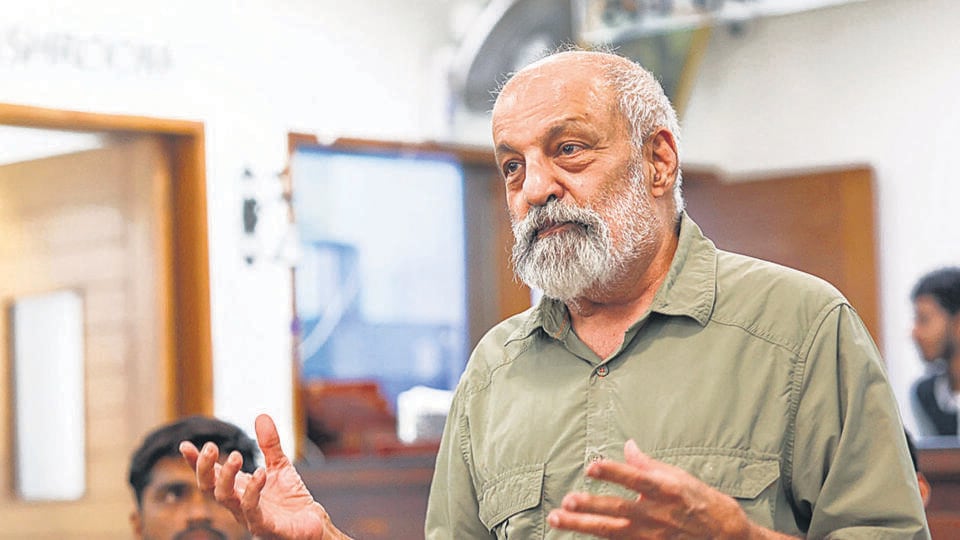
Born in 1944 in Wai, Maharashtra, Navroze grew up in Ahmedabad. Beginning in the late ’60s he had a career as cinematographer that spanned a mind-boggling more than half a century, using all sorts of technology from basic 16mm and 35mm film to today’s latest digital apparatus and filming in every imaginable genre of the moving image from experimental films and feature films to all sorts of documentary work. His feature film work includes ‘Duvidha’ (Mani Kaul), ‘22 June, 1897’ (Nachiket and Jayoo Patwardhan), ‘Percy’ (Pervez Merwanji) ‘Devarakadu’ (Pattabhi Rama Reddy), ‘Pehla Adhyay’ (Vishnu Mathur) ‘Lalach’ (Shankar Nag), ‘Frames’ (Chetan Shah) and ‘Hun Hunshi Hunshilal/ Love in the Time of Malaria’ (Sanjiv Shah).
Having studied art at the MS University in Baroda, Navroze moved to the FTII in Pune to study cinematography. Graduating, he joined the ranks of the second generation of directors and cine-craftspeople dedicated to making serious cinema in a counterpoint to the commercial mainstream films coming out of Bombay, Madras and Calcutta. If Subrata Mitra was the great, meticulous innovator of the first generation, partnering Satyajit Ray in rendering his images, then Navroze Contractor and KK Mahajan were the ones who carried forward the cinematic exploration for directors such as Mrinal Sen, Mani Kaul and Kumar Shahani.
I remember Navroze recounting the huge challenges the unit faced while filming Mani Kaul’s ‘Duvidha’ on a no-budget shoot in the heat of Rajasthan, working the best they could with a particularly slow Kodak film stock. Though Navroze soon became one of the most reputable cinematographers working in India, his ego never got in the way of his hunger to learn more: in the mid-1980s he went to America and enrolled in a tough workshop with the internationally renowned cinematographer Laszlo Kovacs. His stories from that event, of getting to grips with the most elaborate filming equipment and processes were as fascinating as his tales of the rudimentary equipment he struggled with in Rajasthan.
‘Duvidha’ is a stunningly beautiful film, one that still retains its visual power after 50 years, and Navroze could have easily used that and the other features he shot to build a glamorous, comfortable life in Bombay and internationally as a feature-film cinematographer. Instead, he simultaneously intensified his exploration of the other branch of his practice – documentary film-making. At his passing we can note that Navroze Contractor was the seniormost of a handful of people who have brilliantly straddled both fiction and non-fiction cinematography.
Navroze did the camera for a wide variety of documentaries for directors of all nationalities. His work includes ‘Ballad of Pabu’ (Georges Luneau), ‘Dreams of the Dragon’s Children’ (Pierre Hoffman), ‘Are you Listening?’ (Martha Stewart), ‘Last House in Bombay’ (Luke Jennings), ‘All in the Family’ (Ketan Mehta), ‘Famine ‘87’ (Sanjiv Shah) and ‘The Open Frame’ (Chetan Shah). From 1980 Navroze formed a partnership with Deepa Dhanraj, both as life-partners and as cameraman-director, and some of his most powerful work was done in this jugalbandi. Here, (as also with ‘Famine 87’ and a few other documentaries) the role of the cameraman is no longer limited to skillfully rendering the images worked out with the director; in a situation of conflict and struggle the documentary film-makers often become involved in the work as a unit which is emotionally and politically committed to the challenge of making the movie.
Yugantar was India’s first feminist film collective, with Abha Baiya, Deepa Dhanraj, Meera Rao and Navroze who was the only male. Working with different women’s groups Yugantar produced ‘Molkarin’, about domestic workers in Pune, ‘Tobacco Embers’ with female tobacco factory workers, ‘Is This Just a Story’ with a feminist collective in Hyderabad and ‘Sudeshna’ with the Chipko environmental movement. In 1986 Deepa Dhanraj made ‘Kya Hua Iss Shahar Ko?’, a searing and prescient look at urban communal violence in Hyderabad. 1991, saw Dhanraj’s ‘Something Like a War’ about the deeply problematic history of the family planning programme in India and in 1994 came ‘The Legacy of Malthus’ which connected India and Scotland in paring open the economist’s theories about ‘over-population’. The latest documentary which Navroze shot with Deepa was about the suicide of Rohit Vemula, ‘We Have Not Come Here to Die’.
Besides the film work, his still photography work is in the collection of the Smithsonian and the Tate Modern, and his most recent work was on the dying culture of kushti in the akhadas.
A list of ground-breaking work and career highlights are to be expected in any obituary but these by themselves will not give us a complete picture of a complex, multi-faceted, hugely energetic man. For those of us who knew him, even without being among his closest circle, there will always be a memory of a no nonsense, cut-to-the-point man but one of great warmth; there will be a memory of the great story-teller who could quickly have you off your chair and in splits; a sharp wit with an even sharper sense of observation; a bushy-bearded, low centre of gravity who relished life in all its wonder and a man who dedicated most of his gift and talent to fighting for those who continue to be deprived of the means and routes to reach a full enjoyment of existence.
(Ruchir Joshi is a film-maker and writer. He is the author a novel, The Last Jet-Engine Laugh and his films include Eleven Miles and Tales from Planet Kolkata.)


