
 E-Paper



‘Royal weavers’ of Karvat Kati sarees in Maoist areas of Maharashtra get help
Vyusti trust provides raw materials to 80 families from Koshti community to weave Tussar or Kosa Silk sarees. The trust returns 90% of the profit made back to the weavers


Amid the Covid-19 pandemic, 33-year-old Mumbai resident Prachi Saraf decided to help out a weaver community, etched in the history of ancient India as ‘royal weavers’ but who have been in troubled waters in modern-day India, as they battle poverty and are forced to work out of areas largely affected by the Maoist movement.
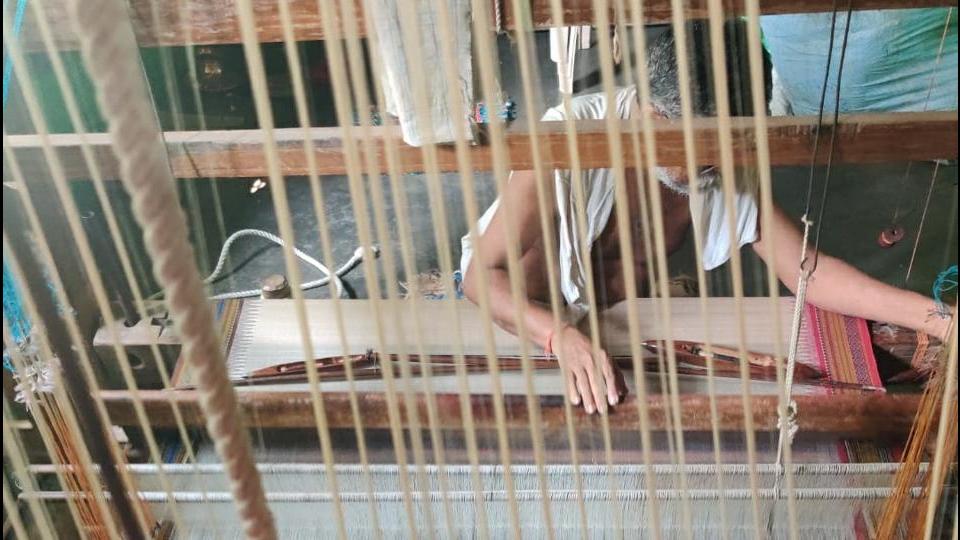
Saraf, who returned to India after completing her accountancy course from Cardiff University and had a family background of garment manufacturing and export business since 1980, set up a trust – Vyusti – through which she is helping 80 families from the Koshti community by giving them orders to weave Tussar or Kosa Silk sarees. The trust is providing raw materials and returning 90% of the profit made back to the weavers.
“I couldn’t bear the fact that the talented weavers were going hungry and decided to help them against all odds,” said Saraf.
She said 10 families at Yeola in Nashik district work with the trust to make Paithani sarees.
The Himroo sarees’ weaving also faces threat of extinction and the art would have ended had it not been for the 25 weavers from three families of Aurangabad’s Qureshis looms.
According to legends, the Koshti community consider themselves to be the descendants of Markandeya Rishi or Rajhans, the king of Devagiri who was given the title ‘Koshti’, which means man of virtues, in 1111AD. The Koshtis were known as the royal weavers, but later took jobs as soldiers in the armies of the Peshwas, Bundelkhand, Rani Laxmi Bai and Tipu Sultan.
Today, the Koshti tribe that has settled in some areas of Chhattisgarh, Vidarbha, Andhra Pradesh, Madhya Pradesh, Uttar Pradesh, Bihar and Gujarat, are largely weaving the famous Karvat Kati sarees made from Tussar Silk or Kosa Silk. A pure Karvat Kati saree costs a minimum of ₹19,500, while those with zari work can cost ₹11,000.
But for families of this tribe, who have settled in the fringes of the Maoist-affected regions of Maharashtra and Chhattisgarh, earning their livelihood through weaving silk has not been easy. They live on the edge as cocoons of the silkworm, Antheraea Mylitta, are found only on Arjun, Saja and Sal trees in the forests that has considerable Maoist presence. Many of the families are not comfortable to describe their lives as they operate out of the ‘Red Corridor.’
Umashankar, who does not know his age, travels five hours to reach Gadchiroli to weave a Karvat Kati gala.
“I found about Kosa Silk when I traded a few cocoons and got money. This made me go through the jungles of Gadchiroli and Chhattisgarh to find cocoons and trade. After 11-12 years, I got a cycle which made it slightly easier to travel,” he said.
Umashankar refrained from talking about Maoists or their presence in the forests of Gadchiroli and Chhattisgarh. To weave one saree, the family of these weavers have to find at least 1,500 cocoons.
“Each cocoon gives anywhere between 350 grams and 500 grams of silk. We take an average of 400 grams of silk per cocoon, and to weave one saree, we need 1,500 cocoons,” said Umashankar.
He stated that each family member has a specific role to play, from extracting the thread to weaving and dyeing the fabric.
Similar is the story of Bhalchandra, who rarely speaks to anyone from outside the village. His 39-year-old son Prakash said, “My father often talks to my mother about the troubled times during his young age when he had to traverse with Maoists around. And I would not want to talk about it. We should not utter that word Maoist here.”
“Life isn’t easy for us,” said Prakash, when asked about the harvest season of cocoons. “Cocoons are harvested twice a year, once during a period closer to Diwali and then in February. But it all depends on many factors surrounding the place we live in,” said Prakash, who is happy that his father could at least build a makeshift house out of loose bricks.
The signature trait of the silk is its dull golden brownish texture which makes it an extremely precious commodity, said Prakash.
“It is also found in natural shades of dark honey, fawn, orange, pale golden and cream. The actual colour of Kosa Silk is dull gold, but the finished product is dyed with natural dyes to give it other colour,” added Prakash.


