
 E-Paper



Ghaziabad forms teams to check stubble burning as city emerges most polluted in country
According to the official statistics of the Consortium for Research on Agroecosystem Monitoring and Modelling from Space (CREAMS) laboratory of the Indian Agricultural Research Institute, New Delhi, the district of Ghaziabad recorded 49 instances of stubble burning during the period from October 1 to November 30, 2018


The Ghaziabad district officials have formed teams to check stubble burning in Muradnagar, Rajapur, Loni and Bhojpur areas and directed them to serve notices to farm owners, caught burning stubble, three days in advance before an environmental compensation cost is levied on them. The development comes a day after Ghaziabad emerged the most polluted city in the country on Wednesday, as per the records maintained by the Central Pollution Control Board (CPCB).
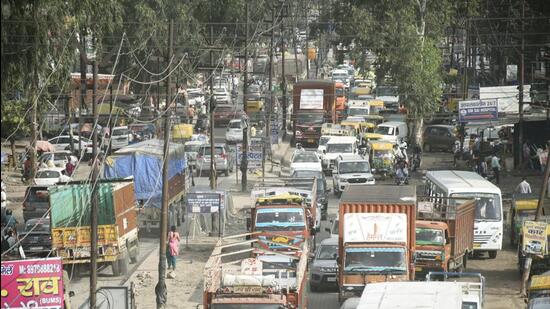
Ghaziabad is already among the 16 “non-attainment” cities in the state of Uttar Pradesh and its pollution levels generally remain on the higher side during winter. Cities are declared “non-attainment” if they do not meet the National Ambient Air Quality Standards for particulate matter (PM10) or nitrogen dioxide (NO2) over a period of five years.
Earlier in April, the city ranked the second-most polluted city in the world after Bhiwadi in Rajasthan, on the World Air Quality Report 2021. The annual report, prepared by Switzerland-based organisation IQAir, surveyed 6,475 cities across the world.
“The teams, to be headed by respective subdivisional magistrates, have been directed to carry out awareness drives and serve notice to landowners if stubble burning is discovered. If they fail to reply to the notice or if the reply is not satisfactory, a penalty will be imposed. In order to control air pollution during the graded response action plan (Grap) period, regular road sweeping and water sprinkling is being carried out by local bodies,” said Utsav Sharma, regional officer, Uttar Pradesh Pollution Control Board.
The Grap came into effect in the National Capital Region (NCR), including Ghaziabad, on October with a view to tackle winter pollution.
The teams will comprise officials from the revenue, rural development, police, agriculture and sugarcane departments, sources said.
Officials said penalties have been defined in accordance with the directions of different orders by the state government. A penalty of ₹ 2,500 per instance shall be imposed if the agricultural land holding is less than two acres while it will be ₹5,000 in case the farmland size is two or more acres but less than five acres. For lands measuring over five acres, a penalty of ₹15,000 has been proposed.
According to the official statistics of the Consortium for Research on Agroecosystem Monitoring and Modelling from Space (CREAMS) laboratory of the Indian Agricultural Research Institute, New Delhi, the district of Ghaziabad recorded 49 instances of stubble burning during the period from October 1 to November 30, 2018.
The fire count reduced to 24 during the same period in 2020, while the count was 17 in 2021. One fire has been reported during the period from September 15 to October 5 this year.
Ghaziabad city on Wednesday also emerged as the most polluted city across India as per the air quality index of the CPCB. The air quality index (AQI) on Wednesday stood at 248 under the “poor” category with the prominent pollution being PM2.5 at all the four air quality monitoring stations of Indirapuram, Vasundhara, Sanjay Nagar and Loni.
“The AQI levels during the past several years have been high in Ghaziabad and on many days, the city emerged the most polluted city in the country. Traffic congestion, industrial emission, construction activities and lack of enforcement are some of the major reasons for bad air quality in Ghaziabad,” said Akash Vashishtha, a city-based environmentalist and a lawyer.
The city also recorded a “poor” AQI of 210 on October 1 and on October 2, the AQI was 207. The AQI improved to the “moderate” category with a reading of 138 and 162 on October 3 and 4, respectively. On October 6, the AQI improved drastically to stand at 69 in the “satisfactory” category, which is a rarity in Ghaziabad.
An AQI between zero and 50 is considered “good”, 51 and 100 “satisfactory”, 101 and 200 “moderate”, 201 and 300 “poor”, 301 and 400 “very poor”, and 401 and 500 “severe.”
“The spike in AQI on Wednesday was the result of localised factors such as traffic congestion during the Dussehra festivities. The AQI was also on the higher side in several districts of western Uttar Pradesh on Wednesday,” Sharma said.

Stay updated with all the Breaking News and Latest News from Mumbai. Click here for comprehensive coverage of top Cities including Bengaluru, Delhi, Hyderabad, and more across India along with Stay informed on the latest happenings in World News.


