Officials of the Noida authority on Monday said the Indian Institute of Technology Roorkee (IIT-Rourkee) has reduced the budget of two underpasses proposed on the Noida-Greater Noida Expressway by ₹22 crore from the initial cumulative estimate of ₹237 crore, owing to a change in the construction method.
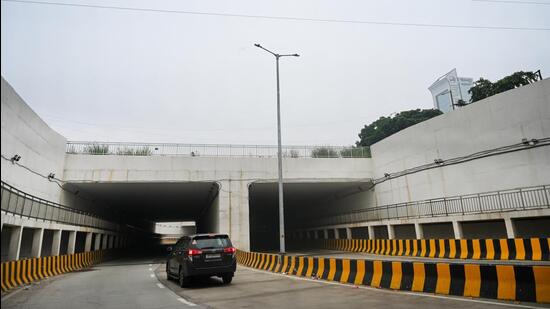
The underpass at 16.9km chainage (horizontal distance as measured along a combination of curves and straight lines between two points) in sector 146 is planned to have a length of 800m. It had an initial budget of ₹131 crore, which has now been reduced to ₹117 crore. This underpass will benefit industrial areas, including sectors 151, 153, 154, 155, 156, 157, 158, 159, and 162, as well as nearby villages.
The second underpass near sector 135, at the 6.10 km chainage, has a length of 731m and a budget of ₹106 crore, which had been reduced to ₹98.2 crore. This underpass will improve connectivity for sectors 104, 105, 106, 107, 108, 110, 80, 81, 82, 83, 127, 128, 129, 130, 131, 132, 133, 134, and 135, along with Phase-2, NSEZ, and 11 villages in the area.
“The two underpasses are planned to improve connectivity to over 30 residential sectors. Once completed, the total number of underpasses on the expressway will increase to five, enhancing traffic flow and reducing congestion. The detailed project reports (DPRs) for the new underpasses were recently approved by IIT-Roorkee after a comprehensive technical evaluation,” said Vijay Rawal, deputy general manager, Noida authority.
{{/usCountry}}“The two underpasses are planned to improve connectivity to over 30 residential sectors. Once completed, the total number of underpasses on the expressway will increase to five, enhancing traffic flow and reducing congestion. The detailed project reports (DPRs) for the new underpasses were recently approved by IIT-Roorkee after a comprehensive technical evaluation,” said Vijay Rawal, deputy general manager, Noida authority.
{{/usCountry}}The authority is set to issue tenders to appoint construction agencies and the approval process took time due to a change in construction techniques aimed at resolving issues encountered during earlier projects, said officials.
To address the problem of road cave-ins, instead of the box-pushing method previously used, the diaphragm wall technique has been adopted for these underpasses.
This method involves constructing underground walls on two sides, followed by casting the underpass roof, which takes about a month to cure and strengthen. This approach minimises disruptions while ensuring structural integrity, said officials.
“Construction will be carried out in phases to minimise traffic disruptions. In the initial phase, service road connections will be completed, followed by the underpass structure on one side of the expressway at a time, ensuring smoother traffic management throughout the process,” said Rawal.
Currently, the expressway has three operational underpasses at chainages 2.36 km, 10.30 km, and 19.40 km, near Sectors 96, 142, and 148, respectively. These underpasses have significantly streamlined traffic movement and accessibility in the region.
Stay updated with all the Breaking News and Latest News from Mumbai. Click here for comprehensive coverage of top Cities including Bengaluru, Delhi, Hyderabad, and more across India along with Stay informed on the latest happenings in World News.
Stay updated with all the Breaking News and Latest News from Mumbai. Click here for comprehensive coverage of top Cities including Bengaluru, Delhi, Hyderabad, and more across India along with Stay informed on the latest happenings in World News.