
 E-Paper



5 firms that burn waste in Aravallis under scanner, probe ordered
The illegal practice has been linked to severe environmental degradation, health hazards among the local population and recurring forest fires in the Khori Kalan and Khori Khurd villages near the Haryana-Rajasthan border.

 Prefer HTon Google


Gurugram: Authorities in Nuh have identified five companies from Bhiwadi, Rajasthan, that have been illegally dumping and burning chemical-laced industrial waste in the ecologically sensitive Aravalli region, causing severe environmental damage and health hazards for local communities.
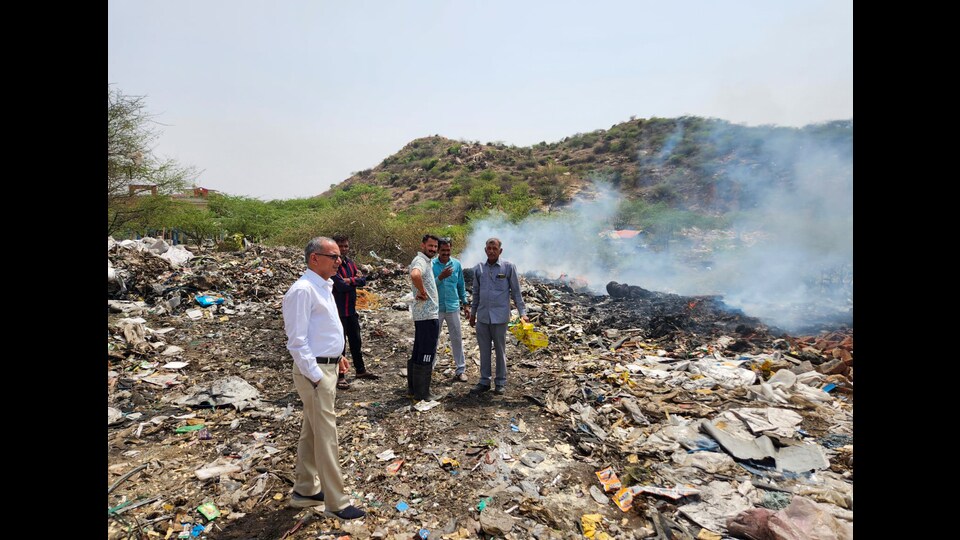
The breakthrough follows a HT exposé that revealed rampant waste burning in the Khori Kalan and Khori Khurd villages near the Haryana-Rajasthan border, which has been linked to recurring forest fires and deteriorating air quality.
Nuh deputy commissioner Vishram Kumar Meena formed a five-member fact-finding committee on Friday after mounting pressure from residents and media reports highlighting the crisis. “We took suo motu cognisance and have formed a committee to investigate,” Meena said.
The panel—comprising the SDM Tawadu, district forest officer, DSP Tawadu, and a regional officer from the Pollution Control Board—seized a tractor-trolley loaded with chemical waste during an inspection of the site on Friday. The trolley contained evidence, including discarded packaging and chemical drums, that helped trace the waste back to industrial units in Bhiwadi.
“We have collected substantial material from the dump site in Khori Kalan, and based on packing slips and container labels, five companies from Bhiwadi have been identified. Notices will be prepared and issued to them shortly,” Meena added.
Local residents describe an organised racket where contractors, paid by industries to process waste responsibly, instead transport it to Aravalli buffer zones and burn it using hazardous chemicals to cut costs.
“This is a full-fledged nexus. Some local contractors with ties to Bhiwadi-based industrial units are dumping waste in the forest, and burning it using hazardous chemicals,” said Haseen Khan, an advocate from Khori village in Tauru who first raised the issue on social media.
Khan alleges that agricultural vehicles are being misused for commercial waste transport to evade taxes. “Despite repeated complaints, enforcement remained sluggish until the fire broke out,” he said.
The crisis escalated earlier this week when a massive fire in Tauru, allegedly sparked by chemical waste, spread dangerously close to residential areas and forest corridors, prompting urgent intervention from both Haryana and Rajasthan officials.
Akhtar Ali, a Khori Khurd resident, described seeing tractor-trolleys arriving at dawn to offload plastic and cardboard scrap on forest fringes. “The entire village has been inhaling toxic smoke. Birds, trees, and small wildlife are perishing in silence,” he said.
Despite official promises of intensified action, residents remain sceptical. “We have given officials videos of the fires, and still, they keep asking for evidence. If this isn’t enough, what is?” said one villager who wished to remain anonymous.
A Haryana Pollution Control Board officer, speaking on condition of anonymity, acknowledged that previous complaints had lacked corroborative evidence but promised: “Now with new proof and seized materials, raids will be intensified. Our teams will conduct surprise night checks. No violator will be spared.”
Environmentalist Vaishali Rana warned that the illegal dumping threatens local biodiversity, including protected species, while contaminating groundwater and undermining the Aravallis’ role as an ecological buffer for the National Capital Region.
Residents are demanding a permanent ban on such waste operations and constant patrolling to prevent further environmental destruction.


