
 E-Paper



The fall of Russia’s only anti-war party has exposed Putin’s vulnerability
Yabloko spent decades censoring itself to survive. The Ukraine war made continuing that balancing act impossible.


 Prefer HTon Google


Russia’s token antiwar party, Yabloko, has spent more than two decades mastering the art of political survival under President Vladimir Putin.
In recent years it has censored its statements, avoided calls for protest and zealously guarded its marginal influence. “We played it safe,” said its co-founder Grigory Yavlinsky.
That’s no longer enough.
Last week, one month before the country’s parliamentary elections, the authorities banned Yabloko from the ballot on minor technicalities such as copyright violations and accusations it received financing from abroad.
The real reason, according to Yabloko leaders and political analysts, is an unusual surge in the party’s support against the backdrop of growing disillusionment with the war in Ukraine it has vocally opposed.
Yabloko’s disqualification underscores the shrinking space for dissent in Russia and the Kremlin’s declining appetite for anything that goes against the official line: that the war is an existential fight to protect Russia from aggressive Western powers.
It comes as Ukrainian drone strikes deepen Russia’s already dire economic situation and a battlefield stalemate in Ukraine fuels frustration with Putin’s war. In this context, even Yabloko’s meek peace platform was too potentially damaging to permit.
Abbas Gallyamov, a former Kremlin speechwriter now living abroad, said the authorities’ own internal polling showed that Yabloko had become a vessel for antiwar sentiment and thus a threat. They understood, he said, that “the elections would have been a referendum between war and peace.”
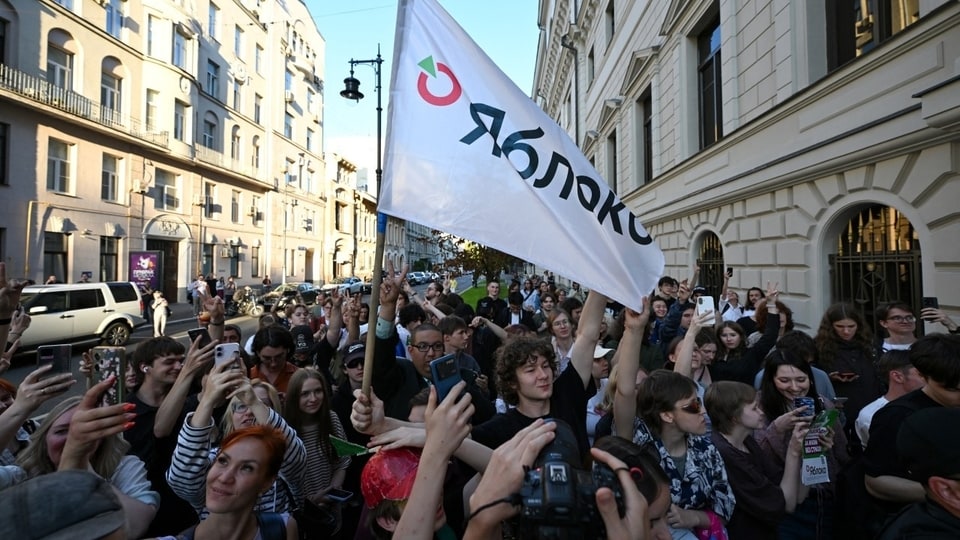
As it campaigned in recent weeks, Yabloko’s Instagram account gained 100,000 new followers. Google searches for the party’s name, which means “apple,” grew 90% in the space of a week. Russians’ social media feeds filled up with videos of people biting into apples, lip-syncing to songs about apples and inking tattoos with the fruit that is the party’s symbol. A party that was irrelevant four years ago was becoming a cause célèbre.
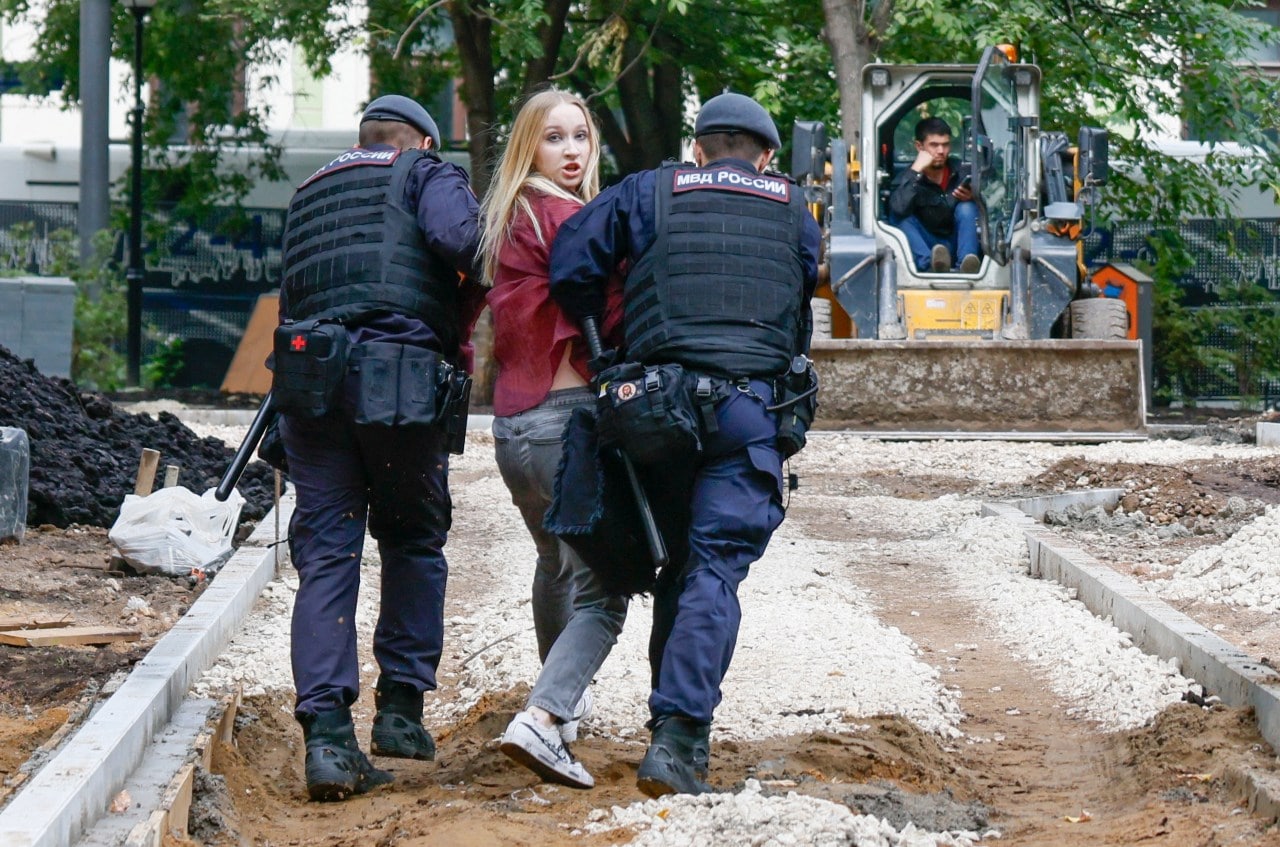
The move to bar Yabloko last week sparked protests. Hundreds of young Russians gathered outside a Moscow courthouse where Yabloko’s bespectacled chairman, Nikolai Rybakov, who has a mop of brown hair and looks like a small-town librarian, spent hours appealing the ruling in vain. Police rounded up some of the protesters, four of whom were given brief jail terms.
What’s striking about Yabloko’s ouster from the election is that the party never even planned to enter parliament. Its goal—elements of which were outlined in a 43-word program titled “For Peace and Freedom!”—was simply to influence the discourse enough to expedite an end to the bloodshed in Ukraine, Rybakov said.
“Yabloko is the only party on the ballot that presents an alternative to the current government, compared to the other 10 parties. Because there’s no difference between the parties currently on the ballot. Absolutely none,” Rybakov said in an interview.
Its leadership has taken pains to avoid statements calling for a change of regime or anything that may fall foul of Russia’s increasingly strict laws on expression.
It’s an approach that has helped it survive for decades.
Yabloko was founded in the early 1990s during Russia’s short-lived experiment with real democracy, when a rambunctious form of politics emerged and dozens of fledgling parties contested power.
When Putin came to power in 2000, Yabloko won a spot in a new political system that was designed to sideline real rivals but permitted—and at times even encouraged—a handful of contenders willing to uphold a facade of fair elections while ultimately toeing the government line.
Kremlin spin doctors dubbed this system “managed democracy”—a form of tightly controlled politics that maintains an illusion of competition. A collection of sanctioned parties including Yabloko was allowed to push harmless policy ideas, but never allowed to cross the line into actual dissent.
The genuine opposition that fought to shed light on corruption and organized protests against Putin—spearheaded for many years by anticorruption crusader Alexei Navalny—was met with police batons, jail terms and exile. Navalny himself was poisoned by the authorities and later died in an Arctic prison.
Yabloko was for decades a core part of this make-believe politics. It advocated for greater freedoms and rule of law even as those notions fell increasingly out of favor with a populace willing to embrace a strongman ruler to end the post-Soviet economic malaise.
But systemic parties such as Yabloko were always cogs in a carefully calibrated machine that could at any point fall apart.
“If things start to go badly with the ruling party and with the status quo in general, and such parties get genuine electoral support, they may start to morph into something quite different,” said political scientist Ekaterina Schulmann.
In the past, if a party or candidate was deemed a threat, authorities would simply refuse to register them ahead of time, citing issues with their paperwork or some other procedural flaw.
When Navalny launched a nationwide political campaign for the 2018 presidential election, he was quickly barred. The same fate befell the sole antiwar candidate who ran against Putin in 2024, Boris Nadezhdin. Russians had flocked in large numbers to campaign for the uncharismatic bureaucrat with no previous political platform. Nadezhdin has since left Russia, saying he feared jail time.
Yabloko was initially allowed to contest this year’s vote because the authorities wanted to show that few Russians were willing to back an antiwar party, said Gallyamov.
Putin sought to rally support for a continuation of the war, and every other party backed him. United Russia, the ruling party, pledged its commitment to the military campaign. The head of Russia’s electoral commission, Ella Pamfilova, said “casting your vote means making your own modest contribution to victory.”
None of that worked. Yabloko kept rising in the polls. This situation prompted a standoff between Kremlin officials managing the country’s tightly controlled elections and hard-liners afraid that permitting an opposition force was risky, Gallyamov said. In the end, the latter camp won out.
Yabloko is still allowed to field dozens of candidates in regional elections happening in parallel with the national vote. In an interview, Rybakov said the party would focus on those races and was careful not to voice any overt criticism of Putin. But he predicted a dark outlook for politics in the country.
He reeled off the names of seven party members now serving jail sentences for speaking out against the war. Rybakov’s deputy Lev Schlosberg, a veteran politician in the city of Pskov near Ukraine, was sentenced this week to 11 years in prison for speaking out against the Russian armed forces.
Another party created by Kremlin spin doctors six years ago is likely to take Yabloko’s place on the national ballot. It’s called New People, and its program is a set of cliché slogans such as “not revolution, but evolution.”
Gallyamov, the former Kremlin speechwriter, said that banning Yabloko may prove risky for the Kremlin. By depriving Russians of a safe outlet for their frustration, in the form of an antiwar party sanctioned by the state, it not only shows its fear of dissent but also allows that frustration to fester.
“The authorities seem to be fully in control of the official political sphere. It looks like nothing threatens them,” Gallyamov said. “But the more strength the regime tries to outwardly project, the weaker its real position actually is.”
Write to Matthew Luxmoore at matthew.luxmoore@wsj.com


