
 E-Paper



Assam govt table report on ST status for six communities; triggers protest
Assam chief minister Himanta Biswa Sarma said this report will represent the aspirations of all communities of Assam

 Prefer HTon Google


Silchar: The much-anticipated report of the Group of Ministers (GoM) recommending Scheduled Tribe (ST) status for six major communities in Assam was tabled on the final day of the State Legislative Assembly’s winter session on Saturday.
The report was placed by Dr Ranoj Pegu, minister for tribal affairs (Plain). Opposition parties demanded a discussion on the politically sensitive document, but Speaker Biswajit Daimary declined the request.
The GoM has recommended that the Centre grant ST status to Tai Ahom, Chutia, Moran, Motok, Koch-Rajbongshi, and Tea Tribes (Adivasis) — a move seen as one of the most significant socio-political policy shifts in recent years.
The tabling came two days after the Assam Cabinet, chaired by chief minister Himanta Biswa Sarma, approved the GoM recommendations.
The GoM was headed by Dr Pegu, with ministers Pijush Hazarika and Keshab Mahanta as members. Sarma had earlier said the report would be tabled and subsequently forwarded to the Ministry of Home Affairs (MHA). The Centre may now seek verification from the Registrar General of India (RGI) or ask for supporting data before taking a final call.
“This report will represent the aspirations of all communities of Assam,” Sarma said after the Cabinet meeting.
The six communities have been staging demonstrations across upper Assam, including in Tinsukia, demanding early recognition. Sarma had said the government “supports the protesters”, noting that several BJP leaders had joined the rallies.
After the report was tabled on Saturday evening, organisations representing the six communities celebrated, calling it a “historic step”.
“We are thankful to the state government and the chief minister for keeping their word. This is a moment of joy, we are finally getting what we deserved,” said Rana Ranjan Gogoi, general secretary of the Tai Ahom Yuva Chhatra Parishad.
However, several tribal bodies under the Coordination Committee of Tribal Organisations of Assam (CCTOA) have opposed the move, arguing that inclusion of large communities could dilute constitutional protections and reduce the share of reservation benefits for existing STs.
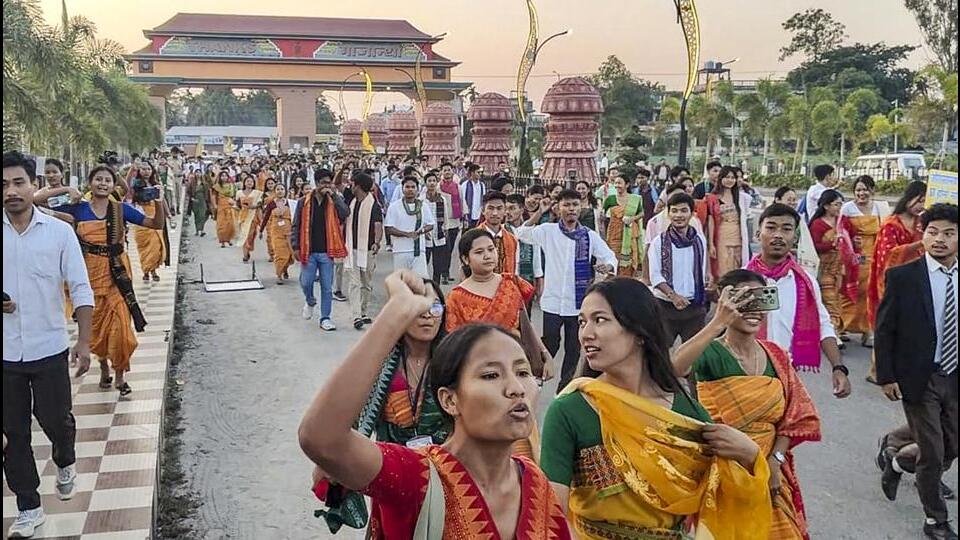
Before the report was placed in the Assembly, Kokrajhar witnessed one of the largest tribal student agitations in recent years. Thousands of Bodo Gen-Z students marched from Bodoland University to the Bodoland Territorial Council (BTC) Secretariat, breaking security barricades and storming the administrative complex.
The protesters alleged that granting ST status to the six communities threatens the political and constitutional safeguards enjoyed by Bodos under the Bodo Accord and may reduce their representation in jobs, education and the BTR’s governance structure.
Police said parts of the BTC Secretariat were allegedly vandalised. Additional forces were rushed to the area as tensions escalated.
Videos circulating on social media showed dramatic scenes of students waving Bodo flags and chanting slogans against the Assam government’s proposal.
“We are not against any community. But this unilateral decision will destroy protections guaranteed to Bodos and other tribal groups,” said a student leader during the rally.
The agitation is expected to intensify, with the influential All Bodo Students Union (ABSU) likely to formally join the protests.
Meanwhile, the Assam assembly on the last day of the winter session passed six bills related to education amid a walkout by opposition members who alleged that ruling party legislators had entered the House after the Speaker ordered closure of all doors for voting on amendments moved by them.


