
 E-Paper



Assam polls: JMM’s decision to contest could shake up poll calculations
Tea-tribes as they are called in Assam are a community of workers or families of former workers in tea-gardens spread across most districts of Upper Assam

 Prefer HTon Google


On March 12, Assam Congress president Gaurav Gogoi and the state’s party in-charge Jitendra Singh met Jharkhand chief minister and president of Jharkhand Mukti Morcha (JMM), Hemant Soren, at Ranchi.
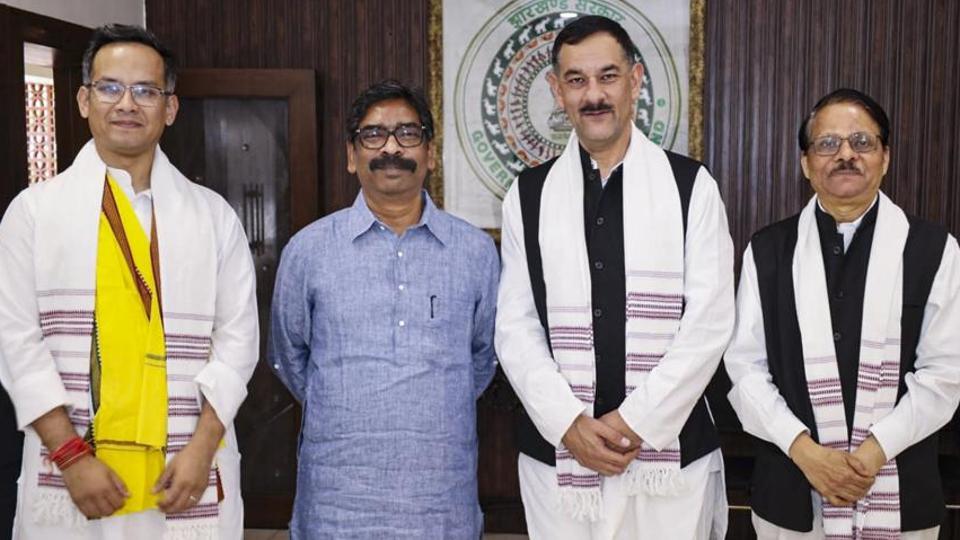
The meeting took place three days ahead of the announcement of polling dates in Assam by the Election Commission of India (ECI) amid speculations of a seat sharing alliance between the two parties.
The same day, Soren also met leaders of Assam Jatiya Parishad (AJP), a constituent of the Congress-led six-party opposition alliance in Assam.
Incidentally, Soren had visited Assam two days prior to that meeting where he addressed a large gathering at Biswanath followed by a mass Iftar event at nearby Tezpur.
When asked by journalists in Ranchi about the meeting, Gogoi remained coy.
“If I disclose it, there will be nothing left to say. The cards will be revealed slowly. An election is happening in Assam and people from there are coming to Ranchi and I am also visiting that place. A road is being prepared to do something better in Assam”, he said.
Soren, however, on March 23, announced the names of 21 candidates who will contest the Assam polls.
Also Read: Miya factor continues to dominate discourse as Assam heads to polls
Following scrutiny of nomination papers, 16 JMM candidates are in the fray---all from constituencies where members of the tea-tribe community, also known as Adivasis, are a significant part of the population and can influence poll results.
Tea-tribes as they are called in Assam are a community of workers or families of former workers in tea-gardens spread across most districts of Upper Assam. The workers were brought by British tea planters from West Bengal, Bihar, Odisha, Madhya Pradesh and present Jharkhand in several phases from the mid-19th and mid-20th centuries. Over years, the community has grown and at present comprises around 17% of Assam’s total population (Census 2011).
Around a million of them are still employed in the 800 big gardens, some in small tea holdings and some have left work in tea gardens for other professions. Due to their sizable numbers, the community plays a key role in the outcome of around 35-40 of the total 126 assembly seats.
According to 2017 data by Assam Tea Plantation Provident Fund and Pension Fund Scheme, there were 9,84,455 tea-garden workers as its members.
Political parties routinely give tickets to members of the community and over past decades several of them have become ministers in both the state and central governments.
But most members of the community haven’t improved much as their health, education and sanitation levels are still poor making them one of the most marginalised sections despite their numbers.
The community was traditionally considered a Congress vote bank. But in the past few years, the Bharatiya Janata Party (BJP) has been able to make inroads.
Since coming to power in Assam for the first time in 2016, the BJP-led government has launched many schemes targeting the tea-tribe community including land rights, reservation of seats in educational institutions, setting up schools in tea gardens as well as providing mobile phones, bicycles, money to meritorious students and funds to youths to set up small businesses.
But two prominent demands of the community are granting Scheduled Tribe (ST) status and improving minimum daily wages for those working in tea gardens haven’t materialised yet despite promises by the BJP. The BJP, in its manifesto released on Tuesday, promised to increase daily wages from present ₹280 to ₹500 in the next five years.
A large section of the tea-tribe community in Assam has their roots in the Chotanagpur region of Jharkhand.
On Saturday, Soren addressed a large election meeting in Gossaigaon to drum up support for the JMM candidate from the seat, Phedrickson Hansdak. He followed it up with more meetings on Sunday to campaign for party’s candidates Baldev Teli and Mahabir Baske who are contesting from Sonari and Tingkhong seats respectively. He is scheduled to address more than a dozen other election meetings for JMM in the state till April 5.
“This is JMM’s first electoral foray in Assam and the love and enthusiasm being shown by you is giving us more strength. I had never thought we would get a chance to be your voice in Assam. You and your forefathers had a big role in setting up tea gardens in Assam and boosting its economy. But what respect and honour have you received? Have you got proper wages, concrete houses and clean drinking water?,” he said in Tingkhong.
“For a long time you have been misused politically and you haven’t got ST status yet. The present political atmosphere in the country is such that we won’t get a chance to rise or move ahead. A time has come to change that through JMM. Many would try to lure you with different inducements, but you need to understand that you won’t get your rights by just asking for it, you have to fight for it. A conglomerate of businessmen is flourishing under the present ruling dispensation. When they came to power they promised control on inflation, ₹15 lakh in each bank account and free LPG? Has any of it happened?
The double-engine government (of BJP) is actually a two-mouthed snake which eats from both mouths,” Soren added.
JMM’s entry into Assam’s poll arena may have surprised some, but the party has been planning it for some time with an eye to expand its base beyond Jharkhand.
Soren is trying to make electoral gains by highlighting the issues of the tea-tribe community as someone who comes from their ancestral region.
Soon after JMM returned to power in 2024, Soren formed a panel to study the plight of Assam’s tea-tribes. Another panel was formed under a cabinet minister Chamra Linda and a party MP Vijay Hansdak to study JMM’s prospects in Assam.
This was coupled with meetings attended in the poll-bound state by Soren before the announcement of candidates on March 23.
“JMM entry into the Assam poll battle has definitely created a buzz. But I don’t think the party will be able to create any impact. Most of the candidates fielded by them don’t have much recognition within the community and are unlikely to win. People are gathering at Soren’s meetings to see his helicopter,” said veteran Congress leader and member of the tea-tribe community, Pawan Singh Ghatowar.
Political scientist and an author of a book, ‘Tea-tribes and their voting trends’, Abu Nasar Saied Ahmed, said that the community is around 8 to 9 million strong and has an influence in around 35 of the total 126 seats.
“JMM might not make a significant impact, but it seems they will cut into BJP votes, which in turn might help Congress. Since both JMM and Congress are part of the ruling dispensation in Jharkhand, they could have some sort of secret understanding as well for the Assam polls,” he said.
BJP chief spokesperson, Kishore Upadhyay believes that the current BJP government in the state has done a lot to improve the quality of life of the community.
“By stating that the tea-tribe community has been deprived of their rights, JMM is blaming their Jharkhand ally Congress which ruled Assam for decades. The present BJP government in Assam has done a lot to improve the lot of the community and they will also get ST status in due course. People from the community know that and will vote for BJP in large numbers this time,” said Upadhyay.



