E-Paper



DU principals propose designated colleges for FYUP’s fourth year amid low student interest
New Delhi: An association of Delhi University (DU) principals has asked the varsity to consider identifying and designating specific colleges for the final year of the Four-Year Undergraduate Programme (FYUP) in the upcoming academic year, stating that only a limited number of students have expressed interest in continuing with the fourth year

 Prefer HTon Google


New Delhi: An association of Delhi University (DU) principals has asked the varsity to consider identifying and designating specific colleges for the final year of the Four-Year Undergraduate Programme (FYUP) in the upcoming academic year, stating that only a limited number of students have expressed interest in continuing with the fourth year.
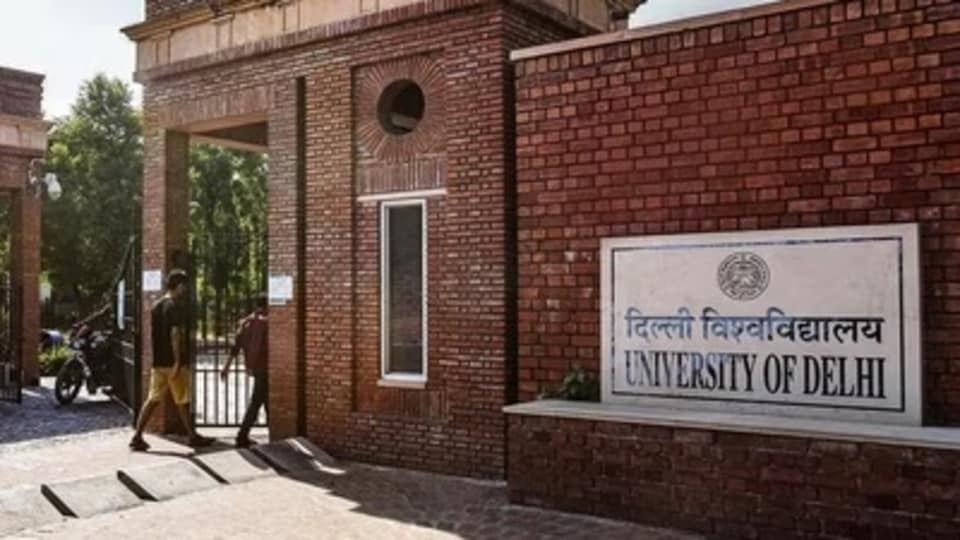
In a letter to DU’s dean and registrar, a copy of which seen by HT, the Delhi University Principals’ Association (DUPA) said only around 30% of third-year UG students had opted for the fourth year in the last academic session, and as per discussions with teachers and students, the expectation is even lower this time.
“Discussions with the principals of various colleges of the DU indicate that it may not be financially, academically, or administratively feasible for every college to offer fourth-year, particularly where student enrolment is very low,” states the letter.
“The university could consider designating certain colleges under it to offer fourth-year, taking into consideration the available infrastructure, faculty strength, academic resources, and student demand. Such rationalisation would ensure optimum utilisation of resources while maintaining the quality and sustainability of the programmes,” the letter adds.
The FYUP was introduced by DU in 2022 in line with the National Education Policy 2020. Under the programme, a student receives an undergraduate certificate after one year, an undergraduate diploma after two years, an undergraduate degree after three years, and an undergraduate degree with a research specialisation after four years. A student can exist at any of the four levels.
DUPA president and Aryabhatta College principal, Manoj Sinha, said the move will help optimise resources. “Last year, we conducted the fourth year of the FYUP, but now we are thinking that it would be wiser if colleges pool resources with each other,” he said.
“For the fourth year, for which there is less student demand, or when the college does not have the required resources, multiple colleges can club together and share teaching resources,” said Sinha.
“Moreover, the faculty is also limited currently, as the additional faculty for the fourth year has not yet been recruited. Not every college will be able to run the fourth year for all the courses,” he said.
He said even fourth-year demand across courses is not uniform, as courses like political science see more fourth-year students than others.
HT reached out to DU for comment but did not receive a response by the time of going to press.