
 E-Paper



LG Manoj Sinha gifts Kashmir’s ‘golden crop’ saffron flowers to PM Modi
This year Kashmir had a bumper saffron production and it is expected to break previous records, according to the growers and the government

 Prefer HTon Google


Jammu and Kashmir lieutenant governor (LG) Manoj Sinha gifted a tray of the valley’s golden crop, saffron flowers, to Prime Minister Narendra Modi in New Delhi on Sunday.
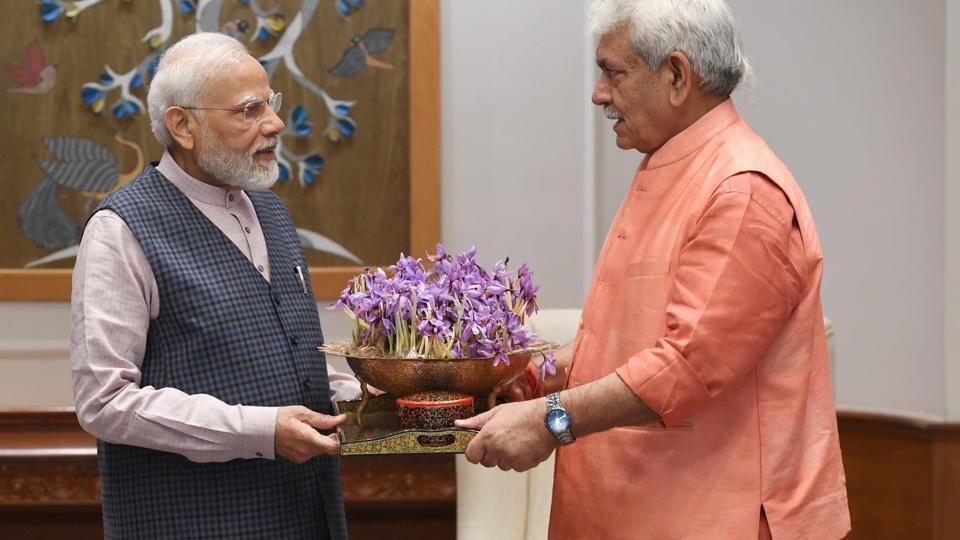
“A special gift of gratitude to Hon’ble PM Shri Narendra Modi Ji from people of J&K. In ancient Indian tradition Saffron is referred as ‘Bahukam’. As harvest festivity draws near, symbol of joy & light GI tagged exquisite & enchanting produce is ready to be delivered globally,” Sinha tweeted along with the picture of a tray with purple saffron flowers.
Sinha also briefed the Prime Minister about J&K’s agriculture and its allied sectors.
“Briefed the Hon’ble PM about recommendations of Apex Committee on holistic development of Agriculture & Allied Sectors for raising farmer’s income & time-bound implementation of reforms to boost agriculture exports, creation of modern infrastructure & value chains,” he said in another tweet.
This year, according to the initial estimates of the growers and the government, Kashmir had a bumper saffron production and the growers got 50 percent more rates due to buying of saffron in bulk by some prominent companies.
Last year, the government said that the annual yield of saffron, the world’s costliest spice cultivated in Kashmir, crossed 13 metric tonnes in 2020 for the first time in 10 years. However, this year the production of the saffron bloom is expected to break more records.
The saffron output is Kashmir, which is mostly cultivated in Pampore in south Kashmir’s Pulwama district near the National Highway, crossed 13.36 tonnes in 2020, the highest in a decade, which, to a large extent, is attributed to the introduction of a government scheme -National saffron Mission- in 2010 to rejuvenate the cultivation of the spice , officials said. The mission brought scientific know-how, underground irrigation and a spice park to rejuvenate the production and post production processes.
Saffron production had peaked in Kashmir in the 1990s with an annual average output of around 15.5 metric tonnes. However, the production declined owing to untimely rainfall, drought and wanton constructions owing to conversion of saffron fields into commercial enterprises on both the sides of the National Highway. The production was 11.72 tonnes in 2015 compared to 1.4 tonnes four years earlier.


