
 E-Paper



Debate: Chandigarh can’t go on a solo ride for MRTS
Tricity residents say that Chandigarh must involve its neighbours Mohali and Panchkula to make its mass rapid transit system plan viable. At present, tricity’s public transport system is not up to the mark, forcing residents to depend on private vehicles and cabs for commuting. A metro is cost and fuel-efficient alternative, they say.

 Prefer HTon Google


Tricity a collective unit
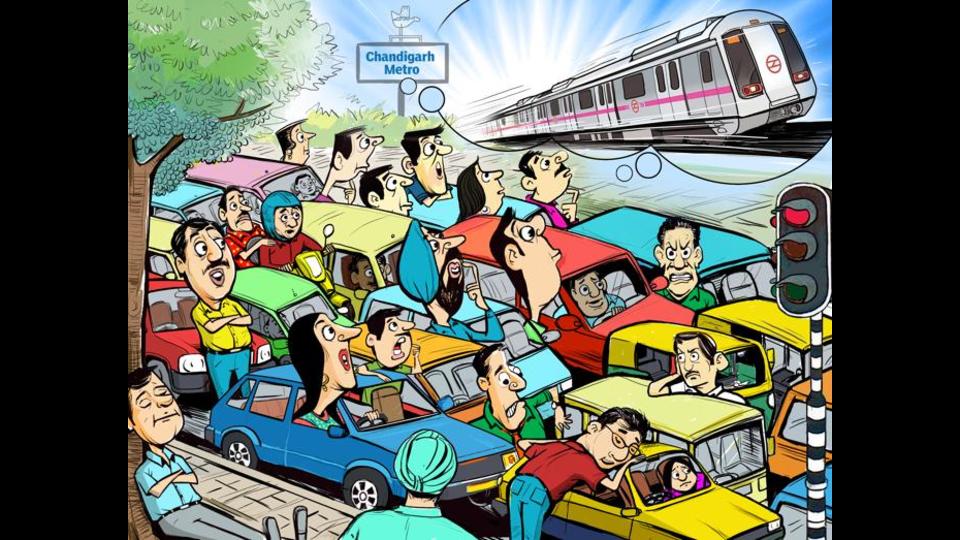
If we take a cursory glance, the neighbouring cities are considered to be a part of Chandigarh and collectively make the tricity. Even the bifurcation of sectors in Mohali seems to be an extension of Chandigarh. A large number of persons commute to and fro from all three cities for various reasons, causing traffic snarls. So, involving the two neighbours in the mass rapid transit system plan would solve half the problems.
Surinder Paul Wadhwa, Mohali
Tricity’s traffic woes may soon match NCR’s
The traffic scenario in tricity is getting complicated and in the next decade or so, may become similar to the National Capital Region. So, a new public mode of transport such as a ,ass rapid transit system should be put in place now, keeping in view all three cities and not just Chandigarh. It is a much-needed step and involvement of Panchkula and Mohali is a must.
Kampreet Gill, Chandigarh
Make up for the delay
It appears that wisdom has finally dawned upon the UT bureaucracy to opt for a metro rail project after losing more than a decade in red tape. This delay has further aggravated the traffic problems on city roads. Now, instead of going it all alone, Chandigarh would do well to involve its neighbours in the plan for the benefit of tricity commuters. More so, when Haryana and Punjab already stand committed to bear the expenditure for their respective portions.
SC Luthra, Chandigarh
MRTS has to be a collective initiative
Thousands of residents commute to and fro on inter-city roads in the tricity on a daily basis for official or personal work. Therefore, a mass rapid transit system (MRTS) will be able serve its purpose fully only if the project is taken up collectively by Chandigarh, Punjab and Haryana. This will also help bring down the vehicle density on city roads and encourage residents to adopt an environment friendly mode of commuting.
Ramesh Aggarwal, Mohali
Need to fast-track MRTS in view of population rise
With an increase in population in Mohali and Panchkula, the need to fast track the transport system has also risen multifold. Housing societies in Pinjore are also adding to the need for a better transport system. A well-coordinated approach to a transport solution is the need of the hour. Chandigarh’s mass rapid transit system has been a good idea but Panchkula, Mohali and the periphery should be included by working in unison.
Garv Bhupesh, Panchkula
Exclusive MRTS for UT a waste
Chandigarh city has a floating population equal in size of its residents, if not more and has become overcrowded due to increasing crisscrossing of vehicular traffic and lack of point-to-point buses and overbridges. It will be a wasteful expenditure for Chandigarh to have MRTS exclusively for UT without engaging Mohali and Panchkula administrations. The proposed MRTS should be financed by Punjab, Haryana and Centre, covering 40 km radius up to Ambala Cantt, Morinda, Ropar and Kalka since employees and visitors in thousands travel back and forth to Chandigarh and surrounding areas on a daily basis. Buses should also run from point to point e.g. one bus from Ambala Cantt linking Sector 17 whereas another connecting high court and a third going to PGI/university. MRTS should consist of buses, metro train and autos.
Col SK Aggarwal (Retd), Panchkula
Projects announced, shelved with change in dispensation
For years, Chandigarh has been mulling on starting a mass rapid transit system but so far, it has not seen the light of the day. Many projects are announced but changed with the change in government. For instance, in 2009, when Pawan Kumar Bansal of the Congress was elected the MP of Chandigarh, he announced the metro rail project for Chandigarh, Mohali and Panchkula very soon. But later, when Kirron Kher became the city’s MP, she declared it unfeasible. Several other projects such as the Tribune Flyover have been hanging fire as residents continue to suffer amid the political tug of war.
Gurpreet S Malhotra, Kansal
City too small for an independent MRTS
Chandigarh is a modern and beautiful city but small in size. No doubt, the mass rapid transit system can prove to be a game-changer but it will be useful only of the neighbouring cities are involved. UT administration must discuss with Mohali and Panchkula regarding the MRTS plan.
Sumesh Kumar Badhwar, Mohali
Fresh mobility plan
Due to an increase in population and vehicular density, tricity roads are seeing frequent jams. To find an effective solution to this, the UT administration must include Mohali as well as Panchkula for a fresh study on the mobility plan for the tricity, and then decide on whether to go for a monorail project, sky bus, metro or any other mode of transport.
Prabhjot Nagpal, Zirakpur
Bring down vehicle density
With over 12 lakh people and 15 lakh registered vehicles, Chandigarh has the highest density of vehicles per household in the country. Inter-state routes cross the city on a daily basis. People from Panchkula and Mohali commute to Chandigarh and the vice-versa on a daily basis. Both Mohali and Panchkula have grown rapidly in terms of population over the last few years, thanks to a spurt in housing societies and BPO industry but the cities have not been able to keep up in terms of infrastructure. The representatives of the three cities should discuss a workable strategy to fix the gaps.
Usha Verma, Chandigarh
Lackadaisical attitude of local leadership
The tricity, particularly Chandigarh, has the highest ratio of vehicles per person in the country but we are unable to work on traffic management for the next 25 to 30 years. While the situation is bearable in Chandigarh, its neighbours Mohali and Panchkula are grappling with traffic issues. The local representatives are still struggling to decide on whether to go for a metro or monorail. Consultants are appointed, a hefty fee is paid and after a meeting or two on the reports, the report is put in cold storage for regime change. The basic problem, we don’t have a railways minister or an influential minister in centre to push the case for approval or funding.
Suresh Verma, Chandigarh
Decongest city roads
The mass rapid transit system is a good plan to decongest the city roads, besides helping commuters save on fuel expenses. Both Panchkula and Mohali should be involved in the projects as Chandigarh residents cross over to its neighbouring cities and vice-versa for work, personal and social purposes.
Vijay Garg, Manimajra
Light metro is the right option
As per the previous detailed project report (DPR), the metro is to run underground within Chandigarh and emerge thereafter to connect adjoining areas. In addition to tricity traffic, thousands of commuters visit daily from Haryana and Punjab daily. Due to this there is tremendous increase of traffic on roads, causing severe vehicular/ dust pollution, traffic jams, and accidents. Chandigarh as a Smart City must accept change, improve the quality of life and usher in efficiency. We must go for a light metro which is fast, comfortable, uninterrupted and non-polluting.
Sateesh Dadwal, Chandigarh
Punjab, Haryana must contribute
Due to denial and monetary non-cooperation by two states, Chandigarh administration had to go alone for MRTS. With a surge in population and number of vehicles per person, it is only reasonable to come up with an MRTS. In the past, due to too much interference by bureaucrats, councillors, ministers, and initiatives taken by residents to protect the legacy of Le Corbusier, the metro project and flyover were put in limbo. A large chunk of population from the city commutes daily to peripheral towns for job or daily work. To make them at ease and decongest the roads, administration should expedite the MRTS project. Punjab and Haryana should also contribute to the project.
Abhilasha Gupta, Mohali
Need reliable public transport system
Tricity has no reliable public transport system and most residents prefer to use their private vehicles or cabs for daily commute. A pan-tricity MRTS project will help bring down the traffic congestion and prove beneficial in the long run. If not a metro, the tricity should look at least improving its bus connectivity. If the tricity does decide to go ahead with an MRTS, it must formulate a solid plan for underground metro rail network.
Sanjay Chopra, Mohali
One transportation system for 3 cities
It is essential for the Chandigarh transport authorities to involve its two neighbouring cities, Mohali and Panchkula in its MRTS project. These three cities share porous borders with each other and therefore must have an integrated transportation system. A resident who is travelling between these three cities should be able to travel around using one transportation system only. The three cities are together and should always work together.
Saikrit Gulati, Chandigarh
Will solve commuting woes
It is great that the UT administration us contemplating to switch to MRTS to decongest city roads, but the plan will be a futile exercise if the neighbours Mohali and Panchkula are not involved. Punjab and Haryana should also understand their responsibility towards a wholesome development of the tricity. A metro is any day better than autos etc, which charge commuters as per their will.
Kundan Lal, Mohali
Combined planning
Chandigarh can’t be separated from the tricity. Not treating the three cities, which are codependent on each other, as one unit is nothing but lack of vision. Hence all development in the three cities must be planned together.
Anju Mohan, Panchkula
A comprehensive approach
The study on Chandigarh’s Mass Rapid Transit System will be unrealistic and incomplete without involving Mohali & Panchkula. Chandigarh UT, Mohali and Panchkula form a large urban complex with multiple traffic and transportation problems and hence the MRST study should be comprehensive to achieve the desired results. Moreover, the Chandigarh inter-state capital region plan studies carried out in the past by the town and country planning organisation, also envisaged proper coordination between these three constituents.
Hardaman Singh Bhogal, Mohali
Decision seems to have been taken in hurry
The decision of the Chandigarh administration to go solo on the new study - mass rapid transit system (RTS) –is lopsided and seems to have been taken in a tearing hurry. The administration needs to revisit the decision and reverse the same in the larger interest of the people. It should, instead of going all alone, mull over bringing the two satellite townships, namely Panchkula and Mohali on board to make the envisaged project a huge success and reap good dividend out of it.
Ramesh K Dhiman, Chandigarh
Come up with a logical, workable solution
Since Chandigarh, Mohali and Panchkula constitute the tricity, a combined MRTS plan for the tricity would be logical and workable. Planning MRTS only for Chandigarh would be meaningless and actually a waste of money because a large number of commuters travel daily from Mohali to Panchkula and from Panchkula to Mohali.
AK Sharma, Chandigarh
UT’s problems also reflect on its satellite towns
The decision of Chandigarh administration to go for a fresh study on mass rapid transit system for City Beautiful is well-received. The population and number of vehicles in Chandigarh have increased manifold leading to traffic congestion. In addition, over two lakh vehicles on inter-state routes cross the city daily. Mohali and Panchkula, the satellite towns of Chandigarh, also have the same problem. Hence, UT Chandigarh must involve the two in its MRTS plan.
Subhash Chugh, via email
Problem of floating population
An MRTS Plan without involving Mohali and Panchkula will be inherently faulty, since the UT is servicing the population of both states and the traffic situation is already worsening. The MRTS should be a holistic plan which should see us through another 100 yrs. The MRTS should come up on all major axis so that people from these towns and cities do not need a car/bus to come to the major service points of the high court, PGI, secretariat, Panjab University. A metro will also help prevent the floating population from commuting to Chandigarh in their personal transport and ensure less pollution and less traffic chaos. The suggested axis could be: Karnal-Ambala- Chd-Nalagarh, Ludhiana-Khanna- Chd-Pinjore, and Ropar-Kurali-Chd Nalagarh.
Maj RS Virk, Chandigarh
Overall development of tricity
Since Chandigarh, Panchkula and Mohali are interlinked, the developmental planning also must be interlinked. Connectivity in Chandigarh alone will not achieve the desired purpose and result. While overall development is the prime consideration, any individual planning, and not a totalitarian planning for the tricity will do against the overall development of all the three entities.
Group Captain Samaresh Kumar Goswami ( Retd), Panchkula
READER OF THE WEEK
Fast and easy commuting
Yes, Mohali and Panchkula should be on board in Chandigarh’s mass rapid transit system (MRTS) plan. Besides making commuting fast and easy, it comes with other advantages such as energy efficiency and low cost of commuting etc. The MRTS may prove especially useful in bringing down the peak-hour rush on the roads.
Ishita Nara, via email
BY INVITATION
What city needs
The mode of transport, routes and distance have to be decided first. The MRTS has to be planned with a long-term perspective for the city.
SD Sharma, member, Chandigarh heritage conservation committee
Signal-free roads
To decongest city roads, we need a signal-free road system. It is imperative that the three main roads - Dakshin Marg, Madhya Marg and Chandigarh Road should be signal free, so that, traffic flows smoothly in and out of the city without any bottleneck.
DS Jaspal, retired IAS officer and former principal secy, transport Punjab
Plan with a vision
To decongest city roads, UT administration should not only include Mohali and Panchkula but also towns like Dera Bassi and New Chandigarh for the MRTS. Chandigarh should have a vision for the next 30 years while deciding on the project.
Sarvjeet Singh, principal secretary, housing and urban development, Punjab
Retain city’s character
A mass rapid transit system cannot be limited to Chandigarh only and has to involve Panchkula, Mohali and beyond. In addition, before finalising the plan, care should be taken to not spoil the character of the city.
Surinder Bahga, former chairman, Indian Institute of Architects Chandigarh- Punjab chapter
Save time, money
An organic solution will help all stakeholders gain as the issue is crucial for the city’s development. It should help save people’s time and money spent on transportation, and prevent environmental pollution.
Urvashi Gulati, IAS retd, former Haryana chief secretary


