PRAYAGRAJ: Data obtained from India’s partially successful Chandrayaan-2’s mission is being harnessed for analysis and a study of part of the data would soon begin at Sangam city’s Jhalwa-based Indian Institute of Information Technology –Allahabad (IIIT-A).
The Indian Space Research Organisation (ISRO) has enlisted the expertise of IIIT-A scientists for this task, with Himanshu Maurya, an assistant professor in the Department of Electronics and Communication Engineering, taking the lead in analysing Chandrayaan-2’s data.
ISRO has allocated a grant of ₹21 lakh for a three-year research project titled ‘Automated Lunar Crater Detection Using Payload from Chandrayaan-2 Mission.’
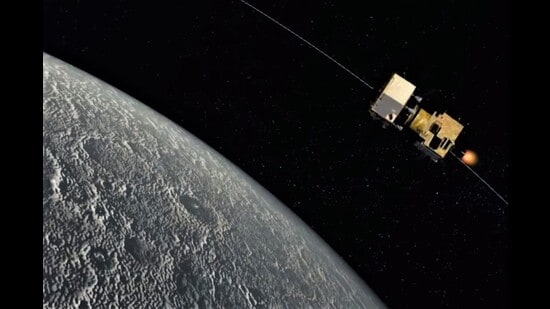
It is important to note that India’s ambitious Chandrayaan-2 mission was successfully launched on July 22, 2019, from the Satish Dhawan Space Centre (SDSC) in Sriharikota. Despite achieving only partial success due to the loss of the lander during its final stages of touchdown, Chandrayaan-2’s Orbiter currently maintains a 100 km x 100 km orbit around the Moon.
It continues to conduct experiments, focusing on surface geology, composition, and exospheric measurements. These efforts build upon knowledge gained from previous lunar missions, thanks to its advanced instruments, including a Terrain Mapping Camera. The orbiter remains on track to complete its seven-year mission to study the Moon as originally planned.
Himanshu Maurya, a specialist in satellite image processing, microwave remote sensing, Synthetic Aperture Radar (SAR) Image Classification, and Biomass estimation, emphasised that Chandrayaan-2’s data will facilitate a comprehensive examination of the lunar surface.
{{/usCountry}}Himanshu Maurya, a specialist in satellite image processing, microwave remote sensing, Synthetic Aperture Radar (SAR) Image Classification, and Biomass estimation, emphasised that Chandrayaan-2’s data will facilitate a comprehensive examination of the lunar surface.
{{/usCountry}}“Our study and analysis of the data aim to reveal the composition and distribution of lunar elements and materials. Additionally, it seeks to unveil the historical evolution of the Moon’s surface, shedding light on the formation of lunar features and craters,” he explained.
He further noted that this thorough lunar analysis holds great importance for future Moon missions, as it will aid in identifying suitable and secure landing sites. The study will enhance our understanding of the lunar terrain and help determine whether moon craters were formed by meteorite impacts.
Additionally, the presence of minerals and other elements such as olivine, pyroxene, carbon, sulphide, etc., on the lunar surface will be examined. This, in turn, will enable ISRO to make more informed decisions about the precise locations for future lunar landings, ultimately improving the safety and success rates of upcoming missions.