
 E-Paper



Residents struggle with faulty amenities in Gurugram
The impact is most visible along the Rampura–Naurangpur Road and across sectors 77, 78, and 79, where roads have disintegrated into slush-filled craters where commuters are forced to navigate through knee-deep water, risking vehicle damage and accidents.


Residents of Sector 79 and its adjoining neighbourhoods are struggling with deteriorating civic infrastructure, which they say has worsened in recent weeks due to heavy rainfall. Waterlogged roads, deep potholes, stray cattle, and toxic dust from nearby ready-mix concrete (RMC) plants have created ‘inhumane living conditions’, said locals.
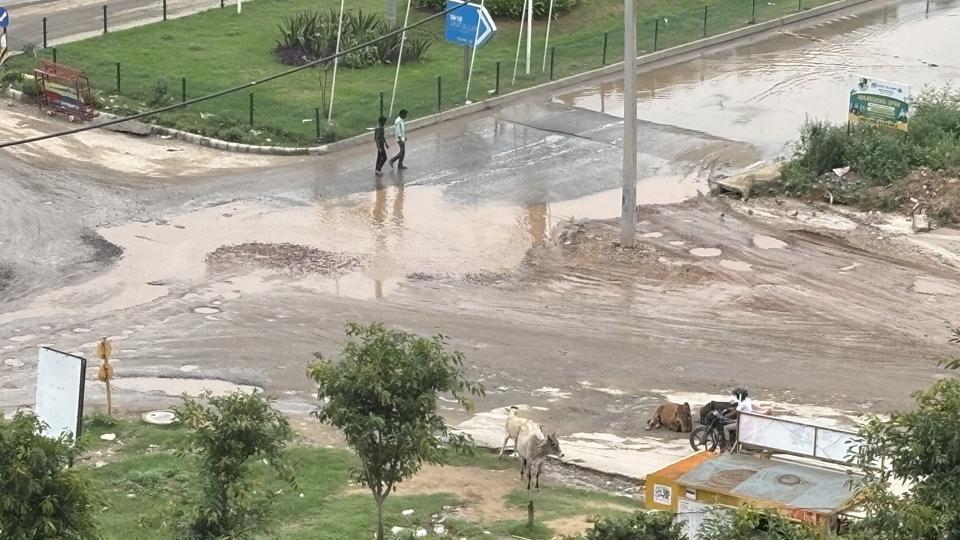
The impact is most visible along the Rampura–Naurangpur Road and across sectors 77, 78, and 79, where roads have disintegrated into slush-filled craters where commuters are forced to navigate through knee-deep water, risking vehicle damage and accidents.
To be sure, the sanitation upkeep in sectors 77, 78, and 79 is maintained by the Municipal Corporation of Gurgaon (MCG) and the jurisdiction of the roads are under the Gurugram Metropolitan Development Authority (GMDA).
“With the onset of the monsoon, the situation has deteriorated beyond acceptable limits,” said Maj Gen Subhash Gogna (Retd), a resident of Mapsko Mount Ville. “These roads are virtually unusable. Our vehicles take a hit every time we step out. GMDA has taken no visible steps towards emergency repairs. While we wait for DBM surfacing, they must deploy pumps and activate storm drains.”
Gogna, who recently submitted a detailed letter to civic authorities, also flagged the unchecked presence of stray cattle as a persistent road safety and hygiene threat. “Cattle regularly occupy roads near our society gates. This is not just an eyesore but a real hazard, especially for school-going children and senior citizens. Despite multiple complaints, there’s been no intervention from MCG.”
Residents have also raised alarm over the environmental impact of two RMC plants operating in close proximity to residential complexes. These plants, once permitted when the area was largely vacant, now contribute to high levels of dust and air pollution.
“These mixing units are running right next to habitable zones. Concrete spills, continuous movement of heavy trucks, and particulate dust have taken over our lives. Repeated requests to the department of town and country planning (DTCP) for shifting these plants have gone unanswered,” Gogna said.
Pradeep Dahiya, MCG commissioner said that now they have over 300 vehicles for clearing and collection of waste from door to door. “Our teams are on the ground and are clearing the legacy waste one by one. The situation will get better in coming days,” said Dahiya.
Yogender Mohan Ambardar, another resident, pointed to the deteriorating road quality and pollution levels: “The section near Mapsko Mount Ville is in shambles. The roads have been battered by construction trucks. The RMC plants have made the air unbreathable. The cattle, illegal vendors, and unreliable sewer lines only add to the chaos. The administration has gone silent.”
Mohit Verma, also a resident of Sector 79, said the situation has crossed the threshold of tolerance. “Every spell of rain turns our roads into pools of disease and filth. Overflowing sewer lines emit unbearable stench. We pay our taxes expecting at least basic services. What we get is silence.”
For many residents, the lack of accountability is the most frustrating. “How long are we supposed to live like this?” asked Vikram Singh, a resident. “Ongoing construction, cattle roaming freely, and a collapsing infrastructure have made this place unlivable. Is this the idea of urban development?”
Responding to these complaints, a Gurugram Metropolitan Development Authority (GMDA) official said, “We are aware of the situation and are actively working on addressing these concerns. The agency has been directed to fill the potholes and carry out the rectification work. The road will be made motorable within two days.”


