E-Paper



Sambhal mosque: ASI’s use of ‘Juma Masjid’ on new signboard sparks row
Mosque committee preparing to officially register its objection and demand reinstatement of the original name

 Prefer HTon Google


: The Jama Masjid in Sambhal is once again at the centre of a controversy—this time over a change in its name on a newly prepared board by the Archaeological Survey of India (ASI).
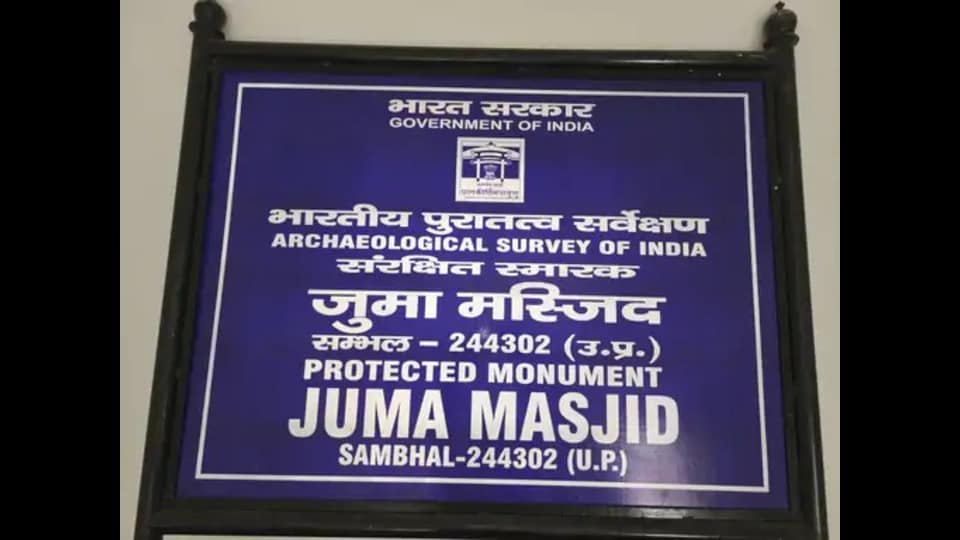
The new signboard, intended to be installed outside the protected monument, refers to the mosque as “Juma Masjid,” a departure from the traditionally recognised name “Jama Masjid.”
According to the mosque committee, the name “Jama Masjid” has been consistently used in official documents and historical agreements, including a 1927 accord between the ASI and the mosque management. The committee is opposing the new nomenclature, calling it historically inaccurate and arbitrary.
Masood Ali Farooqui, joint secretary of the Jama Masjid Committee, said, “When historical records and formal agreements refer to the mosque as Jama Masjid, ASI should not unilaterally adopt a different name. We will be raising this issue with them very soon.”
Previously, the signboard identifying the mosque was placed inside the premises. The ASI now plans to move it outside, sparking renewed attention. The new board, which has already been prepared, bears the name “Juma Masjid,” which the committee claims is not a recognised or commonly used term.
Shakeel Warsi, legal advisor to the mosque’s management committee, criticised the move as a “wrong precedent” and warned it could provoke fresh disputes. “This mosque is popularly known as Shahi Jama Masjid and is identified by that name across the country. Changing it is not only incorrect but also unnecessary,” he said.
The ASI, however, has defended its decision. ASI counsel Vishnu Kumar Sharma stated that the mosque remains a protected monument and that the relocation of the board is being carried out according to departmental protocol. “This is a matter of administrative convenience,” he said.
The dispute has resurfaced at a time when the mosque is already in the national spotlight. On November 24 last year, tensions flared during a survey conducted at the site, leading to violence in which at least four people were killed.
Just days earlier, on November 19, 2024, a petition filed by a Hindu group in a Chandausi court referred to the mosque as “Jami Masjid,” further complicating matters.
The mosque committee has also raised objections to this term. Farooqui explained that while “Jama” (an Urdu word) and “Jami” (of Arabic origin) both mean “congregational,” “Juma Masjid” is not a widely accepted or historically documented name.
“The name of the mosque should remain exactly as it appears in historical records and agreements. Any deviation amounts to tampering with heritage,” he said.
The mosque committee is preparing to officially register its objection and demand the reinstatement of the original name.