
 E-Paper



The ordinary excellence of Old Delhi houses
Mir Taqi Mir mourns Old Delhi's loss, highlighting its once vibrant culture and architecture now overshadowed by neglect and lack of conservation efforts.

 Prefer HTon Google


Mir Taqi Mir, the 18th century master of Urdu poetry, once wrote of a “Dillee” that no longer existed by the time he wrote about it. Fleeing the city as calamity fell on it, which he blamed on the envy of the heavens, he described a city so eminent that the heavens themselves grew envious of it, and a fate that answered with devastation.
O Easteners
You judge me vagrant, vagabond and tramp
Because my clothes are threadbare and my countenance melancholy
and question me, in derision, about my origin and habitat.
Know then that Dillee,
which used to be a special and chosen place
amongst the cities of the world,
attracted as its inhabitants the select and topmost members
of each profession, avocation and calling.
The city grew in eminence
until the Heavens themselves envied it.
Fate visited it with devastation.
I too once inhabited the place which is now desolation.
The streets, lanes, and by-lanes of Dillee
were not mere thoroughfares, roads, passages, and alleyways:
They were gilded folios of an illuminated manuscript
where every face was a masterwork.
Is there another place where you can experience
All seven climes of the world
in each alley, passage, and thoroughfare?
How then is it possible for any city to equal Dillee?
Historian Akhilesh Mithal used this verse to open his account of a 2005 article titled “The Delhi that once was” in Marg Magazine (Vol 56, No. 3). It applies as precisely to a single haveli as it does to the city that surrounded it.
Sita Ram Bazaar still holds a handful of these houses. The stone carvings survive on some façades, moulding shaped by centuries of cultural amalgamation. The baradaris remain too — the twelve-door halls built for cross-ventilation and light, a design principle disguised as a display of grandeur. Jharokha balconies extend over the lanes, carried on brackets carved with the same attention given to the rooms behind them. These were not decorative flourishes. A baradari’s twelve openings did the specific work of keeping a Delhi summer bearable before mechanical cooling existed. The jharokhas let women observe the streets without being observed from them. Havelis were status symbols.
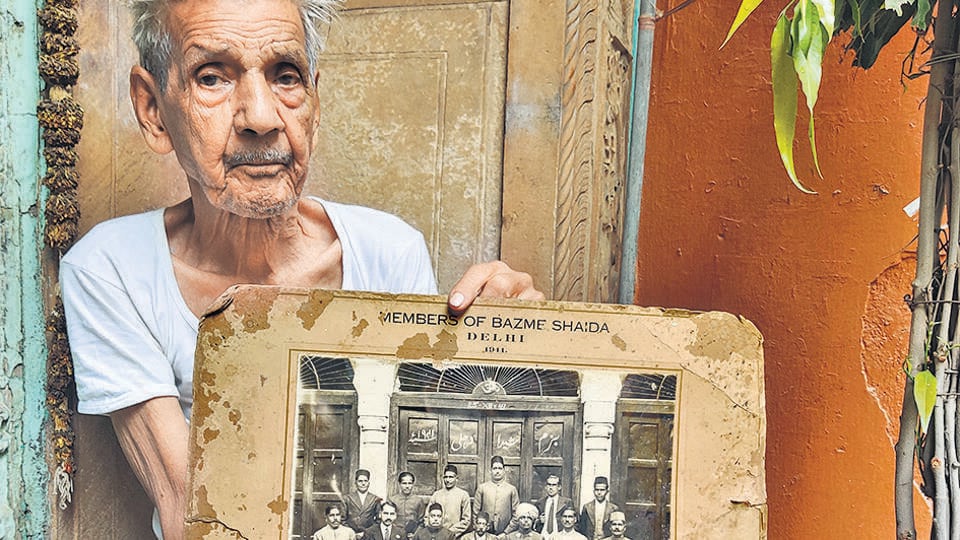
One of these houses still has a resident who remembers what the building meant beyond its architecture. A 93-year-old man in Sita Ram Bazaar keeps a photograph from 1911, a group portrait of a poetry club called Bazm-e-Shaida. He appears in it as a young boy, seated at his grandfather’s feet. The club met for over a century in a haveli with twelve doors. That single photograph carries more evidence of what Old Delhi’s domestic architecture was built to hold than any survey of its brackets and stone screens. A haveli was a venue hosting mushairas, family disputes, weddings, and the ordinary business of a joint family across generations. The building was an institution but, again since Mir’s old time institution is gone in most of these houses, and only the building remains, and often not even that.
This is the same erosion visible at Sujan Singh Park and at the Delhi Gymkhana Club, though it takes a different form here. What is disappearing in Sita Ram Bazaar is not a single well-documented complex but a whole category of ordinary excellence, houses that were never grand enough to attract conservation funding and never poor enough to be cleared and rebuilt. They sit in the gap between heritage protection and redevelopment, and the gap is where they are dying. Families divide a haveli’s ownership across generations until no single heir can afford its upkeep and no group of heirs can agree on its restoration. Delhi’s mixed-ownership havelis are collectively harder to save than any single monument, because there is no one owner to negotiate with.
The state’s attention to Old Delhi since independence has gone largely to Chandni Chowk’s street, not its houses. The Shahjahanabad Redevelopment Corporation, set up in 2008 after the project was first proposed in 2004, spent over a decade before its first phase was completed in 2021: underground wiring, pedestrianisation, resurfaced footpaths, a vehicle-free corridor between 9 am and 9 pm. But these buildings do not need redevelopment, they need conservation.


