
 E-Paper



UP women’s participation in MGNREGS: Backed by govt, training Mahila Mates set to attract rural workforce
Apart from Mahila Mates, UP rural development department is also introducing a few more women-friendly factors in MGNREGS such as creating an all-women worksites and women-specific work projects.


LUCKNOW Uttar Pradesh took a significant step to amend the dismal fact of being among the worst-performing states as far as women’s participation in the Mahatama Gandhi National Rural Employment Guarantee Scheme (MGNREGS) goes. The UP rural development department, aiming for higher women’s participation in MGNREGS, has trained 18,000 Mahila Mates and deployed 3,010 on job sites.
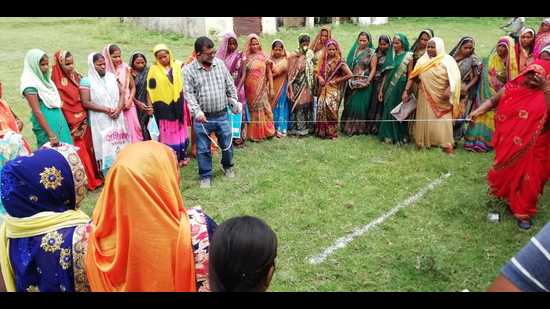
Mahila Mates are women assistants for management and supervision of MGNREGS jobs and job sites.
So, how is UP the worst performer? And how would Mahila Mates make a difference?
During the Covid-19 pandemic in 2019-20, Uttar Pradesh had employed a whopping 1.11 crore people under the MGNREGA, but the workforce was male-dominated.
“The state had generated only 32.52% of women person-days of the 30.55 crore person-days of work generated in the year. At the 28th position, UP was the lowest in the country with only J&K and Lakshadweep ranking lower on the women’s employment index under the MGNREGS. But then we decided to bring in a change. Mahila Mates was one of the top ideas for this”, said Yogesh Kumar, additional commissioner, MGNREGS, UP.
In March, this year, the rural development department announced that it will appoint Mahila Mates on job sites. By June, the appointment process was completed, and till now 18,000 Mahila Mates who were selected have been trained. Of these, 3,010 have begun working on their respective job sites.
“We believe that the Mahila Mate concept will go a long way in increasing women’s participation in the rural employment scheme. First of all, these 18,000 Mahila Mates are getting direct employment in the scheme. Secondly, once the women in villages know that job sites are being managed by women, it will inspire women in villages to opt for work under the scheme because job sites headed by women will change the social structure of a job site and address the hesitancy among prospective women workers. We had observed that men-dominated worksites do make women shy from participating in work even if they wanted to,” he said.
He said that apart from Mahila Mates, the department is also introducing a few more women-friendly factors in MGNREGS such as creating an all-women worksites and women-specific work projects.
The rural development department had ordered that all job sites with less than 40 workers will have a Mahila Mate to supervise the site and work there. Sites with more than 40 workers will have two Mahila Mates.
To make the appointment fast and smooth, the department had selected the Mahila Mates from existing women SHGs (self-help groups) in the panchayats.
Kerala, Puducherry and Tamil Nadu were the top-ranking states offering women work under MGNREGS with 91.41%, 87.04%, and 84.88% women person-days respectively last year.
During these times of pandemic, with a focus on employment generation under MGNREGS, UP had registered a whopping 87% increase in person-days generated in 2019-20 against the previous year. But women’s share remained unchanged in the last five years.
“Yes, over the last five years, women’s participation in the MGNREGS has consistently been low and lower than the national average,” said Yogesh Kumar.
The national average in 2019-20 had been 52% women person-days, UP’s was 32.52%. “Now we aim for 34 to 38%,” said Kumar.
He said: “Socio-cultural set-up and physical intensive works are inhibiting factors behind the low participation. Women do not like to work at male-dominated worksites and on physically gruelling jobs. So, we have decided to introduce all-women worksites and women-specific works--such as plantation, gardening, nutrition gardens, nurseries or organic cultivations.”
All the Mahila Mates that were selected have been trained in how to do their work--making muster roll, record attendance, making a layout for work, measuring of work done, or how to update the work demand, and how to encourage women to work.
The department will also promote horticulture, floriculture, vegetable cultivation, animal husbandry, and fisheries under convergence of MGNREGS and the Rural livelihood mission as these jobs are not as physically intensive and also interest women.


