
 E-Paper



700-year-old paper preserved by Pune’s Bhandarkar institute
The Bhandarkar Oriental Research Institute (Bori) has restored a 700-year-old paper, made in 1320


The Bhandarkar Oriental Research Institute (Bori) has restored a 700-year-old paper, made in 1320. This is the oldest paper in Maharashtra, said Bori officials on Saturday.
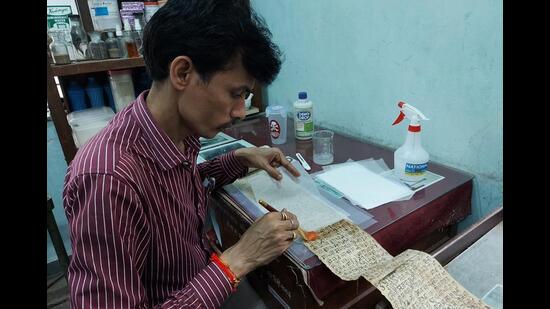
Bhupal Patwardhan, chairman, executive board, Bori said, “A little dive into history states that there were two ways to make paper. One is from bulk of tress and second is from cotton. This is a handmade paper made up of a bulk of tress. It has withstood any corrupt microbiological elements and we intend to keep it that way by preserving it.”
Amruta Natu, assistant curator at Bori said that the plant-based paper was used for ‘Chikitsa Sara Sanghraha’ (Sanskrit medical manuscript). “The regular white paper we use today has cellulose and fibre aligned in one direction and is rolled on a roller during manufacturing. However, the cellulose and fibre in handmade paper is aligned randomly which affects its tear and mending capacity. There was no chemical usage while manufacturing this paper and it has zero chemical absorbing capacity from the atmosphere, hence, it has high lasting capacity. The paper can be preserved for another 100 years.”
According to Natu, the paper was earlier preserved at Elphinstone College, Mumbai during the British-era. However, considering the humid weather in Mumbai, it was shifted to Deccan College in Pune in 1878. The humid atmosphere increases the chances of biological infection. In 1922, the paper was shifted to Bori. The institute has also built an anti-fire wall for its preservation.
“The paper is stores in a special Burma teak wood rack. To avoid pest, fungus and microbial infection mechanical cleaning, soft brushing is included in regular maintenance,” said Natu.
Speaking about conservation, preservation and restoration process, Varsha Kotphode, book/ manuscript conservator at Bori said, “Our preservation treatment depends on the damage. However, anoxia treatment is important. In this, the infested object is placed in a bag where oxygen level is reduced to a stage that can kill the life cycle of an insect. Then, through various stages like deacidification, flexibility treatment, anti-fungal treatment, tear mending process and strip lining we usually carry forward the process of preservation and restoration.”


