E-Paper



A construction worker’s unfinished Olympic dream lives on through the children in his village
Shikalgar grew up in an Ankalkhop family marked by financial struggle. His father sold tea, and sports were never part of his upbringing

 Prefer HTon Google


Every evening, a group of children gathers at a modest training ground in Ankalkhop village in Sangli district. They sprint down a narrow runway clutching fibreglass poles before launching themselves into the air. Today, they land safely on a professional pole vault mat. Just a few years ago, however, their landing area consisted of soft riverbank soil, discarded vehicle seats and sponge scraps collected from a nearby factory.
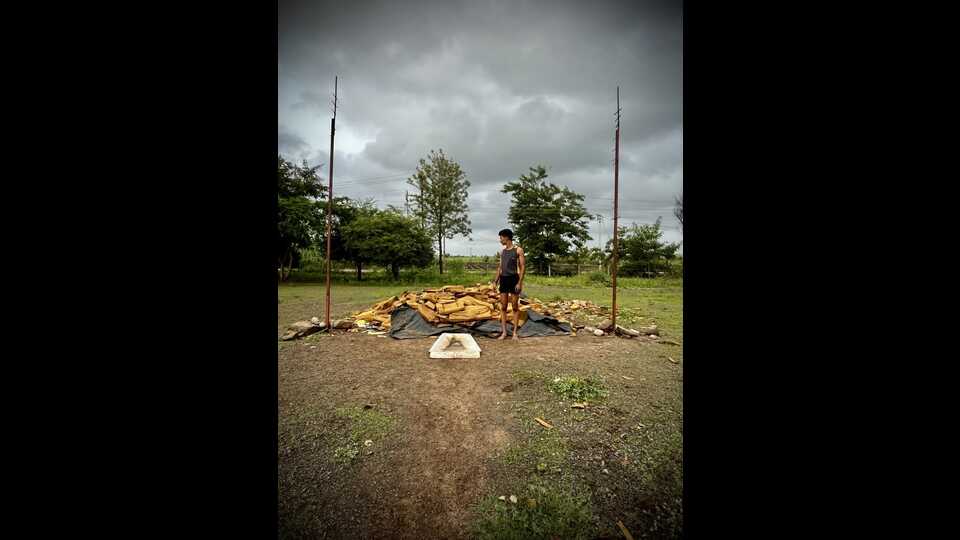
Behind this unlikely academy is Anis Shikalgar, a former construction worker and class 10 dropout whose own dream of representing India ended before it could truly begin. Instead of leaving the sport behind, he chose to build opportunities for children from his village—free of cost.
Shikalgar grew up in an Ankalkhop family marked by financial struggle. His father sold tea, and sports were never part of his upbringing. He worked as a construction labourer before taking up running in search of a better future. It was during that phase when he was already 27 years old that Shikalgar met veteran athletics coach Sham Bhosale, who introduced him to pole vaulting.
“Most athletes retire around that age, but I was just starting,” he recalled.
Although he went on to compete in the senior category and finish fourth, he soon realised that his chances of representing India had slipped away.
“I wanted to play for India, but because I started athletics late, I crossed the age limit. So, I decided to teach pole vaulting to children from my village free of cost,” he said.
In 2021, Shikalgar began coaching children on the banks of a river, where the soft soil offered a safer landing than hard ground. The challenge, however, was not finding talent but convincing parents to send their children to learn the sport.
Many families could not afford coaching fees, while others were sceptical because there was no equipment or proper landing facility. Only two children joined initially.
Determined not to abandon his dream, Shikalgar improvised. Sponge scraps from a nearby factory were stitched together to create a makeshift landing pit, while discarded vehicle seats served as cushions during practice. He later travelled to scrap markets in Kolhapur to source better-quality foam and reused discarded material to improve safety.
Pole vaulting is among athletics’ most expensive disciplines. A standard landing mat costs around ₹4.5 lakh, while the poles themselves cost tens of thousands of rupees. Unable to afford the equipment, Shikalgar began sharing videos of his trainees on social media. Gradually, donations from villagers and well-wishers helped the academy buy better equipment, including a second-hand pole from Uttar Pradesh for ₹55,000. More recently, LUJO Furnishing helped the academy acquire its first professional landing mat.
Today, the academy trains 12 athletes, compared to just two when it started. Only one trainee is a girl, reflecting the social barriers that still exist in many rural areas.
Shikalgar’s coaching revolves around mastering technique—everything from grip and run-up to take-off, pole plant and body position. He often encourages his students to study the technique of legendary Ukrainian pole vaulter Sergey Bubka, whose achievements continue to inspire him.
Shikalgar’s efforts began attracting attention when Atharv Mirajkar emerged as the academy’s first athlete to compete at the national level.
“When Atharv created a state record, people finally recognised my work. Through him, I was able to create interest in pole vaulting,” Shikalgar said.
Atharv’s own journey mirrors that of his coach.
“I first went to the Bhagat Singh School ground for running. My coach initially wanted me to run the 800 metres. Later, I watched Anis Sir coaching during the Sangli district competition and decided to take up the event,” Atharv said.
Like the others at the academy, Atharv too trained at the riverbank before proper facilities were made available.
“In the beginning, we practised near a river because we did not have proper facilities,” Atharv said.
One of the defining moments of his career came during the state championships.
“My pole broke during the competition, but on my third attempt I cleared the qualifying height. That helped me qualify for the national championships,” he recalled.
Atharv went on to represent Maharashtra at the 69th National School Athletics Championship in 2025, finishing fourth. He has since improved his personal best from 4.10 metres to 4.20 metres and now hopes to qualify for the Asian Championships before eventually clearing the five-metre mark. After completing his own training sessions, he also helps coach younger children at the academy.
“I failed many times at the district level and even thought of quitting. But I kept reminding myself that I wanted to see the Indian flag raised and win a gold medal for the country,” Atharv said.
Besides Atharv, Shikalgar is now training promising athletes such as Sarthak Gavade, Shubham Motgate and Nandini Motgate, while three of his under-17 athletes are preparing for national-level competitions.
For Bhosale, who introduced Shikalgar to the sport years ago, the academy represents what determination can achieve despite limited resources.
“It is very important for Indian parents to give sports the same importance as academics. I have seen how hard Anis works with his students. All these children come from villages, but they have tremendous determination. We should support them because they have the talent to make history and contribute to the country,” Bhosale said.
Bhosale noted that pole vaulting remains one of Maharashtra’s least accessible athletics disciplines because of the specialised coaching and expensive infrastructure it demands.
“It is a significant achievement that students in Sangli are now receiving training in this event,” he said.
Calling pole vaulting one of athletics’ most technical disciplines, he said India’s long-term goal should be to produce athletes capable of meeting the demanding qualification standards for global events.
“These students should certainly aim for podium finishes at competitions such as the Commonwealth Games, but their ultimate goal should be to prepare Indian pole vaulters to meet the challenging five-metre qualification standard for the 2028 Los Angeles Olympics. I firmly believe this is achievable with the right support and training,” Bhosale said.
Despite producing national-level athletes, Shikalgar says government support has remained elusive. He believes rural India possesses immense sporting talent but lacks infrastructure, equipment and access to specialised coaching.
He also sees the sport as a powerful social intervention.
“If you want to keep your children away from addiction, encourage them to take up sports,” he said.
Shikalgar knows that he may never wear the India jersey himself. But every evening, as another child grips a pole and sprints down the runway, he watches a dream that once belonged to him take wing in an entire generation.
“My dream is to produce at least one athlete who qualifies for the national championships every year,” he said.
For Atharv, that dream has already become personal.
“I want to win a gold medal for India and see our national flag raised at the Olympics,” he said.
From a riverbank lined with discarded vehicle seats to a training ground producing national-level athletes, the journey of Ankalkhop’s pole vaulters has shown that talent often needs little more than belief, perseverance and someone willing to give it a chance.