
 E-Paper



BJP sweeps Pune, Pimpri-Chinchwad; NCP unity fails to deliver
The NCP secured 20 seats, the Sharad Pawar-led NCP (SP) won three, while the Congress finished with 15 seats. The Shiv Sena failed to win a single seat, while the Shiv Sena (UBT) managed just one

 Prefer HTon Google


The Bharatiya Janata Party (BJP) registered a decisive and expanded victory in the Pune and Pimpri-Chinchwad municipal corporation elections, comfortably bettering its 2017 performance and consolidating its dominance over the region’s two biggest urban civic bodies. The results marked a sharp setback for the Nationalist Congress Party (NCP) despite a rare coming together of its rival factions, while the Eknath Shinde-led Shiv Sena failed to open its account in Pune.
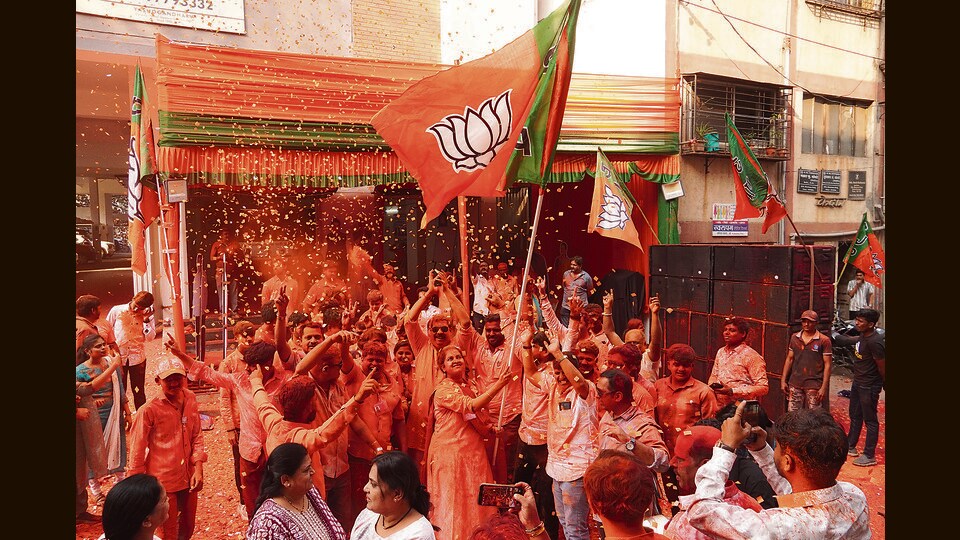
In the 165-member Pune Municipal Corporation (PMC), the BJP emerged as the clear frontrunner, winning 122 seats and crossing the majority mark with ease. The NCP secured 20 seats, the Sharad Pawar-led NCP (SP) won three, while the Congress finished with 15 seats. The Shiv Sena failed to win a single seat, while the Shiv Sena (UBT) managed just one.
The BJP’s tally represents a significant improvement over the 2017 civic polls, when the party had won 97 seats in alliance with the Republican Party of India (RPI). In contrast, the united NCP, which had secured 39 seats in 2017, suffered a steep decline this time despite Ajit Pawar’s faction and Sharad Pawar’s group contesting together. The Maharashtra Navnirman Sena, which had opened its account in the previous election, failed to win any seat.
The scale of the BJP’s victory was reinforced in neighbouring Pimpri-Chinchwad, where the party won 84 of the 128 seats, securing a clear majority on its own. The NCP (Ajit Pawar faction) followed with 37 seats, while the Shiv Sena (Shinde faction) won six seats, including one independent supported by the BJP. The Congress, Shiv Sena (UBT) and MNS failed to win a single seat in the industrial township.
Senior BJP leader Murlidhar Mohol attributed the party’s performance to a development-focused campaign. “Pune has always voted with development in mind. Whenever people here have trusted us with responsibility, we have delivered. This mandate reflects that confidence,” he said.
Political observers said the results underlined the BJP’s organisational strength and ability to convert fragmented opposition politics into an electoral advantage. In Pune, the BJP benefited not only from its own consolidation but also from the erosion of the traditional vote bases of rival parties.
The NCP’s performance, in particular, has raised questions about the effectiveness of its reunification strategy at the civic level. The alliance between Ajit Pawar’s faction and Sharad Pawar’s group was projected as a bid to reclaim the party’s traditional stronghold in Pune. However, despite joint campaigning and symbolic unity, the NCP failed to translate this into a significant seat haul.
“This election has been a reality check for the NCP in urban Maharashtra,” said a political analyst. “The party once dominated civic politics in Pune, but the combined effort still fell far short of challenging the BJP.”
Deputy chief minister Ajit Pawar accepted the verdict, saying the mandate of the people was supreme. “We accept the people’s decision with humility. Where we did not achieve the expected success, we will work with greater responsibility and determination to regain public trust,” he said, urging elected representatives to prioritise civic issues and development.
The results were equally sobering for the Shiv Sena. While the Shinde-led faction is part of the ruling alliance at the state level, it failed to win a single seat in Pune, signalling its limited urban footprint in the city. Political analysts described the outcome as a major setback for both factions of the Sena as well as the MNS, raising questions about their relevance in Pune’s civic politics.
The Congress, meanwhile, marginally improved its tally compared to 2017, aided in part by local-level leadership consolidation, though it remained far behind the BJP.
Analysts said the twin victories in Pune and Pimpri-Chinchwad have reinforced the BJP’s dominance in western Maharashtra’s urban centres and could shape political calculations ahead of future assembly and parliamentary elections. For now, voters in the Pune region appear to have delivered a clear and unambiguous mandate in favour of the BJP, redrawing the city’s civic power equations.


